Cyclone Murasu alert: Andhra Pradesh coast braces for severe storm on Nov 2-3

Synopsis
Cyclone Murasu is bearing down on the Andhra Pradesh coast less than a week after severe cyclonic storm Arnab killed seven people and caused ₹4,600 crore in damage. A second severe cyclone striking the same coastline within days is a rare and alarming pattern — one that could overwhelm recovery efforts still under way from Arnab's destruction.
Key Takeaways
The IMD on 1 November 2026 issued a cyclone alert for Andhra Pradesh and north Tamil Nadu coasts as a deep depression intensified into cyclonic storm 'Murasu' .
Murasu is forecast to cross the south AP coast between Nellore and Narsapur with winds of 100–110 kmph , gusting 120 kmph , around midnight of 2–3 November .
This will be AP's second cyclonic storm in under a week — very severe cyclone 'Arnab' struck near Narsapur on 28 October with winds up to 150 kmph .
Arnab claimed 7 lives and caused preliminary losses of ₹4,600 crore in coastal Andhra Pradesh.
A Central assessment team is currently surveying Arnab damage as Murasu approaches the same coastline.
The India Meteorological Department (IMD) on Sunday, 1 November 2026, issued a cyclone alert for the Andhra Pradesh and adjoining north Tamil Nadu coasts after a deep depression in the Bay of Bengal intensified into cyclonic storm 'Murasu'. The storm is expected to further strengthen into a severe cyclonic storm and cross the south Andhra Pradesh coast between Nellore and Narsapur during the midnight of 2 November to early hours of 3 November.
Where Murasu Stands Now
As of 11:30 am IST on Sunday, cyclonic storm Murasu lay centred over the southwest and adjoining west-central Bay of Bengal, approximately 560 km east-southeast of Chennai, 660 km south-southeast of Vishakhapatnam, 630 km east-southeast of Nellore, 640 km southeast of Machilipatnam, and 680 km east-southeast of Ongole. The system has been moving west-northwestwards at a speed of 23 kmph over the past six hours.
According to the IMD bulletin, the storm is very likely to intensify into a severe cyclonic storm over the west-central Bay of Bengal around Monday morning before curving northwestwards toward the coast.
Expected Landfall and Wind Speed
Murasu is forecast to cross the south Andhra Pradesh coast as a severe cyclonic storm with sustained wind speeds of 100 to 110 kmph, gusting up to 120 kmph, between 11:30 pm IST on 2 November and 4:00 am IST on 3 November. Coastal districts between Nellore and Narsapur are in the direct path of the expected landfall zone.
Andhra Pradesh's Second Cyclone in Under a Week
Notably, this will be the second cyclonic storm to strike the Andhra Pradesh coast in fewer than seven days — an unusually compressed succession of cyclones for the region. Very severe cyclonic storm 'Arnab' made landfall near Narsapur in the early hours of 28 October, packing maximum sustained winds of 125 to 135 kmph and gusts touching 150 kmph.
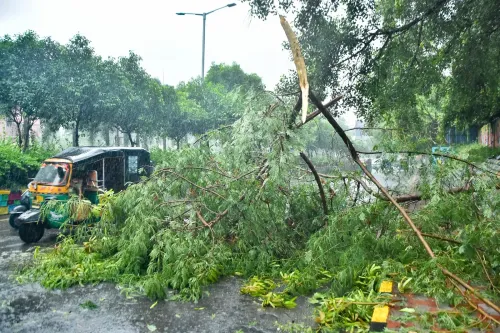
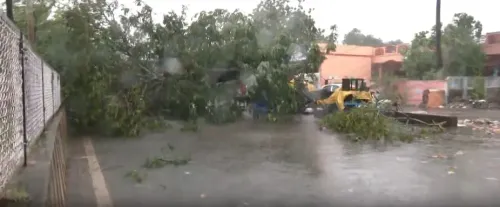
Arnab claimed seven lives and caused extensive damage to crops, roads, electricity, and telecom infrastructure across coastal districts. Preliminary estimates put losses from that storm at ₹4,600 crore, with crops damaged across thousands of acres and hundreds of electricity poles and trees uprooted. A Central government assessment team is currently touring the state to evaluate the damage.
What the Back-to-Back Cyclones Mean for the Coast
Coastal Andhra Pradesh, still in active recovery from Arnab's devastation, now faces a second severe storm before rebuilding efforts have meaningfully begun. Emergency infrastructure — power lines, relief camps, and road connectivity — that was damaged or strained by Arnab may be further compromised. Authorities are expected to step up evacuations in low-lying and coastal areas as Murasu approaches.
This comes amid a broader pattern of intensifying Bay of Bengal cyclones in the pre-winter season, with scientists linking warmer sea-surface temperatures to faster cyclone intensification in recent years.
Alerts and Precautions
The IMD has issued a cyclone alert covering the Andhra Pradesh coast and adjoining north Tamil Nadu, advising fishermen not to venture into the sea. Residents in coastal districts have been urged to follow official advisories as the storm tracks toward the Nellore–Narsapur stretch. Detailed district-level warnings and evacuation orders are expected to be issued by state authorities as the storm draws closer.
With landfall projected within 36 to 40 hours of Sunday's alert, the situation will be closely monitored as Murasu strengthens over the warm Bay of Bengal waters.
Point of View
Still mid-operation from Arnab's ₹4,600 crore blow, must now pivot to pre-positioning for Murasu without the luxury of a recovery window. The back-to-back pattern also raises a harder structural question: as Bay of Bengal sea-surface temperatures rise, is India's coastal early-warning and evacuation infrastructure being scaled commensurately, or are we still planning for one cyclone season at a time? The Central team currently assessing Arnab's damage will likely find itself in the middle of a second active emergency before it files its report.
NationPress
1 Nov 2026
Frequently Asked Questions
What is Cyclone Murasu and where is it headed?
Cyclone Murasu is a cyclonic storm that formed in the southwest Bay of Bengal and is tracking northwest toward the Andhra Pradesh coast. It is expected to make landfall as a severe cyclonic storm between Nellore and Narsapur around midnight of 2–3 November 2026, with winds of 100–110 kmph gusting to 120 kmph.
When will Cyclone Murasu make landfall?
According to the IMD, Murasu is likely to cross the south Andhra Pradesh coast between 11:30 pm IST on 2 November and 4:00 am IST on 3 November 2026. The landfall zone is the coastal stretch between Nellore and Narsapur.
What was Cyclone Arnab and how much damage did it cause?
Very severe cyclonic storm Arnab struck the Andhra Pradesh coast near Narsapur on 28 October 2026 with maximum sustained winds of 125–135 kmph and gusts up to 150 kmph. It killed seven people and caused preliminary losses of ₹4,600 crore, damaging crops, roads, power infrastructure, and telecom networks across coastal districts.
Why is Cyclone Murasu unusually dangerous for Andhra Pradesh?
Murasu will be the second cyclone to hit the Andhra Pradesh coast in under a week, striking before the region has recovered from the damage caused by Arnab. Weakened infrastructure, ongoing relief operations, and limited recovery time make coastal communities especially vulnerable to a second severe storm.
What precautions has the IMD advised ahead of Cyclone Murasu?
The IMD has issued a cyclone alert for the Andhra Pradesh and north Tamil Nadu coasts, advising fishermen not to venture into the sea. Coastal residents are urged to follow state government advisories, and district-level evacuation orders are expected as Murasu approaches the landfall zone.