How has Delhi’s air quality improved slightly while smog persists?
Synopsis
Amidst the ongoing struggle with air pollution, Delhi has recorded a slight improvement in air quality. However, several areas continue to suffer from significant smog. Dive into the latest air quality data and what it means for residents of the national capital.
Key Takeaways
Delhi's air quality improved slightly with an AQI of 196.
Persistent smog remains a concern across various areas.
Several hotspots recorded 'poor' AQI levels, indicating serious pollution.
Some areas report cleaner air, with AQIs in the 'moderate' range.
The IMD predicts weather conditions that may further affect air quality.
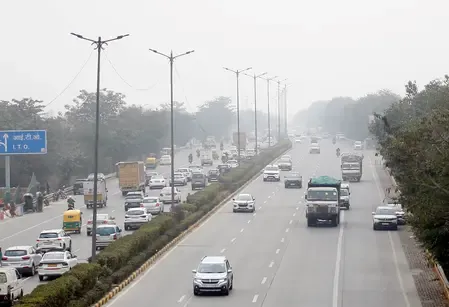
New Delhi, Feb 8 (NationPress) The air quality in the national capital has seen a slight improvement this morning, although pollution levels continue to pose a significant challenge in various regions of the city.
As reported by the Central Pollution Control Board (CPCB), the average Air Quality Index (AQI) in Delhi was recorded at 196 at 7 a.m., categorizing it as ‘moderate’.
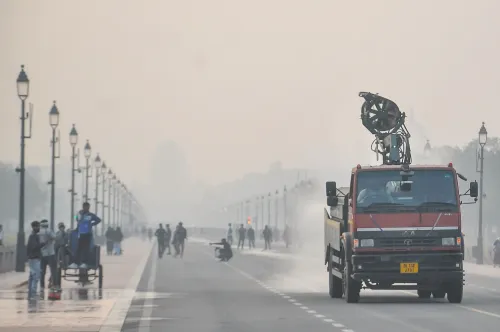
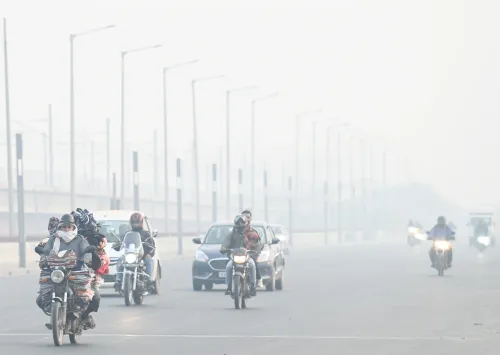
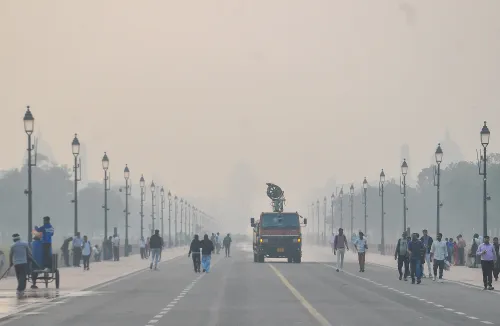
This is a notable enhancement compared to Saturday’s AQI of 227, which fell under the ‘poor’ category at 4 p.m. Despite this minor reduction in pollution levels, a persistent layer of smog remains over many areas, indicating that the overall air quality is still far from satisfactory.
Certain pollution hotspots in Delhi continue to show ‘poor’ AQI levels, with Mundka reporting the highest at 266, followed by Pusa at 257, Narela at 247, Rohini at 247, Ashok Vihar at 243, Jahangirpuri at 242, and Wazirpur at 239. Other areas such as Nehru Nagar at 237, Shadipur at 236, Bawana at 231, Vivek Vihar at 231, Sirifort at 222, and Chandni Chowk at 220 also remain in the poor category.
Conversely, some parts of Delhi enjoyed relatively cleaner air, with Sri Aurobindo Marg reporting the lowest AQI at 126, followed by IGI Airport at 131, Aya Nagar at 136, Lodhi Road at 139, Major Dhyan Chand National Stadium at 140, IIT Delhi at 141, and Mandir Marg at 145, all classified as ‘moderate’.
Sunday’s measurements were largely consistent with those from the previous day. On Saturday, Anand Vihar had an AQI of 260, while RK Puram was at 237, both classified as poor. ITO saw a bustling morning with an AQI of 223, and Chandni Chowk recorded 232. Other locations such as Aya Nagar at 151, IGI Airport Terminal 3 at 138, and Pusa at 157 were in the moderate range.
According to official classifications, an AQI of 0-50 is considered good, 51-100 is satisfactory, 101-200 is moderate, 201-300 is poor, 301-400 is very poor, and 401-500 is severe.
Additionally, the India Meteorological Department (IMD) has predicted a maximum temperature of 23 degrees Celsius and a minimum of 10 degrees Celsius for the day. The weather agency has also forecast mist conditions, which may continue to impact visibility and air quality in various parts of the city.
Point of View
It's crucial to highlight the ongoing air quality crisis in Delhi. While marginal improvements are noted, the persistence of smog indicates that we are far from overcoming this challenge. Continuous monitoring and public awareness are essential for safeguarding health in the national capital.
NationPress
21 Oct 2026
Frequently Asked Questions
What is the current air quality in Delhi?
The current air quality in Delhi is categorized as 'moderate', with an average AQI of 196.
What areas in Delhi have the worst air quality?
Mundka has the worst air quality with an AQI of 266, followed by Pusa and Narela.
How is air quality categorized?
Air quality is categorized based on AQI readings: 0-50 (good), 51-100 (satisfactory), 101-200 (moderate), 201-300 (poor), 301-400 (very poor), and 401-500 (severe).
What is the forecast for Delhi's weather today?
The forecast predicts a maximum temperature of 23 degrees Celsius and a minimum of 10 degrees Celsius, with mist conditions that may affect visibility.
What actions can residents take to protect themselves from pollution?
Residents are advised to limit outdoor activities, use air purifiers indoors, and wear masks when pollution levels are high.