Dr. Jitendra Singh Flags India's First SkyCast System at Delhi Airport

Synopsis
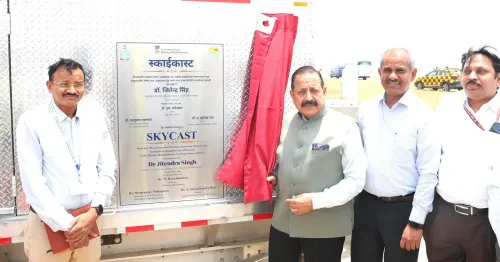
Union Science and Technology Minister Dr. Jitendra Singh has flagged the deployment of India's first SkyCast weather monitoring system at Indira Gandhi International Airport in New Delhi, marking a significant upgrade in aviation meteorological infrastructure at the country's busiest air hub.
Key Takeaways
India's first SkyCast weather monitoring system has been installed at Indira Gandhi International Airport, New Delhi .
Jitendra Singh highlighted the development on 30 May 2026 , underscoring the Ministry of Earth Sciences' role in aviation infrastructure upgrades.
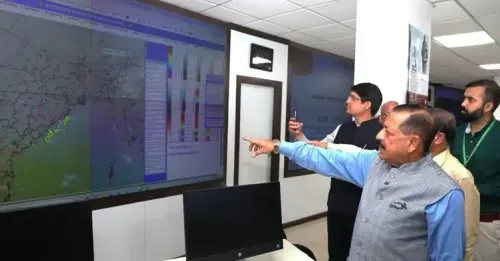
The system is expected to provide real-time, high-accuracy weather data to air traffic controllers and pilots operating at Delhi's airport.
The deployment follows India's sustained effort to meet ICAO safety benchmarks through progressive meteorological upgrades at major aerodromes.
Coordination between the Ministry of Earth Sciences , India Meteorological Department (IMD) , and Airports Authority of India (AAI) underpins the installation.
Possible rollout to other metro airports — including Mumbai, Chennai, Bengaluru , and Hyderabad — is being watched by the aviation sector.
Union Science and Technology Minister Dr. Jitendra Singh on Saturday, 30 May 2026 highlighted the installation of the country's first SkyCast weather monitoring system at Indira Gandhi International Airport, New Delhi, sharing the development on his official X account to underscore the advancement of meteorological infrastructure at India's busiest air gateway.
Context
The SkyCast system marks a first-of-its-kind deployment in India, bringing advanced real-time weather monitoring capability to Indira Gandhi International Airport (IGIA), the nation's highest-traffic international hub. The minister's post drew attention to the milestone as part of his ministry's broader mandate to integrate cutting-edge science into public infrastructure. The system is expected to enhance the quality and granularity of weather data available to air traffic management and flight operations teams at the airport.
Dr. Jitendra Singh holds independent charge of both the Ministry of Science and Technology and the Ministry of Earth Sciences, making aviation meteorology a direct policy area under his purview. The India Meteorological Department (IMD), which functions under the Ministry of Earth Sciences, is the nodal agency for supplying aviation weather services across Indian airports.
Policy Backdrop
India has steadily upgraded meteorological infrastructure at airports over the past decade and a half, following the airport modernisation wave that gathered pace after 2008. These upgrades have been guided in part by benchmarks set by the International Civil Aviation Organisation (ICAO), which mandates that member states maintain reliable, high-accuracy weather observation at major aerodromes.
The Airports Authority of India (AAI), the statutory body under the Ministry of Civil Aviation responsible for airport operations and safety, has been a key partner in rolling out such systems. Coordination between the Ministry of Earth Sciences and civil aviation authorities has been central to each successive technology infusion at Indian airports. The SkyCast installation follows this established pattern of inter-ministerial collaboration to meet rising flight volumes and safety standards.
Stakeholders and Impact
The primary beneficiaries of the new system are pilots, air traffic controllers, and the roughly 70 million-plus annual passengers who pass through Delhi's IGIA — one of the busiest airports in Asia. More precise, localised weather data directly reduces the risk of weather-related flight delays, diversions, and safety incidents. Airlines operating out of the capital stand to gain from improved operational predictability, particularly during the monsoon season and winter fog months, which historically cause significant disruption at Delhi.
For the broader aviation sector, the first-ever domestic deployment of the SkyCast platform signals that India is actively closing the gap with international peers on aerodrome meteorological standards. The development is also significant for the Ministry of Earth Sciences, which has been expanding IMD's technological footprint as part of the government's emphasis on science-led public service delivery.
What's Next
With the SkyCast system now operational at Delhi's IGIA, attention will turn to whether comparable installations follow at other high-traffic metro airports such as Mumbai, Chennai, Bengaluru, and Hyderabad. Budget allocations in upcoming civil aviation and science ministry statements will be a key indicator of the pace of any national rollout. Any formal policy announcement on scaling the technology across Tier-1 and Tier-2 airports would represent a significant step in India's aviation safety and meteorological modernisation agenda.
Point of View
Ahead of India's monsoon season, is strategically apt: aviation weather disruptions peak between June and September, giving the announcement immediate public relevance. More broadly, the move reflects the government's effort to demonstrate tangible, citizen-facing outcomes from science ministry investments, countering any perception that such ministries operate in abstraction. Whether the SkyCast rollout extends to secondary airports will test whether this is a flagship showcase or the start of a systemic national upgrade.
NationPress
14 Oct 2026
Frequently Asked Questions
What is the SkyCast weather monitoring system at Delhi airport?
The SkyCast system is India's first advanced weather monitoring platform deployed at an airport, installed at Indira Gandhi International Airport in New Delhi to provide real-time, high-accuracy meteorological data for aviation operations.
Which ministry is responsible for the SkyCast system at Delhi airport?
The Ministry of Earth Sciences, under Union Minister Dr. Jitendra Singh, oversees aviation meteorological services through the India Meteorological Department, which coordinates with the Airports Authority of India on such deployments.
How will the SkyCast system benefit passengers and airlines at Delhi airport?
By delivering more precise, localised weather data to pilots and air traffic controllers, the system is expected to reduce weather-related flight delays, diversions, and safety risks, particularly during monsoon and winter fog seasons.
Will SkyCast be installed at other Indian airports?
No official announcement has been made yet, but the aviation sector and policy watchers are closely monitoring whether similar systems will be rolled out at other major airports such as Mumbai, Chennai, Bengaluru, and Hyderabad.
What is India Meteorological Department's role in airport weather monitoring?
The India Meteorological Department, functioning under the Ministry of Earth Sciences, is the nodal agency for supplying aviation weather services and forecasting systems at airports across India, working in coordination with the Airports Authority of India.