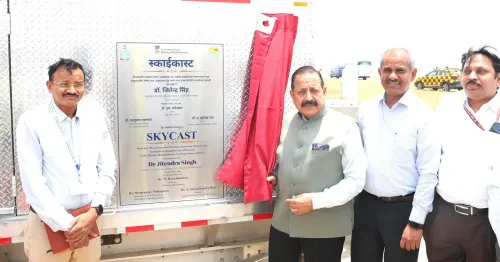
Dr. Jitendra Singh flags India's first advanced aviation weather system at Delhi IGI
Synopsis
India's first advanced SkyCast aviation weather monitoring system has been deployed at Delhi's IGI Airport, Union Minister Dr. Jitendra Singh announced on 30 May 2026. The system, under IMD and the Ministry of Earth Sciences, upgrades real-time meteorological data for pilots and air traffic controllers at the country's busiest airport.
Key Takeaways
India's first SkyCast aviation weather monitoring system has been installed at Indira Gandhi International Airport, New Delhi .
The system provides enhanced, real-time meteorological data to pilots, air traffic controllers, and airport operators .
The deployment is part of IMD's long-running modernisation programme aligned with ICAO standards.
Jitendra Singh flagged the development on 30 May 2026 , underscoring the government's focus on science-led aviation safety infrastructure.
Similar systems may be extended to major airports in Mumbai, Bengaluru, and Hyderabad in subsequent phases.
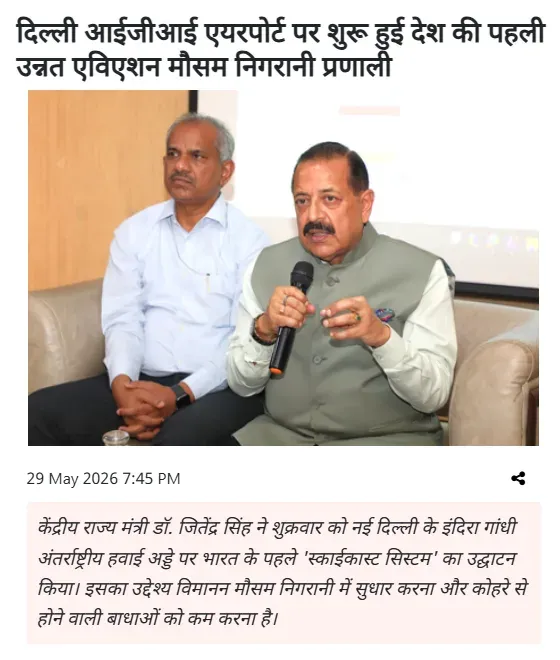
Union Science and Technology Minister Dr. Jitendra Singh on Saturday, 30 May 2026 highlighted the launch of the country's first advanced aviation weather monitoring system at Indira Gandhi International (IGI) Airport, New Delhi, marking a significant upgrade in meteorological infrastructure for India's busiest airport.
Context
The minister shared a report noting that Delhi's IGI Airport has received India's first SkyCast system — an enhanced aviation weather monitoring platform designed to deliver more precise, real-time meteorological data to pilots, air traffic controllers, and airport operators. The development positions IGI Airport as the first civil aviation hub in the country to deploy this class of automated weather surveillance technology.
Aviation weather monitoring is critical to flight safety, influencing take-off and landing decisions, route planning, and fuel calculations. Accurate, high-resolution weather data is especially vital at IGI Airport, which handles the highest passenger traffic of any airport in India.
Policy Backdrop
The deployment builds on a long-running modernisation drive by the India Meteorological Department (IMD), the national weather agency operating under the Ministry of Earth Sciences. IMD's infrastructure upgrades — spanning Doppler weather radars, nowcasting systems, and automated observation platforms — were initiated during the 11th and 12th Five Year Plans (2007–2017) and have continued under successive administrations.
India has progressively aligned its aviation meteorological services with standards set by the International Civil Aviation Organisation (ICAO), aiming to reduce weather-related flight disruptions and improve safety outcomes. The SkyCast deployment at IGI Airport represents the latest step in that trajectory, bringing tier-1 airport infrastructure closer to global benchmarks.
Dr. Jitendra Singh, who holds independent charge of both the Ministry of Science and Technology and the Ministry of Earth Sciences, has consistently championed technology-led upgrades within IMD's operational network as part of a broader push to make India's scientific institutions globally competitive.
Stakeholders and Impact
The primary beneficiaries of the new system are airline pilots, air traffic controllers, and airport operators at IGI Airport, who will gain access to more granular and timely weather intelligence. For airlines, better weather data can translate directly into fuel savings, fewer diversions, and improved on-time performance — outcomes with tangible economic value given the airport's volume of daily movements.
Passengers stand to benefit indirectly through reduced weather-related delays and cancellations, a persistent pain point at Delhi during the monsoon season and during winter fog events that historically cause widespread disruption across northern India's aviation network.
What's Next
Industry observers and policymakers will now watch whether IMD and the Ministry of Earth Sciences fast-track similar deployments at other high-traffic airports, including those in Mumbai, Bengaluru, and Hyderabad. A phased national rollout would signal a systemic rather than one-off commitment to aviation weather modernisation. The initiative is also likely to feature in upcoming parliamentary discussions on aviation safety expenditure and in IMD's annual reporting on infrastructure milestones.
Point of View
Dr. Jitendra Singh signals that science and technology ministries are keen to claim visible, citizen-facing wins in sectors — aviation safety, weather forecasting — that resonate beyond specialist audiences. The real test will be the pace of rollout at secondary airports, where weather-related disruptions are often more severe and less resourced. If the SkyCast model scales nationally, it could meaningfully reduce the economic cost of weather-driven flight delays, which runs into hundreds of crores annually.
NationPress
20 Sept 2026
Frequently Asked Questions
What is the SkyCast system launched at Delhi IGI Airport?
SkyCast is India's first advanced aviation weather monitoring system deployed at Indira Gandhi International Airport in New Delhi. It provides enhanced, real-time meteorological data to support safer flight operations, benefiting pilots, air traffic controllers, and airport operators.
Which ministry is responsible for the new aviation weather system at Delhi airport?
The system falls under the India Meteorological Department (IMD) , which operates under the Ministry of Earth Sciences , headed by Union Minister Dr. Jitendra Singh.
Will other Indian airports get similar advanced weather monitoring systems?
While no official rollout schedule has been announced, airports in Mumbai, Bengaluru, and Hyderabad are widely expected to be next in line as India continues upgrading aviation meteorological infrastructure to meet ICAO standards.
How does advanced aviation weather monitoring improve flight safety?
Precise, real-time weather data helps pilots and air traffic controllers make better decisions on take-off, landing, and routing. This reduces weather-related diversions, delays, and safety risks — particularly important at high-traffic airports like Delhi IGI during monsoon and winter fog seasons.
What has India done to modernise its aviation weather infrastructure?
India has upgraded Doppler weather radars, installed nowcasting systems, and deployed automated observation platforms at major airports since the 11th Five Year Plan (2007) . The SkyCast installation at IGI Airport is the latest milestone in this ongoing modernisation drive.