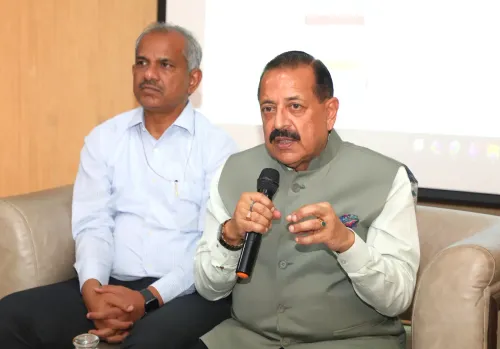
Dr. Jitendra Singh launches India's first SkyCast system at IGI Airport
Synopsis
Union Science and Technology Minister Dr. Jitendra Singh launched India's first SkyCast integrated atmosphere remote-sensing system at IGI Airport, New Delhi on 29 May 2026. The system monitors fog, turbulence, wind speed and aerosols to enhance flight safety. Phased deployments at Jewar, Varanasi and Ahmedabad airports are planned under Mission Mausam.
Key Takeaways
India's first SkyCast system was launched at Indira Gandhi International Airport, New Delhi on 29 May 2026 .
The system provides continuous, high-resolution monitoring of fog, turbulence, wind speed, vertical velocity and aerosols.
The deployment is part of Mission Mausam , the Government of India's weather and climate services modernisation programme announced in 2024 .
IITM Pune , led by Director Dr.
Suryachandra Rao , and the Ministry of Earth Sciences under Secretary Dr.
Ravichandran executed the project.
Future SkyCast installations are planned at Jewar Airport , Varanasi and Ahmedabad airports.
The system is aimed at reducing weather-related flight disruptions, particularly during the northern plains' fog season.
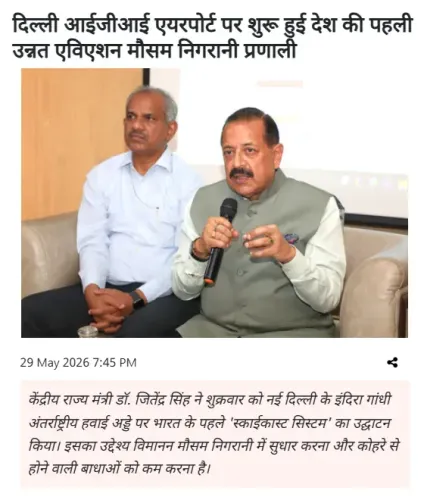
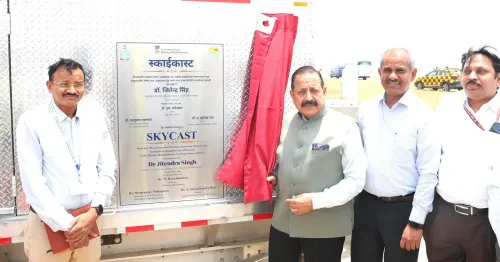
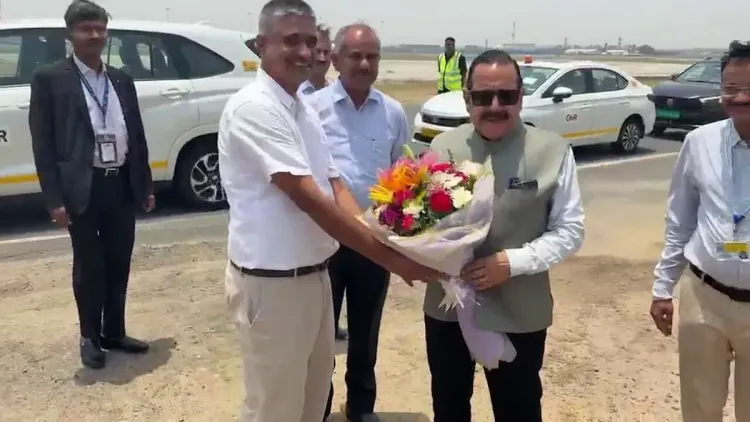
Union Science and Technology Minister Dr. Jitendra Singh on Friday, 29 May 2026 launched India's first SkyCast system at Indira Gandhi International Airport, New Delhi — an integrated atmosphere remote-sensing platform designed to improve flight safety during fog and turbulence conditions. The minister described the system as a state-of-the-art tool for continuous monitoring of fog, turbulence, wind speed, vertical velocity and aerosols, and credited the deployment to Prime Minister Narendra Modi's Mission Mausam programme.
Context
In his post, Dr. Jitendra Singh announced that the SkyCast installation at IGI Airport makes India one of a select group of countries operating such a system, calling it 'India's first-ever' deployment of the technology. The system is intended to make 'air flight take off and landing far more safe than before, particularly during the fog and turbulence conditions,' the minister wrote. He extended congratulations to Team Ministry of Earth Sciences (MoES), led by Secretary Dr. M. Ravichandran and Director of IITM Pune Dr. A. Suryachandra Rao.
The northern plains of India — including the New Delhi region — are among the worst affected by dense winter fog, which regularly disrupts hundreds of flights each season at IGI Airport, India's busiest aviation hub. A high-resolution, continuous remote-sensing system of this kind addresses a long-standing operational gap that has caused significant passenger inconvenience and economic cost to airlines.
Policy Backdrop
Mission Mausam, announced in 2024, is a Government of India programme under the Ministry of Earth Sciences to comprehensively upgrade India's weather forecasting, climate services and atmospheric observation networks. The SkyCast launch represents one of the programme's most visible aviation-facing deliverables to date. The Indian Institute of Tropical Meteorology (IITM), Pune — a premier atmospheric research institution under MoES — has been a key technical partner in developing and deploying the system.
The deployment at IGI Airport extends the MoES observational network beyond traditional surface-based India Meteorological Department (IMD) stations, integrating remote-sensing technology directly into civil aviation infrastructure. This mirrors a broader national pattern of embedding nowcasting and visibility tools at major airports to complement existing runway visual range instruments.
Stakeholders and Impact
Airlines operating out of IGI Airport stand to benefit from improved pre-departure and approach-phase weather intelligence, potentially reducing fog-related cancellations, diversions and delays that affect millions of passengers each year. Air traffic management authorities will gain access to continuous, high-resolution turbulence and wind-shear data, supporting safer routing decisions. Passengers on routes through New Delhi — particularly during the October–February fog season — are the most direct beneficiaries.
The system's rollout is also significant for the civil aviation regulator and airport operators, who have faced recurring pressure to demonstrate improved safety outcomes during adverse weather. For the Ministry of Earth Sciences, a successful operational deployment at India's flagship airport builds the institutional case for scaling the technology nationally.
What's Next
Dr. Jitendra Singh indicated that the IGI Airport installation will be followed by deployments at Jewar Airport — the upcoming greenfield international airport near Noida, Uttar Pradesh — and subsequently at airports in Varanasi and Ahmedabad, with further rollouts implied. The phased expansion signals that Mission Mausam envisions SkyCast as a national-scale aviation safety infrastructure rather than a single-site pilot. Progress on commissioning at Jewar, Varanasi and Ahmedabad, along with MoES performance metrics on aviation safety outcomes, will be the key milestones to watch in the months ahead.
Point of View
Passenger-facing deliverable from Mission Mausam at a moment when the government has been keen to demonstrate that its science-ministry investments yield real-world outcomes. By anchoring the announcement at IGI Airport — India's highest-traffic aviation hub — and naming the next three deployment sites, Dr. Jitendra Singh is framing this not as a one-off pilot but as the start of a national rollout, raising the political stakes for timely commissioning at Jewar and beyond. The explicit credit to Prime Minister Modi reinforces the pattern of linking infrastructure milestones to flagship programmes, keeping Mission Mausam visible in the public narrative ahead of the parliamentary session. Whether the system's operational performance during the next fog season validates the launch-day claims will be the true test of this initiative's policy credibility.
NationPress
19 Sept 2026
Frequently Asked Questions
What is the SkyCast system launched at IGI Airport?
SkyCast is an integrated atmosphere remote-sensing system that continuously monitors fog, turbulence, wind speed, vertical velocity and aerosols to improve flight safety. India's first such system was launched at Indira Gandhi International Airport, New Delhi on 29 May 2026 by Union Minister Dr. Jitendra Singh.
Which airports will get SkyCast next after IGI Airport?
According to Dr. Jitendra Singh, SkyCast will next be deployed at Jewar Airport near Noida, followed by airports in Varanasi and Ahmedabad, with further installations planned thereafter.
What is Mission Mausam and how is it related to SkyCast?
Mission Mausam is a Government of India programme launched in 2024 under the Ministry of Earth Sciences to modernise India's weather forecasting and atmospheric observation infrastructure. The SkyCast deployment at IGI Airport is one of its key aviation safety deliverables.
How will SkyCast help flight passengers in India?
SkyCast provides real-time, high-resolution data on fog, turbulence and wind conditions, enabling airlines and air traffic controllers to make safer take-off and landing decisions. This is expected to reduce weather-related flight delays and cancellations, particularly during the winter fog season in northern India.
Who developed the SkyCast system for India?
The system was developed and deployed under the Ministry of Earth Sciences, with the Indian Institute of Tropical Meteorology (IITM) Pune playing a key technical role. Secretary Dr. M. Ravichandran and IITM Pune Director Dr. A. Suryachandra Rao led the effort.