Dr. Jitendra Singh Launches SkyCast at IGI Airport
Synopsis
Union Minister Dr. Jitendra Singh launched India's first SkyCast integrated aviation weather system at IGI Airport, New Delhi, on 29 May 2026. Developed under Mission Mausam, it delivers real-time atmospheric data to pilots to cut fog and turbulence-related delays. India is now the 19th country to deploy such a system, with Jewar Airport next in line.
Key Takeaways
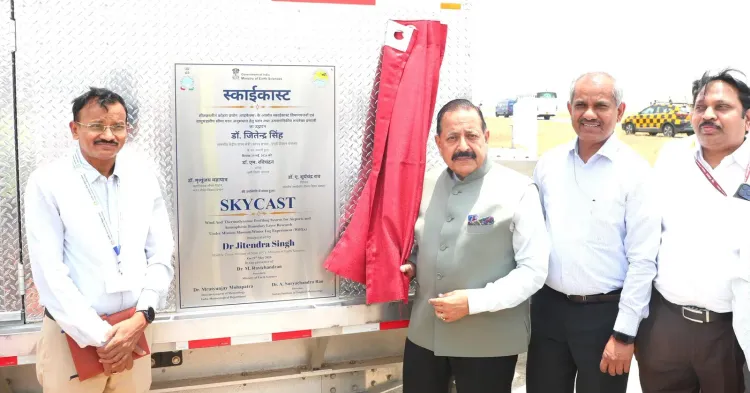
India's first SkyCast system was launched at IGI Airport, New Delhi on 29 May 2026 by Union Minister Dr.
The system monitors the atmosphere up to 3 kilometres using a Radar Wind Profiler, Fog Aerosol Spectrometer, Lidar Ceilometer and other sensors.
India becomes the 19th country in the world to deploy an advanced integrated aviation weather monitoring system.
SkyCast is developed under Mission Mausam , the government's initiative to integrate advanced atmospheric technologies for aviation safety.
The next SkyCast facility is planned for Jewar Airport , Gautam Buddh Nagar, followed by a national rollout across other airports.
The system aims to reduce avoidable flight delays, diversions and cancellations caused by fog and turbulence .
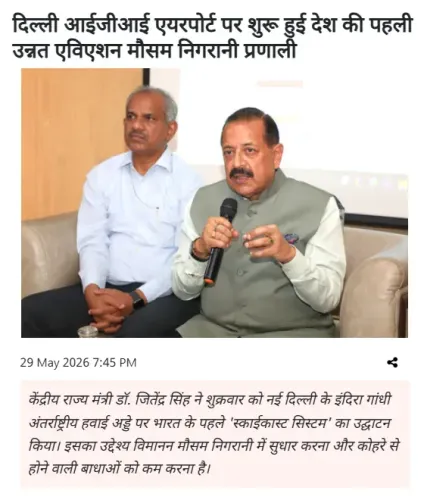
Union Minister of State (Independent Charge) for Science and Technology and Earth Sciences Dr. Jitendra Singh announced the launch of India's first 'SkyCast' aviation weather intelligence system at Indira Gandhi International (IGI) Airport, New Delhi, on Friday, 29 May 2026, calling it 'a new era of weather-smart aviation.'
Context
The SkyCast system is designed to deliver real-time atmospheric data directly to pilots, with the stated aim of enhancing flight safety and reducing avoidable delays, diversions and cancellations caused by fog and turbulence. According to the minister's post, India has become the 19th country in the world to deploy an advanced integrated aviation weather monitoring system of this kind. Dr. Singh described the launch as 'a new beginning in the aviation history of India' and 'a milestone indeed.'
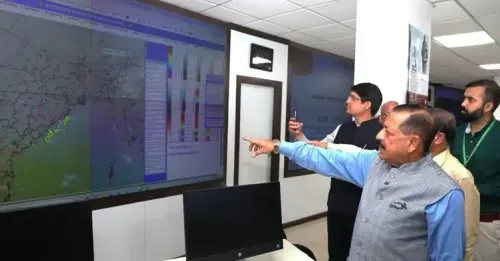
The system combines a Radar Wind Profiler, a Ground-based Fog Aerosol Spectrometer, a Lidar Ceilometer and other advanced sensors capable of monitoring the atmosphere up to 3 kilometres in altitude. Together, these instruments are intended to give flight crews actionable, location-specific weather intelligence before and during operations at one of the country's busiest air hubs.
Policy Backdrop
SkyCast has been developed under 'Mission Mausam', a government initiative that integrates advanced atmospheric technologies to support safer take-offs and landings. The mission reflects a broader push to modernise the India Meteorological Department (IMD) and align its aviation weather services with International Civil Aviation Organisation (ICAO) standards. Successive upgrades to radar, lidar and sensor networks at major airports have formed part of this phased national effort.
The deployment at IGI Airport — India's primary international gateway and its busiest — positions the capital's hub as the anchor site for a planned national rollout. The minister confirmed that the next SkyCast facility will come up at Jewar Airport in Gautam Buddh Nagar, Uttar Pradesh, the greenfield international airport being developed as part of the Delhi-NCR aviation expansion. Further expansion across other airports in India is expected to follow.
Stakeholders and Impact
Airline pilots are the primary end-users of the SkyCast output, receiving weather intelligence that can inform pre-flight planning and in-flight decision-making. Airport operators and air traffic management teams stand to benefit from reduced disruption to schedules, particularly during the winter fog season that routinely affects north Indian airports including IGI. Passengers on high-frequency routes through Delhi could see fewer weather-related cancellations and diversions as the system matures.
India's rapidly expanding aviation sector — which has seen passenger traffic grow sharply over the past decade — has placed increasing pressure on weather forecasting infrastructure. Fog-related disruptions at New Delhi and other northern airports have historically caused cascading delays across the network, making real-time atmospheric monitoring a commercially significant as well as a safety-critical investment.
What's Next
The immediate next step flagged by the minister is commissioning a SkyCast facility at Jewar Airport, which is being built to serve the growing aviation demand of the National Capital Region. Analysts and aviation stakeholders will watch whether the rollout timeline at Jewar and subsequent airports is incorporated into updated civil aviation safety protocols or IMD operational guidelines. The phased expansion model suggests the government intends SkyCast to become a standard infrastructure component at major Indian airports, potentially reshaping how weather risk is managed across the national flight network.
Point of View
Signalling that the government is moving meteorological modernisation from policy intent to operational infrastructure at key nodes. Anchoring the rollout at IGI Airport — the country's busiest and most fog-prone major hub — maximises early visibility and commercial impact, while the Jewar sequencing ties the initiative to a flagship infrastructure project in the politically significant National Capital Region. The 19th-country framing is a deliberate positioning of India within a global aviation-safety benchmark, consistent with the current administration's pattern of using multilateral rankings to validate domestic policy progress. Whether the phased expansion maintains momentum beyond the two named airports will be the real test of Mission Mausam's institutional staying power.
NationPress
12 Oct 2026
Frequently Asked Questions
What is the SkyCast system launched in India?
SkyCast is India's first integrated aviation weather monitoring system, launched at IGI Airport, New Delhi, on 29 May 2026. It provides real-time weather intelligence to pilots by combining a Radar Wind Profiler, Fog Aerosol Spectrometer, Lidar Ceilometer and other sensors to monitor the atmosphere up to 3 km.
Which airport got India's first SkyCast system?
India's first SkyCast system was installed at Indira Gandhi International (IGI) Airport in New Delhi. The next facility is planned for Jewar Airport in Gautam Buddh Nagar, Uttar Pradesh.
What is Mission Mausam?
Mission Mausam is a government initiative that integrates advanced atmospheric technologies to support safer aviation take-offs and landings. SkyCast has been developed under this mission.
How will SkyCast reduce flight delays in India?
SkyCast delivers real-time atmospheric data to pilots, helping them anticipate fog and turbulence conditions. This is intended to reduce avoidable flight delays, diversions and cancellations, particularly during north India's winter fog season.
Is India the first country to use an aviation weather monitoring system like SkyCast?
No. According to the announcement by Minister Dr. Jitendra Singh, India is the 19th country in the world to deploy an advanced integrated aviation weather monitoring system of this type.