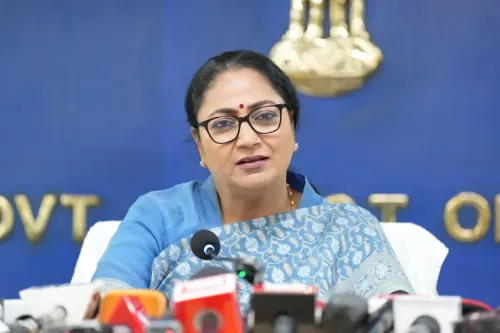
CM Rekha Gupta Introduces Time-Bound Services Bill for Delhi
Synopsis
Delhi Chief Minister Rekha Gupta has announced the Delhi Right of Citizen to Time Bound and Ease of Delivery of Services Bill, 2026, which mandates time-bound delivery of public services and imposes strict penalties on officers for unjustified delays, strengthening citizen rights in the national capital.
Key Takeaways
Delhi CM Rekha Gupta announced the Delhi Right of Citizen to Time Bound and Ease of Delivery of Services Bill, 2026 on 15 July 2026 .
The bill mandates time-bound delivery of government services and holds officers accountable for unjustified delays.
Strict penalties for delays are a core feature, marking a shift from the existing system where delays rarely carry formal consequences.
The legislation is part of the #ViksitDelhi initiative by the BJP -led Delhi government.
Similar Right to Services laws were enacted by Madhya Pradesh (2010) and Bihar (2011); a central bill introduced in 2011 lapsed without passage.
The bill must clear the Delhi Legislative Assembly before implementation, with rules and a grievance mechanism to follow.
Delhi Chief Minister Rekha Gupta on Wednesday, 15 July 2026 announced the introduction of the Delhi Right of Citizen to Time Bound and Ease of Delivery of Services Bill, 2026, a proposed legislation designed to make government service delivery faster and more accountable for residents of the national capital. The bill promises strict penalties against officers responsible for unjustified delays and aims to give every Delhiite a legally enforceable right to timely public services.
Context
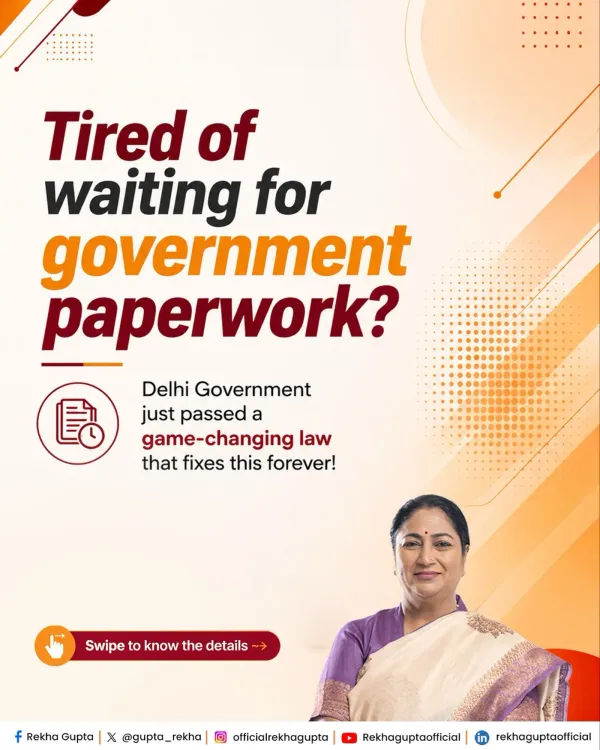
Announcing the bill via a thread on X, CM Rekha Gupta wrote: 'Government services shouldn't test your patience.' She framed the legislation as a direct response to the frustration citizens routinely face when dealing with public administration. The bill, introduced under the #ViksitDelhi initiative, positions officer accountability and transparency as its twin pillars.
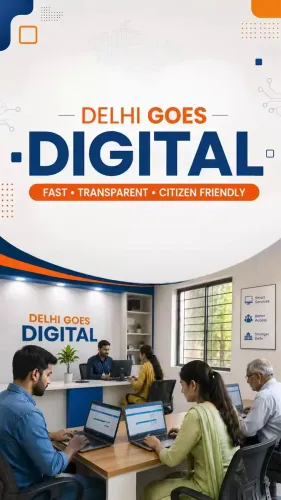
The announcement is accompanied by four images shared alongside the post, suggesting the government has already prepared detailed communication material around the bill's key provisions. The use of a thread format signals that further details on specific services and timelines are expected to follow.
Policy Backdrop
The Delhi bill joins a long lineage of Right to Services legislation across India. A central bill introduced in Parliament in 2011 lapsed without passage, but several states moved independently: Madhya Pradesh enacted its Right to Public Services Act in 2010, and Bihar followed in 2011. These laws established the template of notified services, fixed timelines, and monetary compensation or penalties for delays.
The Bharatiya Janata Party-led Delhi government's move aligns with the central government's broader Ease of Living and Digital India frameworks, under which cities are ranked on service-delivery performance metrics. BJP-governed states have periodically strengthened such frameworks to project efficient administration as a governance credential.
Stakeholders and Impact
Delhi's approximately 2 crore residents stand to be the primary beneficiaries if the bill is enacted and implemented effectively. Citizens who have historically faced delays in obtaining certificates, licences, utility connections, and other government-issued documents would gain a statutory right to escalate complaints and seek redress.
Government officers across Delhi's departments will face the most direct institutional change. The bill, as announced, places accountability squarely on officials, meaning unjustified delays could attract penalties — a significant shift from the current system where such delays rarely carry formal consequences. Civil-society groups tracking urban governance have long called for exactly this kind of enforceable accountability mechanism.
What's Next
The bill must be tabled and passed in the Delhi Legislative Assembly before it can become law. Once passed, the government will need to notify the rules — specifying which services are covered, the exact timelines for each, the penalty structure, and the grievance-redressal mechanism. Observers will watch closely for the launch of a public-facing tracking portal or helpline, which would signal genuine intent to operationalise the legislation in the 2026–27 fiscal cycle.
The #ViksitDelhi framing suggests the bill will be positioned as a flagship governance reform ahead of future electoral cycles, making its implementation timeline and scope politically significant for the BJP in the national capital.
Point of View
2026 is a significant governance signal from CM Rekha Gupta, positioning the BJP-led administration as a reform-oriented force in the national capital. By placing penalty-backed accountability on officers, the bill attempts to convert a long-standing citizen grievance — bureaucratic delay — into a justiciable right, echoing frameworks that BJP-governed states have used to build an efficient-administration narrative. The real test will be in the rules: which services are covered, how tight the timelines are, and whether a credible grievance mechanism is actually built. If implemented robustly, the bill could become a template for urban governance reform; if the rules are diluted, it risks becoming another well-intentioned law that exists on paper but not in practice.
NationPress
14 Oct 2026
Frequently Asked Questions
What is the Delhi Right of Citizen to Time Bound and Ease of Delivery of Services Bill, 2026?
It is a proposed Delhi government law announced by CM Rekha Gupta on 15 July 2026 that gives citizens a legal right to receive government services within fixed timeframes and imposes penalties on officers who cause unjustified delays.
What happens if a government officer delays a service under this bill?
The bill provides for strict penalties against officers responsible for unjustified delays, though the exact penalty amounts and escalation process will be specified in the rules notified after the bill is passed.
Has India had similar Right to Services laws before?
Yes. Madhya Pradesh enacted a Right to Public Services Act in 2010 and Bihar followed in 2011. A central bill introduced in Parliament in 2011 lapsed without being passed.
Which services will be covered under the Delhi time-bound services bill?
The specific list of covered services has not yet been made public; these details will be notified in the rules framed after the bill is passed by the Delhi Legislative Assembly.
What is the Viksit Delhi initiative mentioned alongside this bill?
Viksit Delhi is a governance and development initiative of the BJP-led Delhi government under which CM Rekha Gupta is rolling out a series of policy measures aimed at improving quality of life and public administration in the national capital.