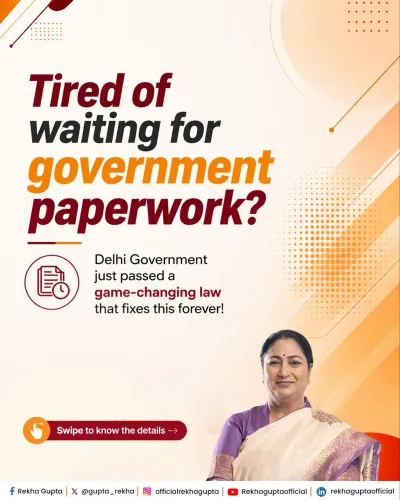
Delhi Cabinet clears Right to Time-Bound Services Bill 2026, replacing 15-year-old law

Synopsis
Delhi's Cabinet has replaced a 15-year-old services law with a Bill that makes time-bound delivery a statutory right, introduces automatic appeal escalation so citizens never have to chase the system, and imposes daily fines on errant officials — a structural overhaul that could redefine how the capital's bureaucracy is held accountable.
Key Takeaways
The Delhi Cabinet approved the 'Delhi Right of Citizens to Time-Bound and Easy Delivery of Services Bill, 2026' on 15 July 2026 , replacing the 2011 law.
Officials who delay services without valid reason face a penalty of ₹250 per day , capped at ₹5,000 .
An automatic escalation mechanism routes unresolved cases first to the Citizen Grievance Redressal Authority , then to the Delhi Right to Service Commission — without citizens needing to file separate appeals.
The entire service delivery process — from application to delivery — will be fully digitalised with real-time online tracking.
A new independent statutory body, the Delhi Right to Service Commission , will oversee second appeals, office inspections, and departmental action against negligent officials.
Appeals at the grievance authority level must generally be disposed of within 30 days .
The Delhi Cabinet led by Chief Minister Rekha Gupta on 15 July 2026 approved the 'Delhi Right of Citizens to Time-Bound and Easy Delivery of Services Bill, 2026', replacing the 2011 legislation with a technology-driven legal framework designed to make public service delivery a statutory right for every resident of the capital.
Key Provisions of the Bill
Under the new law, every citizen gains a statutory right to receive notified government services within a prescribed timeframe. Officials who fail to deliver without valid reason face a penalty of ₹250 per day, capped at ₹5,000. Crucially, before any penalty is imposed, the concerned official will be given a full opportunity to present their case — a safeguard the government says upholds principles of natural justice.
The Bill mandates end-to-end digitalisation of the service delivery process, from application submission to final delivery. Citizens will be able to apply online, track their application via a unique application number, and monitor real-time status updates — significantly reducing the need for repeated visits to government offices.
Automatic Escalation: A Structural Shift
A standout feature of the Bill is its automatic escalation mechanism. If a designated officer fails to deliver a service within the stipulated period, the matter is automatically escalated to the Citizen Grievance Redressal Authority — without the citizen needing to file a separate appeal. Should that authority also fail to resolve the matter within the prescribed window, the case is automatically referred to the Delhi Right to Service Commission. Appeals at the grievance authority level are generally required to be disposed of within 30 days.
New Institutional Architecture
The Bill establishes two new oversight bodies. Citizen Grievance Redressal Authorities will be appointed within every department to adjudicate appeals, issue directives, fix responsibility for delays, and initiate penal action where warranted. At the apex sits the independent statutory Delhi Right to Service Commission, comprising a Chairperson and members, which will hear second appeals, inspect government offices, recommend departmental action against negligent officials, and propose inclusion of new services under the law.
What the Government Said
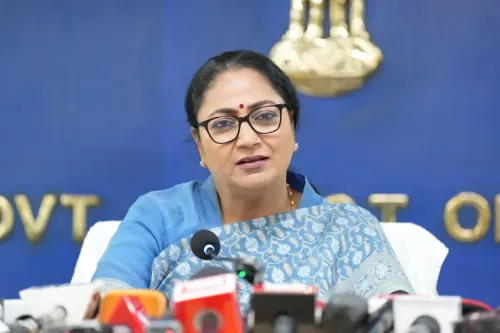
Chief Minister Rekha Gupta described the Bill's objective as ensuring 'every citizen receives government services within a stipulated timeframe' and making 'government departments and officials more accountable for delays and negligence.' The Chief Minister's Office (CMO) called it 'a historic governance reform that transforms time-bound public services into a legal right of every citizen,' adding that it is 'inspired by the spirit of Seva Hi Sankalp.' Gupta also framed the legislation as aligned with Prime Minister Narendra Modi's vision of good governance.
What Comes Next
The Delhi Government will issue notifications specifying which services fall under the law's ambit, along with their respective timeframes and the designated officials responsible. The Bill now moves toward formal enactment. Once operational, it is expected to cover a broad range of citizen-facing services across departments, with the scope expandable over time through fresh notifications.
Point of View
Which removes the burden of appeal from the citizen and places accountability squarely on the system. But the law's reach depends entirely on which services the government chooses to notify, and that list has not yet been published. If past practice holds, politically sensitive or capacity-constrained services may be quietly left off. The ₹5,000 penalty ceiling is also modest enough that it may not deter senior officials. The architecture is sound; the test will be in the notifications and the Commission's independence once constituted.
NationPress
15 Oct 2026
Frequently Asked Questions
What is the Delhi Right to Time-Bound Services Bill 2026?
It is a legislation approved by the Delhi Cabinet on 15 July 2026 that gives every citizen a statutory right to receive notified government services within a prescribed timeframe. It replaces the earlier 2011 law and introduces digital tracking, automatic appeal escalation, and financial penalties for officials who cause unjustified delays.
What penalty can officials face under the new Bill?
Officials responsible for unjustified delays in service delivery can be fined ₹250 per day, with the total penalty capped at ₹5,000. Before any penalty is imposed, the official is given an opportunity to explain their position, in keeping with natural justice principles.
How does the automatic escalation feature work?
If a designated officer misses the service delivery deadline, the case is automatically escalated to the Citizen Grievance Redressal Authority — no separate appeal is needed from the citizen. If the authority also fails to resolve it within the prescribed period, the matter is automatically referred to the Delhi Right to Service Commission.
What is the Delhi Right to Service Commission?
It is a new independent statutory body to be constituted under the Bill, comprising a Chairperson and members. It will hear second appeals, monitor implementation of the law, inspect government offices, recommend departmental action against negligent officials, and propose the addition of new services to the law's coverage.
Which services will be covered under the new law?
The Delhi Government will issue notifications specifying which services fall under the law, along with their respective timeframes and responsible officials. The scope can be expanded over time through fresh notifications, though the initial list has not yet been published.