Delhi notifies time-bound services law 2026, fines officials ₹250/day for delays

Synopsis
Delhi has replaced its 15-year-old service delivery law with a tougher 2026 Act that gives citizens a statutory right to time-bound services, assigns named officials to every application, and hits delinquent officers with fines of up to ₹5,000. With online tracking and enforceable penalties, the Rekha Gupta government is betting accountability can be legislated — the real test is in the rollout.
Key Takeaways
Delhi has notified the Delhi (Right of Citizens to Time-Bound and Easy Delivery of Services) Act, 2026 on 9 November 2026 .
The law replaces the earlier 2011 time-bound services legislation with stricter accountability measures.
Officials face a fine of ₹250 per day of unjustified delay, capped at ₹5,000 ; rejection without adequate grounds attracts a one-time fine of ₹250–₹5,000 .
Every application will be assigned a unique application number for online status tracking.
A designated official will be responsible for each covered service across departments, local bodies, and notified institutions.
Chief Minister Rekha Gupta linked the move to PM Modi's 'Nagrik Devo Bhava' and 'Minimum Government, Maximum Governance' principles.
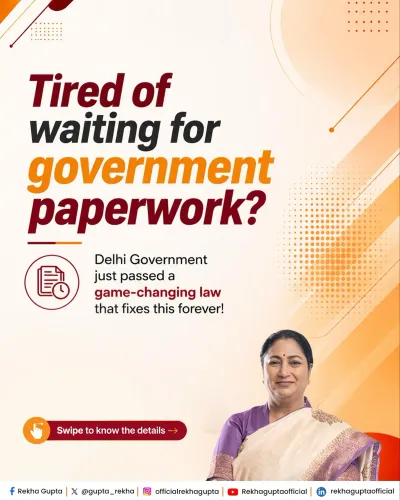
The Delhi government led by Chief Minister Rekha Gupta has officially notified the Delhi (Right of Citizens to Time-Bound and Easy Delivery of Services) Act, 2026, introducing statutory deadlines for public service delivery and monetary penalties for officials who cause unjustified delays. The notification, confirmed by an official on Monday, 9 November 2026, replaces the city's existing time-bound service delivery framework from 2011 with a sharper, digitally enabled accountability architecture.
What the New Law Does
At its core, the 2026 Act grants every eligible Delhi resident a statutory right to receive government services within a government-notified timeframe. A designated official will be assigned to each service, and the law will cover all departments, local bodies, and notified institutions under the Delhi government. Citizens will be able to file applications online and track their status using a unique application number — a significant shift from the largely offline processes under the older law.
The government will issue notifications specifying which services fall under the Act and the maximum number of days permissible for delivery of each. This removes ambiguity that critics of the 2011 legislation argued allowed delays to continue unchallenged.
Penalties for Officials
The penalty mechanism is the law's sharpest edge. Under the new provisions, an official responsible for an unjustified delay can be fined ₹250 per day of delay, up to a maximum of ₹5,000. Separately, an officer who rejects an application without adequate grounds faces a one-time fine ranging from ₹250 to ₹5,000.
Notably, before any penalty is levied, the concerned official must be given a fair opportunity to present their explanation — a safeguard designed to prevent arbitrary action against government staff while still ensuring accountability.
What the Government Said
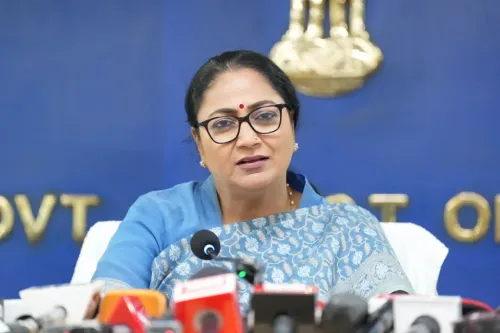
Chief Minister Rekha Gupta said the law is inspired by Prime Minister Narendra Modi's vision of 'Nagrik Devo Bhava' and the principle of 'Minimum Government, Maximum Governance.' 'The government is committed to making Delhi's governance system citizen-centric, responsive and accountable, ensuring that every eligible citizen receives services on time and without difficulty,' she said.
Gupta added that the objective is not merely to provide public services, but to ensure that every citizen enjoys their rights 'with dignity, transparency and within a prescribed timeframe.'
Why This Matters for Delhi Residents
The 2011 law it replaces was widely regarded as toothless in practice, with limited digital infrastructure and weak enforcement mechanisms. The new framework's online tracking system and enforceable penalties address both gaps directly. For the roughly 2 crore-plus residents of Delhi, the law could meaningfully reduce the friction of obtaining services ranging from caste certificates to building permits.
This comes amid a broader national push under various state governments to digitise and streamline citizen-facing administration. Delhi's move places it alongside states such as Madhya Pradesh and Telangana that have enacted or strengthened right-to-service legislation in recent years.
What Happens Next
The government is expected to issue notifications detailing which specific services are covered and their prescribed delivery timelines. Departments, local bodies, and notified institutions will then be required to designate responsible officials for each service. Implementation and digital infrastructure rollout will determine whether the law's intent translates into ground-level change — a question Delhi's residents and civic watchdogs will be watching closely.
Point of View
But ₹5,000 as a maximum fine for a government official is modest enough to risk becoming a rounding error in bureaucratic behaviour. The more consequential design choice is mandatory digital tracking and named official responsibility — if implemented rigorously, that creates a paper trail that the 2011 law never did. The gap between notification and genuine culture change will be the story worth watching.
NationPress
9 Nov 2026
Frequently Asked Questions
What is the Delhi Right of Citizens to Time-Bound Services Act 2026?
It is a law notified by the Delhi government on 9 November 2026 that gives every eligible Delhi resident a statutory right to receive government services within prescribed timelines. It replaces the city's earlier 2011 service delivery law and introduces digital tracking, designated officials per service, and financial penalties for unjustified delays.
What penalties do officials face under the new Delhi services law?
An official who causes an unjustified delay can be fined ₹250 for each day of delay, subject to a maximum penalty of ₹5,000. Rejecting an application without adequate grounds attracts a separate one-time fine of ₹250 to ₹5,000. Officials are given a chance to explain before any penalty is imposed.
How does the 2026 Act differ from the 2011 law it replaces?
The 2026 Act introduces enforceable monetary penalties for officials, mandatory online application and digital progress tracking with unique application numbers, and designated officer accountability for every service — features largely absent from the 2011 framework, which was widely criticised for weak enforcement.
Which services and bodies are covered under the new Delhi law?
The Act covers all Delhi government departments, local bodies, and notified institutions. The specific services and their maximum delivery timelines will be specified through government notifications issued separately. Every service must have a designated responsible official.
When will the new Delhi services law come into effect?
The law has been officially notified as of 9 November 2026, making it legally effective. However, the government is yet to issue the notifications listing covered services and their prescribed timelines, which will determine when citizens can invoke their rights under the Act in practice.