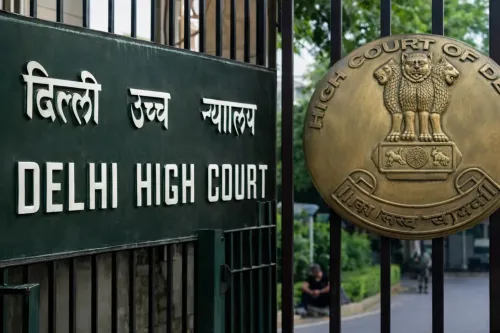
Delhi HC orders reinstatement of school teacher, rules DoE nod mandatory before dismissal

Synopsis
The Delhi High Court has overturned a nearly two-decade-old dismissal of a private school teacher, ruling that the school broke the law by skipping mandatory government approval — and raising pointed questions about why her misconduct complaints only appeared after she was suddenly assigned subjects she was never trained to teach.
Key Takeaways
The Delhi High Court ordered reinstatement of Rekha Sabharwal , dismissed from Saai Memorial Girls School in 2006 , nearly two decades after her removal.
The court ruled the dismissal violated Section 8(2) of the Delhi School Education Act, 1973 as no prior Directorate of Education (DoE) approval was obtained.
Sabharwal has been granted continuity of service and 50 per cent back wages , subject to the outcome of a fresh inquiry.
The disciplinary committee was found improperly constituted — the Principal and Vice-Principal , both complainants and witnesses, also sat on the authority that decided her case.
The court directed a de novo inquiry and quashed the disciplinary order, inquiry report, Delhi School Tribunal decision, and single-judge ruling.
The Delhi High Court has ordered the reinstatement of Rekha Sabharwal, an assistant teacher at Saai Memorial Girls School, nearly two decades after her dismissal, ruling that the school violated Section 8(2) of the Delhi School Education Act, 1973 by removing her without prior approval from the Directorate of Education (DoE). The court also directed a fresh disciplinary inquiry into the charges framed against her.
Key Ruling and Legal Basis
A Division Bench of Justices C. Hari Shankar and Om Prakash Shukla set aside the dismissal order dated 7 November 2006, granting Sabharwal continuity of service and 50 per cent back wages for the period she remained out of service, subject to the outcome of the fresh inquiry.
The court held that recognised private unaided schools cannot terminate a teacher without securing prior DoE approval. 'The order dated 7 November 2006 dismissing the appellant from service, having been issued without the prior approval of the DOE, violates Section 8(2) of the DSE Act and is, therefore, liable to be set aside,' the judgment stated.
Retrospective Application of Supreme Court Precedent
The school had argued that a Supreme Court ruling mandating prior DoE approval should apply only prospectively to future dismissals. The Division Bench rejected this contention, reaffirming that apex court judgments operate retrospectively unless they explicitly state otherwise. 'It is trite that the judgments of the Supreme Court apply retrospectively unless the judgments themselves state otherwise,' the bench observed.
Flawed Disciplinary Process
The court found the disciplinary committee to have been improperly constituted. The Principal and a Vice-Principal — who were themselves complainants and witnesses in the inquiry — had also participated as members of the disciplinary authority that decided Sabharwal's case, breaching the legal principle of nemo judex in causa sua (no one should be a judge in their own cause).
'We agree with Mr. Singla (the appellant's counsel) that the DA could not have included the Principal and Ms. Jasvir Kaur as members, as that would clearly breach the nemo judex in causa sua doctrine,' the bench said. It clarified that while both officials could depose as witnesses, they could not simultaneously sit on the disciplinary authority deciding the case.
Suspicious Timing of Misconduct Allegations
The court also questioned the circumstances under which complaints of incompetence arose. Sabharwal held degrees in Hindi and History and had taught Hindi for over three years without any adverse remarks. Complaints surfaced only after she was abruptly directed on 2 August 2006 to teach English and Environmental Science (EVS) to Class III students — subjects outside her academic background.
The bench noted that the school failed to explain why she was suddenly reassigned, and directed the fresh inquiry officer to examine all aspects of the dispute, including the question of who was the oppressor and who was the oppressed. The punishment order of 29 July 2007 imposing removal was also found legally unsustainable for being completely unreasoned.
What the Court Has Directed
The Division Bench quashed the disciplinary authority's order, the inquiry report, the Delhi School Tribunal's decision, and the earlier single-judge ruling. It ordered a de novo (fresh from the start) inquiry into the original misconduct charges — covering allegations of poor teaching performance, misbehaviour with colleagues, and refusal to attend a parent-teacher meeting — and directed that any future disciplinary decision must be properly reasoned.
Separately, the court dismissed a second appeal filed by Sabharwal alleging that the school paid her salary by cheque and then recovered part of it in cash. While calling such a practice 'completely illegal' if established, the bench held that the disputed factual questions could not be resolved in writ proceedings and would need to be substantiated by the employee through appropriate proceedings.
The ruling is likely to reinforce compliance obligations for private unaided schools across Delhi regarding the mandatory DoE approval process before any teacher dismissal is effected.
Point of View
Not just a one-off legal setback.
NationPress
16 Sept 2026
Frequently Asked Questions
Why did the Delhi High Court order the reinstatement of Rekha Sabharwal?
The Delhi High Court ordered reinstatement because Saai Memorial Girls School dismissed Sabharwal in 2006 without obtaining mandatory prior approval from the Directorate of Education (DoE), as required under Section 8(2) of the Delhi School Education Act, 1973. The court held that this procedural violation rendered the dismissal order illegal and liable to be set aside.
What is the DoE approval requirement for private schools in Delhi?
Under Section 8(2) of the Delhi School Education Act, 1973, recognised private unaided schools must obtain prior approval from the Directorate of Education before dismissing a teacher. The Delhi High Court has now confirmed this requirement applies retrospectively, rejecting the school's argument that a Supreme Court ruling on this point should only apply to future cases.
What benefits has Rekha Sabharwal been granted?
The court has granted Sabharwal continuity of service and 50 per cent back wages for the period she remained out of service, subject to the outcome of the fresh de novo disciplinary inquiry it has ordered.
Why was the disciplinary committee found to be improperly constituted?
The Principal and a Vice-Principal, who were both complainants and witnesses in the original inquiry against Sabharwal, also participated as members of the disciplinary authority that decided her case. The court held this breached the legal principle of nemo judex in causa sua — that no one should be a judge in their own cause.
What happens next in Rekha Sabharwal's case?
A fresh de novo inquiry into the original misconduct charges — including allegations of poor teaching performance, misbehaviour with colleagues, and refusal to attend a parent-teacher meeting — has been ordered. The inquiry officer has been directed to examine all aspects of the dispute holistically, and any resulting disciplinary decision must be properly reasoned.