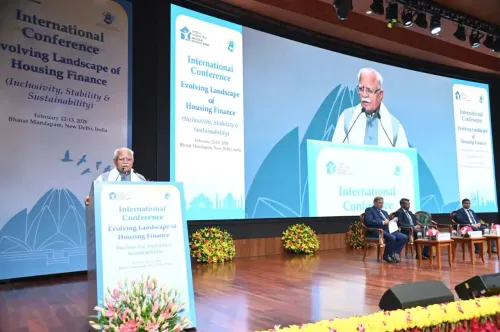
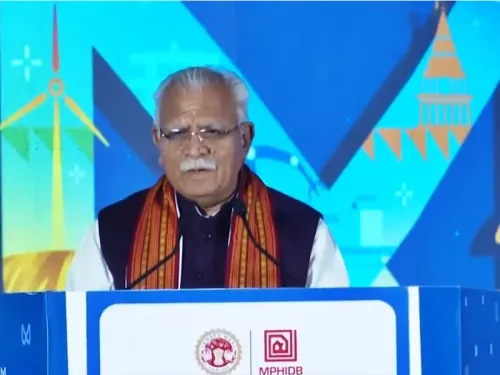
Delhi's Vision: Affordable Housing Along Metro and RRTS Corridors
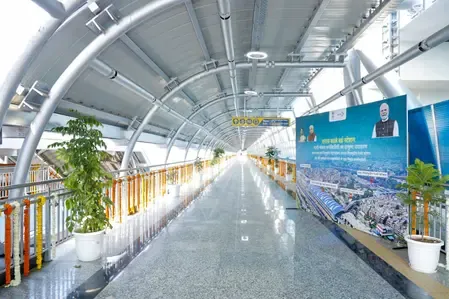
Synopsis
In a bold move, Union Minister Manohar Lal presents a plan to develop affordable housing along Delhi Metro and RRTS corridors, aiming to eliminate illegal colonies. This initiative promises a future-ready city with sustainable urban growth.
Key Takeaways
Affordable housing to be developed along metro and RRTS corridors.
New policy aims to tackle illegal colonies.
Integrated approach for sustainable urban growth.
Delhi Development Authority and private builders involved in construction.
Maximum built-up area for affordable housing set at 100 sq metres.
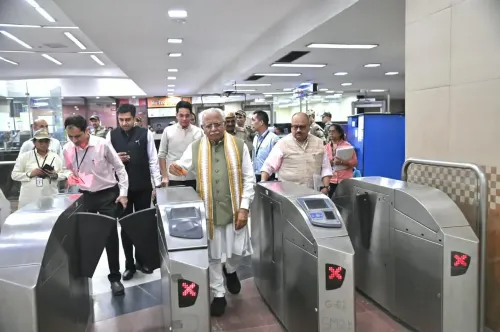
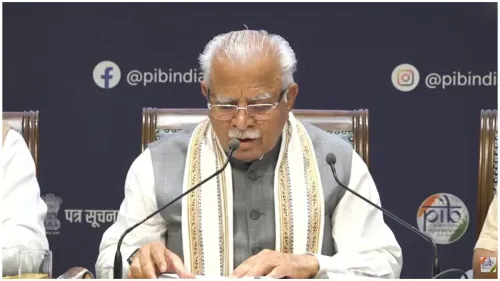
New Delhi, April 7 (NationPress) Union Minister for Housing and Urban Affairs, Manohar Lal, on Tuesday, presented a comprehensive plan aimed at developing affordable housing – with a maximum built-up area of 100 sq metres – along the corridors of Delhi Metro and Regional Rapid Transit System (RRTS). This initiative aims to diminish the necessity for illegal colonies that provide low-cost housing options.
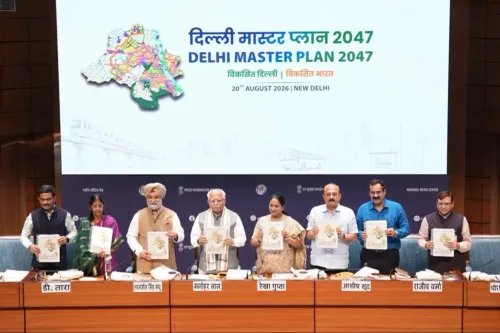
During a press briefing, Manohar Lal noted that in alignment with Prime Minister Narendra Modi’s vision, the city will tackle longstanding issues, establishing the groundwork for a future-ready metropolis through the Transit Oriented Development (TOD) strategy outlined in the Master Plan of Delhi 2021.
He explained that regulations for Transit Oriented Development and Charges, 2026, build on this vision to foster planned, sustainable urban growth linked to transit, especially along metro corridors. This will improve accessibility while facilitating the establishment of affordable housing options.
According to Manohar Lal, under the TOD framework, the Delhi Development Authority along with private developers will construct small, affordable homes that will be marketed at rates determined by the market.
The Minister emphasized that under the Prime Minister’s leadership, Delhi is entering a new era of organized and inclusive urban development, focused on resolving historical issues while constructing a city prepared for the future.
This new policy aims to ensure the availability of affordable housing within the National Capital Territory (NCT) of Delhi, promoting sustainable mobility and optimizing land use through compact, mixed-use developments that leverage both existing and future public transit infrastructures and the large number of anticipated users.
The current policy adopts a corridor-oriented approach, unlocking an area of 207 sq. km (500m on either side of metro corridors and a 500m radius around Regional Rapid Transit System (RRTS)/Railway Stations) primarily for affordable housing through organized development and redevelopment.
Of this 207 sq. km, approximately 80 sq. km, previously excluded from the earlier TOD Policy, encompassing Land Pooling, Low Density Residential Areas, and Unauthorised Colonies, has now been included within the scope of the new TOD Policy, as stated by the Union Minister.
Additionally, Delhi Chief Minister Rekha Gupta's TOD policy offers flexibility and allows for development along both operational and proposed metro corridors, RRTS, and railway stations.
This approach will align TOD development with the construction of new metro corridors, enabling planned new affordable housing and related infrastructure in those areas. It will also enhance metro ridership and improve overall livability, she remarked.
The policy facilitates the development of smaller plots of 2000 sq.m. under TOD provisions.
A maximum Floor Area Ratio (FAR) of up to 500 is permitted in TOD Zones for plot sizes of 2000 sq.m and above, considering an 18-meter road. Of this, 65 percent of the total permissible FAR is mandatorily designated for residential use with dwelling units having a built-up area of 100 sq m, thus ensuring the availability of affordable housing along the metro corridor.
In summary, the policy envisions a high-density, mixed-use planned development focused on creating affordable housing along all metro corridors, as stated by Manohar Lal.
Point of View
This initiative represents a significant step towards addressing housing shortages in urban spaces. By integrating affordable housing with public transport infrastructure, the government is attempting to tackle legacy issues while promoting sustainable development.
NationPress
17 Oct 2026
Frequently Asked Questions
What is the purpose of the new housing policy in Delhi?
The new housing policy aims to develop affordable houses along metro and RRTS corridors, reducing the need for illegal colonies.
Who will construct the affordable housing units?
The affordable housing units will be developed by the Delhi Development Authority and private builders.
What is the maximum area allowed for affordable housing?
The policy allows for affordable houses with a built-up area of up to 100 sq metres.
How will the new policy affect urban development in Delhi?
The policy promotes organized, sustainable urban growth linked to transit, enhancing accessibility and housing availability.
What is the significance of the Transit Oriented Development (TOD) concept?
TOD aims to integrate affordable housing with public transport, encouraging more efficient land use and better urban living conditions.