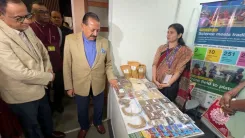
Kishan Reddy: Dhori Mine Gets Closure Cert, Goes Green
Synopsis
Union Coal and Mines Minister G. Kishan Reddy announced that the Dhori Underground Mine in Bokaro, Jharkhand, has received its Mine Closure Certificate. The site now hosts 23,500 saplings across 9.4 hectares, 1,000 fruit-bearing plants for villagers, and a repurposed Kayakalp School.
Key Takeaways
The Dhori Underground Mine in Bokaro, Jharkhand , which operated from 1976 to 2011 , has received its official Mine Closure Certificate after a scientific closure process.
23,500 saplings have been planted across 9.4 hectares of reclaimed mine land as part of the ecological restoration effort.
1,000 fruit-bearing plants were distributed to villagers in surrounding communities to support local livelihoods.
Former mine infrastructure has been repurposed into a Kayakalp School , giving the site a new educational purpose.
The certification aligns with India's mandatory mine closure framework under the Mines and Minerals (Development and Regulation) Act and Coal Mines Special Provisions rules.
Kishan Reddy framed the closure as a model for ecological restoration and community development at legacy mining sites.
A coal mine that powered Jharkhand's economy for 35 years has now been handed back to the earth — and to its community. Union Coal and Mines Minister G. Kishan Reddy announced on Tuesday, November 17, 2026 that the Dhori Underground Mine in Bokaro, Jharkhand, which operated from 1976 to 2011, has received its Mine Closure Certificate following a successful scientific closure process.
The numbers tell a vivid story of transformation. Across 9.4 hectares of former mining land, 23,500 saplings have been planted, and 1,000 fruit-bearing plants distributed directly to surrounding villages — turning extraction into cultivation, literally. The old mine infrastructure has been repurposed into a Kayakalp School, giving the site an educational second life instead of a slow, rusting retirement.
What a Mine Closure Certificate actually means
India's mine closure framework — built into the Mines and Minerals (Development and Regulation) Act and reinforced through Coal Mines Special Provisions rules since the mid-2010s — requires exhausted mines to undergo scientific decommissioning before receiving official closure certification. This isn't just paperwork. It demands verified land reclamation, afforestation targets, and community rehabilitation measures. Dhori's certificate signals that all those boxes have been ticked.
Bokaro sits at the heart of Jharkhand's legacy coal belt, home to several ageing Central Public Sector Undertaking mines that ceased production well before formal closure frameworks were tightened. Getting a mine like Dhori — silent for over a decade — across the finish line of certified, documented ecological restoration is exactly the kind of milestone the Ministry of Coal has been pushing Coal India's subsidiaries to deliver.
From extraction to community asset
The Kayakalp School conversion is the detail that sharpens the story. Rather than demolishing or abandoning mine-era infrastructure, the administration chose to retrofit it into a school — a move that sidesteps construction costs while anchoring a new social institution in a community that built its livelihood around the mine. The fruit-bearing plant distribution follows a similar logic: economic productivity for villagers, without a pickaxe in sight.
The Ministry of Mines is tagged in the original post, underscoring this as a coordinated signal from the government's mining policy apparatus, not just a local administrative achievement. Expect further mine closure certificates for other legacy sites across Jharkhand and neighbouring states — the Dhori model, Minister Reddy is signalling, is the template.
Point of View
Orchard plants, large-scale afforestation — the Ministry of Coal is building a replicable public narrative around 'responsible exit' from fossil fuel sites. This matters geopolitically too: India's credibility on mine rehabilitation directly feeds into international climate financing discussions. If Dhori becomes a documented template, it could accelerate pressure on Coal India subsidiaries to fast-track dormant closure cases across the eastern coal belt.
NationPress
17 Nov 2026
Frequently Asked Questions
What is the Dhori Underground Mine in Bokaro?
The Dhori Underground Mine is a former coal mine located in Bokaro district, Jharkhand, that operated from 1976 to 2011 under a Central Public Sector Undertaking. It has now received its Mine Closure Certificate after completing a government-mandated scientific closure process.
What is a Mine Closure Certificate in India?
A Mine Closure Certificate is an official document issued by the government confirming that an exhausted mine has been decommissioned in compliance with India's Mines and Minerals (Development and Regulation) Act. It requires verified land reclamation, afforestation, and community rehabilitation before it is granted.
How many saplings were planted at the Dhori Mine site?
According to Union Minister G. Kishan Reddy's announcement, 23,500 saplings were planted across 9.4 hectares of reclaimed land at the Dhori Underground Mine site in Bokaro, Jharkhand.
What is a Kayakalp School?
In the context of the Dhori Mine closure, a Kayakalp School refers to an educational institution set up by repurposing former mine infrastructure rather than constructing a new building — giving the site a community-serving second life after the mine ceased operations.
Which ministry oversees mine closures in India?
Mine closure policy in India falls under the purview of both the Ministry of Coal and the Ministry of Mines, which set regulatory compliance requirements for decommissioning exhausted mines and certifying their ecological restoration.