DMK accuses BJP of using agencies to intimidate regional parties
Synopsis
DMK leader T.K.S. Elangovan has accused the BJP of weaponising central agencies against regional parties — citing summons to Jharkhand CM Hemant Soren and notices to Kejriwal's family — and called for maximum opposition unity under CPI(M)'s framework, while simultaneously attacking Tamil Nadu's TVK government over its first 100 days in office.
Key Takeaways
Elangovan accused the BJP of using investigative agencies to intimidate regional parties on 20 September .
He cited summons to Jharkhand CM Hemant Soren (land case) and notices reportedly sent to Arvind Kejriwal 's family as evidence.
Elangovan backed CPI(M) 's call for broadest possible opposition unity, rejecting a separate third front.
He accused the TVK government in Tamil Nadu of failing on law and order in its first 100 days , citing reports of eight murders in a single day .
Stalin 's Emergency-era MISA arrest was confirmed by the Justice Ismail Commission , Elangovan said, dismissing calls for fresh proof.
Elangovan endorsed Rahul Gandhi 's position that the system is suppressing students, affirming citizens' right to peaceful protest.
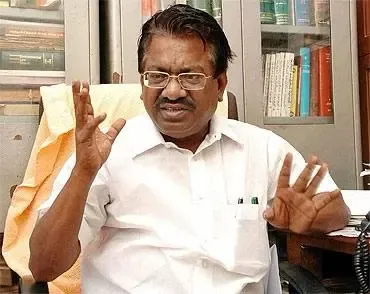
Dravida Munnetra Kazhagam (DMK) leader T.K.S. Elangovan on Sunday, 20 September accused the Bharatiya Janata Party (BJP) of deploying central investigative agencies as political weapons against regional parties, asserting that these parties have now emerged as the BJP's primary opposition as the Indian National Congress (INC) remains weakened at the national level.
Elangovan cited specific instances, including the summons issued to Jharkhand Chief Minister Hemant Soren of the Jharkhand Mukti Morcha (JMM) in connection with a land case, and notices reportedly served to family members of Aam Aadmi Party (AAP) leader Arvind Kejriwal in Delhi. He alleged these actions form part of a systematic campaign designed to pressure and weaken non-BJP regional forces ahead of future electoral contests.
Regional Parties as the New Opposition Frontline
According to Elangovan, the BJP is apprehensive about regional parties joining forces to present a unified challenge. He said these parties are actively strengthening coordination and preparing to place their collective political and ideological opposition before voters across the country.
He expressed support for the Communist Party of India (Marxist) [CPI(M)]'s call for the broadest possible opposition unity, firmly opposing the idea of a separate third front. Elangovan stressed that all parties opposed to the BJP must work together, with their shared objective being to highlight what he described as the ruling party's policy failures before seeking a public mandate.
Democratic Values Under Threat, Says DMK
Elangovan accused the BJP of actively undermining democratic institutions, alleging it was attempting to steer India towards a monopolistic political system. Those in power, he claimed, were conducting themselves like rulers with unchecked authority, unwilling to hear or redress public grievances.
He also backed Leader of the Opposition in the Lok Sabha, Rahul Gandhi, in his contention that the system was suppressing students. Elangovan maintained that every citizen holds a fundamental constitutional right to protest peacefully against the government over a genuine cause, and that elected governments are obligated to engage with protesters and address their concerns rather than suppress agitations.
DMK Targets TVK Government in Tamil Nadu
Turning his attention to state-level politics, Elangovan levelled sharp criticism at the TVK government in Tamil Nadu, alleging it had failed to maintain law and order during its first 100 days in office. He cited reports of eight murders committed within a single day as evidence of the government's governance failures, and alleged the administration was reviving allegations dating back five decades against the DMK to divert public attention from its present shortcomings.
M.K. Stalin's Emergency-Era Arrest
Responding to questions surrounding DMK president M.K. Stalin's arrest during the Emergency, Elangovan said Stalin had no obligation to produce fresh proof of his detention under the Maintenance of Internal Security Act (MISA). He stated that the Justice Ismail Commission, appointed by the state government, had already confirmed the arrest on record.
As opposition parties continue to calibrate their strategy ahead of the next electoral cycle, the DMK's posture signals a sharper focus on projecting regional parties as the credible national alternative to the BJP.
Point of View
The DMK is staking a claim to leadership in any future alliance arithmetic. The dual attack on the BJP and the TVK government in Tamil Nadu also reveals an intra-state competitive dynamic that complicates the opposition unity narrative. Notably, invoking M.K. Stalin's Emergency-era detention serves a double purpose: shoring up the DMK's democratic credentials while deflecting scrutiny of the party's own governance record. The broader argument about agency misuse is real and contested, but its impact depends on whether opposition parties can translate rhetorical unity into coordinated electoral strategy — something that has historically eluded them.
NationPress
20 Sept 2026
Frequently Asked Questions
What did DMK leader T.K.S. Elangovan accuse the BJP of?
Elangovan accused the BJP of using central investigative agencies to intimidate and suppress regional parties, which he described as the ruling party's primary political opponents now that Congress is weakened nationally. He cited specific cases including summons to Jharkhand CM Hemant Soren and notices reportedly sent to Arvind Kejriwal's family.
Why did Elangovan mention Hemant Soren and Arvind Kejriwal?
He cited the summons issued to Jharkhand Chief Minister Hemant Soren in a land case and notices reportedly served to family members of AAP leader Arvind Kejriwal as concrete examples of what the DMK alleges is a systematic BJP campaign against non-BJP regional forces.
What is the DMK's position on opposition unity?
The DMK supports the CPI(M)'s call for the broadest possible opposition unity and opposes the formation of a separate third front. Elangovan said all parties opposed to the BJP should work together to highlight governance failures and seek a common public mandate.
What criticism did Elangovan level at the TVK government in Tamil Nadu?
Elangovan alleged that the TVK government failed to maintain law and order during its first 100 days in office, citing reports of eight murders committed within a single day. He also alleged the government was reviving decades-old allegations against the DMK to divert attention from its present failures.
What did Elangovan say about M.K. Stalin's Emergency-era arrest?
Elangovan said Stalin did not need to produce fresh proof of his detention under the Maintenance of Internal Security Act during the Emergency, as the Justice Ismail Commission — appointed by the state government — had already confirmed the arrest on record.