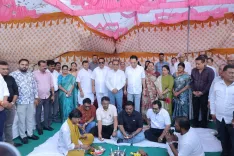
Dr Jitendra Singh hails Cabinet step on women's reservation
Synopsis
Union minister Dr Jitendra Singh on 28 November 2026 welcomed a Cabinet decision under PM Modi towards ensuring women's reservation, saying it would widen nari shakti in decision-making and sit on the 2023 law's unfinished delivery.
Key Takeaways
Dr Jitendra Singh on 28 November 2026 welcomed a Union Cabinet decision under PM Narendra Modi towards ensuring women's reservation.
He said the far-reaching move would add an important chapter to India's democratic history.
He argued it would broaden women's role in decision-making, expand political opportunities, and strengthen representation of all states.
India already reserves one-third of panchayat and municipality seats for women under the 73rd and 74th Amendments of 1992-93.
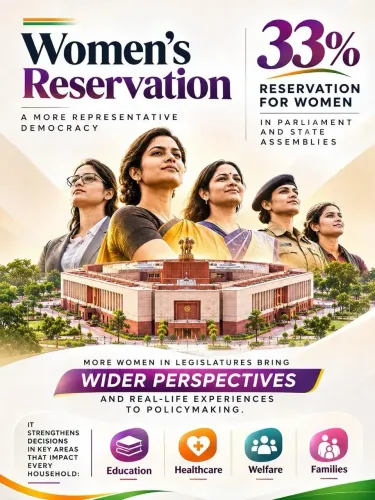
The 2023 Nari Shakti Vandan Adhiniyam provides for one-third reservation in the Lok Sabha and state assemblies, with rollout linked to delimitation after the census.
Union Science and Technology Minister Dr. Jitendra Singh on Saturday, 28 November 2026 treated a Union Cabinet decision on women's reservation as more than a file movement — he called it a new chapter in India's democratic history. Posting from New Delhi, he credited Prime Minister Narendra Modi's leadership and said the far-reaching step would widen nari shakti's role in how the country is governed.
Singh wrote in Hindi that the Cabinet decision towards ensuring women's reservation will add an important chapter in the country's democratic history. He welcomed the call without hedging. The initiative, he said, would broaden women's role in decision-making, offer them more opportunities in politics, and give new strength to the representation of all states.
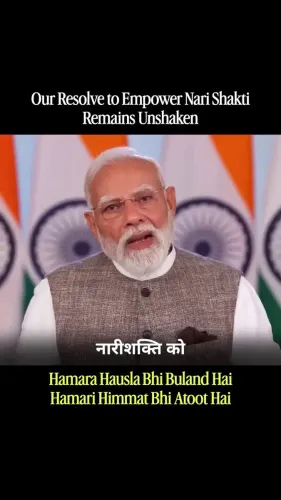
He closed on a line the government has repeated for years: सशक्त नारी शक्ति ही सशक्त और विकसित भारत की आधारशिला है (empowered nari shakti is the foundation of a strong and developed India).
Singh's welcome for a 'far-reaching' Cabinet call
The minister, who holds Independent Charge of Science and Technology and Earth Sciences and serves as Minister of State in the Prime Minister's Office and Personnel, did not list operational clauses in the post. He listed political meaning. In his telling, a Cabinet decision is now tied to a larger project: making women's reservation real, not merely legislated.
That framing matters because India has already passed the law. The unfinished business has always been delivery. Singh's verb of choice was ensure — the word that has followed every round of applause on this file.
From panchayat wards to the Lok Sabha floor
Reserved seats for women are not a new idea in Indian governance. The 73rd and 74th Constitutional Amendments of 1992-93 put one-third of seats in panchayats and municipalities in women's names. That local experiment became the template every later fight invoked.
Parliament took far longer. The Women's Reservation Bill cleared the Rajya Sabha in 2010 and then lapsed. The breakthrough came with the Constitution (One Hundred and Twenty-Eighth Amendment) Bill, 2023 — popularly the Nari Shakti Vandan Adhiniyam — which provides for one-third reservation for women in the Lok Sabha and state legislative assemblies.
Singh's Saturday post sits on that lineage. He is celebrating a Cabinet move he describes as a step towards ensuring the reservation, the part of the story that has always been harder than the vote in the House.
The seats still wait on implementation
What political India will watch next is the machinery: census, delimitation, and the election calendar that will actually redraw who can contest where. The 2023 amendment tied the reservation's rollout to a delimitation exercise after the relevant census figures are in. A ministerial welcome does not by itself set that clock.
Women politicians, state legislatures, and political parties are the first to feel the change when seats are finally reserved. Until then, every Cabinet signal is read as a clue to pace.
The minister's message leaves little room on intent. The argument now is not whether women should have a third of the House — it is how soon that third shows up on the ballot.
Point of View
And a senior MoS puts the Prime Minister's name on the political credit while tying the decision to the long nari shakti brand. The substance sits in a three-decade arc from local-body quotas to the 2023 constitutional amendment, where the real bottleneck has always been implementation after delimitation. By welcoming a decision towards ensuring reservation rather than announcing operational dates, the government keeps the equity narrative alive without the post itself unlocking a timeline. Watch whether subsequent official papers convert this welcome into a census-delimitation calendar before the next Lok Sabha or assembly cycle.
NationPress
28 Nov 2026
Frequently Asked Questions
What did Dr Jitendra Singh say about the Cabinet decision on women's reservation?
On 28 November 2026 he welcomed a Union Cabinet decision under Prime Minister Narendra Modi towards ensuring women's reservation, calling it a far-reaching step that would add an important chapter to India's democratic history. He said it would widen nari shakti in decision-making, give women more political opportunities, and strengthen representation of all states.
What is the Nari Shakti Vandan Adhiniyam?
It is the popular name for the Constitution (One Hundred and Twenty-Eighth Amendment) Bill, 2023, which provides for one-third reservation for women in the Lok Sabha and state legislative assemblies. Parliament passed the measure in 2023 after earlier attempts, including a 2010 Rajya Sabha vote, failed to become lasting law.
When did India first reserve seats for women in elected bodies?
The 73rd and 74th Constitutional Amendments of 1992-93 introduced one-third reservation for women in panchayats and municipalities. That local-body quota became the political template for later attempts to reserve seats in Parliament and state assemblies.
Does the 2023 women's reservation law apply immediately?
No. The 2023 amendment ties the actual reservation of Lok Sabha and assembly seats to a delimitation exercise after the relevant census figures are available. Singh's 2026 post welcomed a Cabinet step towards ensuring reservation but did not itself announce a rollout date.
Who is Dr Jitendra Singh?
He is Union Minister of State (Independent Charge) for Science and Technology and Earth Sciences, and Minister of State in the Prime Minister's Office and the Ministry of Personnel. He posted the welcome for the Cabinet decision on women's reservation on 28 November 2026.