Dr. Jitendra Singh at NDC: AI and Quantum to Power India's Security
Synopsis
Union Science and Technology Minister Dr. Jitendra Singh, addressing the National Defence College on 25 June 2026, said India's security future hinges on AI, Quantum Technologies, Biotechnology and Space, and cited a 174 percent rise in defence production and a 34-fold jump in exports since 2014.
Key Takeaways
Jitendra Singh delivered a special address at the National Defence College, New Delhi on 25 June 2026 on science, technology and national security.
He identified AI, Quantum Technologies, Biotechnology and Space capabilities as the four pillars of India's future security architecture.
Defence production has reportedly risen by nearly 174 percent since 2014, reaching approximately ₹1.54 lakh crore .
Defence exports have expanded nearly 34-fold to more than ₹23,000 crore over the same period.
The Minister called for deeper integration of civilian innovation with military requirements and greater public-private synergy, including through Defence StartUps .
Future military systems, he said, will depend on autonomous platforms, predictive analytics, and cognitive warfare capabilities.
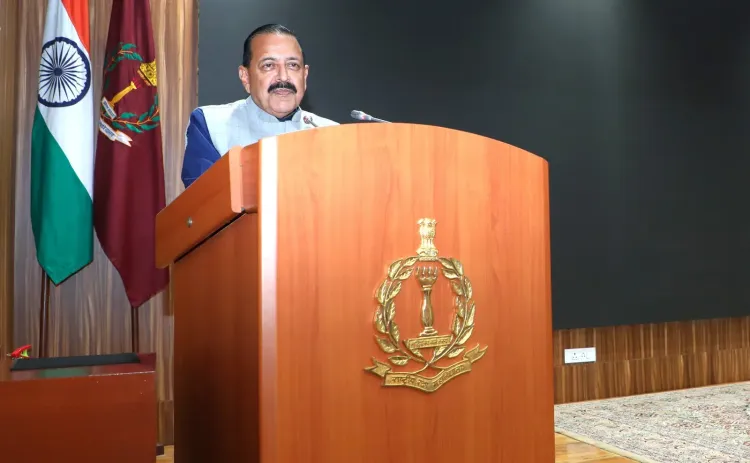
Union Science and Technology Minister Dr. Jitendra Singh delivered a special address on 'Future Trajectory of Science and Technology and its Impact on National Security' at the National Defence College, New Delhi, on 25 June 2026, outlining how emerging technologies will reshape India's strategic and military landscape.
Context
Speaking to senior armed forces and civil services officers at one of India's premier institutions for strategic studies, Dr. Singh argued that the nature of warfare is undergoing a fundamental transformation. 'India's future security architecture will be powered by AI, Quantum Technologies, Biotechnology and Space capabilities, as warfare increasingly shifts from conventional combat to technology-driven strategic operations,' he said.
The Minister stressed that future military systems will rely on autonomous platforms, intelligent surveillance, predictive analytics, cognitive warfare capabilities, and hyper-fast decision-making mechanisms — a vision that places scientific innovation at the centre of national security planning.
Policy Backdrop
Dr. Singh's address is anchored in a decade-long policy arc that began with the launch of Make in India in September 2014, which identified defence manufacturing as a priority sector. Subsequent milestones include the revision of the Defence Procurement Procedure in 2016 to favour Indian vendors, the announcement of a negative import list of 101 defence items in August 2020, and the raising of FDI limits in defence to 74 percent under the automatic route.
The Defence Production and Export Promotion Policy of 2020 set ambitious targets of ₹1.75 lakh crore in production and ₹35,000 crore in exports by 2025. The iDEX (Innovations for Defence Excellence) programme, launched in 2018, has been a key vehicle for bringing private startups into the military technology ecosystem.
Dr. Singh cited figures attributed to the period since 2014: defence production rising by nearly 174 percent to approximately ₹1.54 lakh crore, and defence exports expanding nearly 34-fold to more than ₹23,000 crore. He credited this shift to the priority accorded to the defence sector under Prime Minister Narendra Modi.
Stakeholders and Impact
A recurring theme in Dr. Singh's address was the need for deeper integration between civilian innovation and military requirements. He specifically called for 'extensive synergy between public and private sectors, including the Defence StartUps' — a signal that programmes like iDEX and the broader Atmanirbhar Bharat framework will remain central to India's technology-security strategy.
AI and Machine Learning, he said, will fundamentally transform military training, logistics, operational planning, and threat assessment, enabling faster and more accurate responses in dynamic security environments. This positions India's civilian technology sector — particularly its AI and quantum research ecosystem — as a direct contributor to strategic preparedness.
Defence startups, private sector firms, and the armed forces all stand at the intersection of this policy push. The address reinforces the government's intent to close the traditional gap between civilian research and military application, mirroring a broader global pattern among major powers integrating emerging technologies into defence doctrine.
What's Next
The address at the National Defence College is likely to inform discussions around the next iteration of the Defence Procurement Manual and future challenge competitions under iDEX or DRDO-private sector partnerships focused on autonomous systems and cognitive warfare. Policymakers and industry will watch for concrete programme announcements that translate Dr. Singh's technology-security vision into funded mandates. As India deepens its civilian-military technology integration, the role of the Science and Technology Ministry in shaping national security policy is set to grow considerably.
Point of View
A domain traditionally owned by the Defence and Home ministries. By front-loading AI, Quantum and Space as security imperatives rather than economic ones, the government is framing its decade-long indigenisation push as a strategic necessity, not merely an industrial policy. The explicit mention of defence startups and public-private synergy suggests the next phase of Atmanirbhar Bharat in defence will lean heavily on the civilian innovation ecosystem. This positions India's technology policy community as a core, rather than peripheral, actor in shaping the country's strategic doctrine.
NationPress
25 Jun 2026
Frequently Asked Questions
What did Dr. Jitendra Singh say at the National Defence College?
Dr. Jitendra Singh said India's future security architecture will be powered by AI, Quantum Technologies, Biotechnology and Space capabilities, and called for deeper integration of civilian innovation with military requirements.
How much has India's defence production grown since 2014?
According to Dr. Singh's address, defence production has increased by nearly 174 percent since 2014, reaching approximately ₹1.54 lakh crore, while defence exports have grown nearly 34-fold to more than ₹23,000 crore.
What is iDEX and how does it relate to defence startups?
iDEX, or Innovations for Defence Excellence, is a government programme launched in 2018 to fund and fast-track private startups developing military technologies, and it forms a key part of the public-private synergy Dr. Singh advocated.
What is cognitive warfare and why did Dr. Singh mention it?
Cognitive warfare refers to operations that target an adversary's decision-making and perception rather than physical assets; Dr. Singh cited it as one of the emerging capabilities future Indian military systems must develop alongside autonomous platforms and predictive analytics.
What is the National Defence College in New Delhi?
The National Defence College is a premier institution in New Delhi that trains senior armed forces officers and civil servants on strategic studies and national security policy, making it a key venue for high-level policy addresses.