Dr. Jitendra Singh Highlights Kashmir Wagoo Mat Revival from Mann Ki Baat
Synopsis
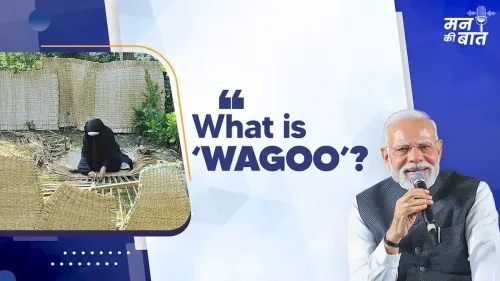
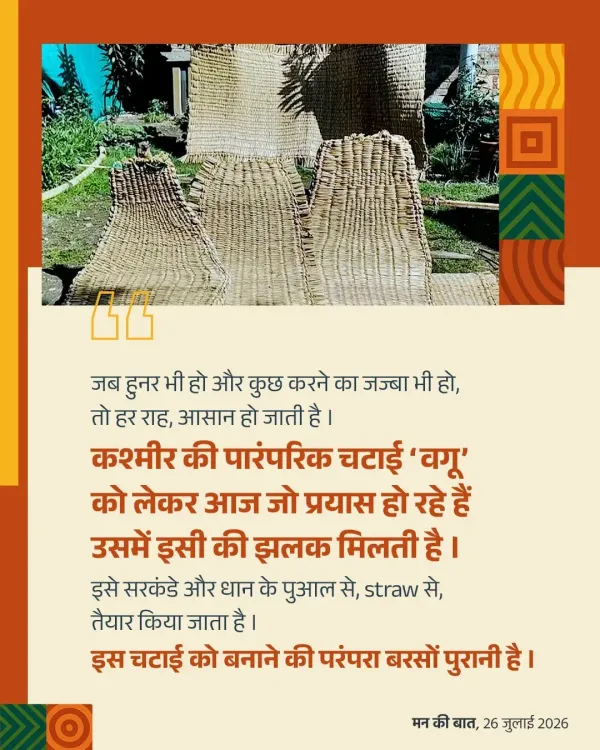
Union Minister Dr. Jitendra Singh amplified PM Modi's Mann Ki Baat remarks on the revival of Kashmir's traditional Wagoo reed mat, crediting local artisans for keeping the unique craft alive amid renewed national attention.
Key Takeaways
Jitendra Singh shared PM Modi's statement on the Wagoo mat revival on 26 July 2026 via X.
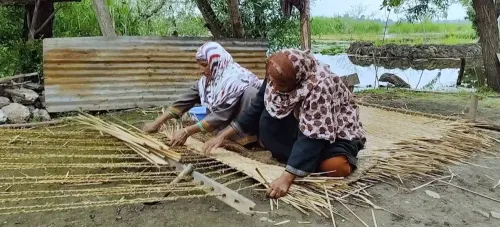
The Wagoo mat is a traditional reed-based handicraft indigenous to the Kashmir Valley .
The craft's revival was highlighted in PM Modi's Mann Ki Baat radio address, which has featured grassroots craft stories since 2014 .
Government messaging has consistently linked Jammu and Kashmir craft preservation with livelihood generation since the region's 2019 reorganisation .
A Mann Ki Baat mention has historically preceded policy interventions such as GI tagging and artisan cluster development for featured crafts.
Union Science and Technology Minister Dr. Jitendra Singh on Sunday, 26 July 2026 shared a post on X amplifying Prime Minister Narendra Modi's remarks on the revival of Kashmir's traditional Wagoo mat, citing the craft's comeback as driven by the dedicated efforts of local artisans.
Quoting the Prime Minister directly, the post reads: 'Kashmir's traditional Wagoo mat is making a comeback, thanks to the efforts of local artisans who are keeping this unique craft alive.' The minister attributed the statement to PM Modi's Mann Ki Baat radio address, the long-running monthly programme in which the Prime Minister spotlights grassroots stories from across India.
Context
The Wagoo mat is a reed-based handicraft indigenous to the Kashmir Valley, woven from a semi-aquatic plant found in the region's wetlands. Like several traditional Kashmiri crafts, it faced declining demand and dwindling artisan numbers over successive decades. The renewed attention from the highest levels of government signals an effort to reverse that trajectory.
Mann Ki Baat, which has aired continuously since October 2014, has regularly featured revival stories of regional crafts, artisan livelihoods, and cultural heritage from across India's states and union territories. The Wagoo mat's inclusion in the programme places it within a well-established pattern of using the broadcast as a platform to amplify local products to national audiences.
Policy Backdrop
Government messaging around Jammu and Kashmir has, since the region's reorganisation in August 2019, consistently linked the preservation of traditional crafts with livelihood generation and cultural identity. Handicraft promotion in the union territory has been positioned as both an economic tool and a marker of the region's distinct heritage.
Central schemes administered through the Ministry of Textiles and the Office of the Development Commissioner for Handicrafts have provided financial and marketing support to artisan clusters across the country. Observers note that a mention in Mann Ki Baat often precedes or accompanies steps such as Geographical Indication tagging, e-marketplace listings, or dedicated artisan cluster development for the featured craft.
Stakeholders and Impact
The primary beneficiaries of this renewed visibility are the Kashmiri artisan communities who have continued to practice Wagoo weaving despite limited market access and competition from machine-made alternatives. A national platform mention can translate directly into increased demand, tourist interest, and eligibility for central craft-promotion funding.
The broader handicraft ecosystem in Kashmir — which includes Pashmina weaving, Kani shawls, papier-mâché, and willow-wicker work — stands to benefit from the cultural momentum generated when individual crafts receive high-profile attention. Domestic consumers and the growing segment of culturally conscious buyers represent the key demand-side stakeholders.
What's Next
Analysts and craft-sector observers will watch for any follow-up policy action, including the possible initiation of a Geographical Indication (GI) tag process for the Wagoo mat, integration into central e-marketplace portals, or designation of artisan clusters in the Kashmir Valley for targeted development support. A Mann Ki Baat mention has historically served as a catalyst for such downstream interventions, making the coming weeks a period of significance for artisans engaged in this craft.
Point of View
Often preceding formal interventions such as GI tagging or artisan cluster funding. The Wagoo mat story, therefore, is worth watching not just as cultural news but as a potential leading indicator of policy action.
NationPress
26 Jul 2026
Frequently Asked Questions
What is the Wagoo mat of Kashmir?
The Wagoo mat is a traditional reed-based handicraft woven from a semi-aquatic plant found in Kashmir's wetlands. It is one of the valley's indigenous crafts that has faced declining demand over the years but is now seeing a revival driven by local artisans.
What did PM Modi say about the Wagoo mat in Mann Ki Baat?
PM Modi stated that Kashmir's traditional Wagoo mat is making a comeback, crediting local artisans who are keeping the unique craft alive. The remark was made during his Mann Ki Baat radio address and was shared by Union Minister Dr. Jitendra Singh on X.
What is Mann Ki Baat?
Mann Ki Baat is a monthly radio address by Prime Minister Narendra Modi that has aired since October 2014. The programme regularly features positive stories of citizen initiatives, grassroots innovation, and cultural heritage from across India.
Will the Wagoo mat get a GI tag?
No official announcement of a GI tag for the Wagoo mat has been made as of the date of this report. However, observers note that Mann Ki Baat mentions have historically preceded steps such as Geographical Indication tagging and artisan cluster development for featured crafts.
How has the government supported Kashmir handicrafts?
Central schemes through the Ministry of Textiles and the Office of the Development Commissioner for Handicrafts have provided financial and marketing support to artisan clusters in Jammu and Kashmir. Craft promotion in the region has been a consistent government priority, particularly since the 2019 reorganisation.