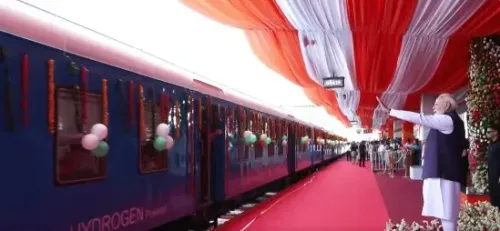
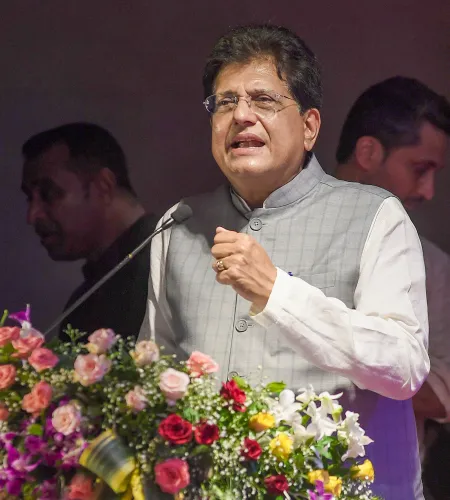
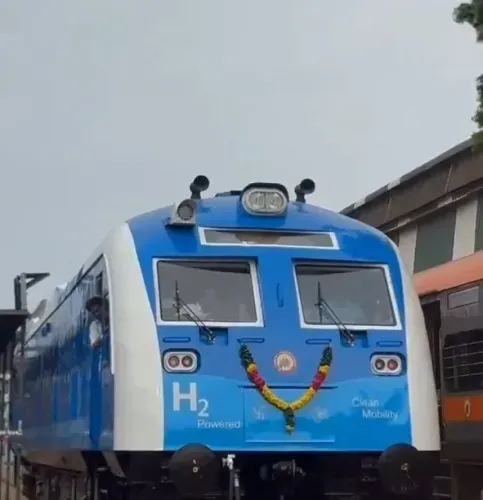
India's first indigenous hydrogen fuel cell train launches on Jind-Sonipat route
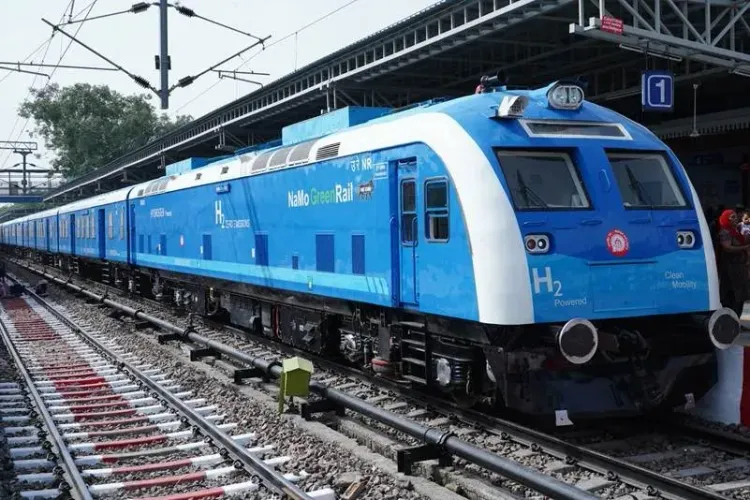
Synopsis
India has launched its first indigenously built Hydrogen Fuel Cell Train on the Jind–Sonipat corridor, powered by a PEMFC that emits only water vapour. With a 2,600-passenger capacity and a dedicated refuelling hub at Jind, this is India's most concrete step yet toward hydrogen-powered rail — built entirely in-house, not licensed from abroad.
Key Takeaways
India's first indigenous Hydrogen Fuel Cell Train has been launched on the Jind–Sonipat section of Northern Railway .
The train carries 2,600 passengers and produces only water vapour and heat — a zero-emission alternative to diesel.
It is powered by a Proton Exchange Membrane Fuel Cell (PEMFC) using a Perfluorosulfonic Acid (PFSA) polymer membrane.
Operational speed is 75 kmph ; design speed is 110 kmph .
A dedicated hydrogen production, storage, and dispensing facility has been set up at Jind, Haryana .
The train is equipped with real-time hydrogen leak detectors for operational safety.
India has flagged off its first indigenously developed Hydrogen Fuel Cell Train on the Jind–Sonipat section of Northern Railway, marking a landmark moment in the country's push for zero-emission rail transport, the government announced on Sunday, 26 July. Designed, engineered, and integrated entirely within India, the train signals a decisive step toward a domestic hydrogen-powered rail ecosystem.
Key Specifications and Technology
The train carries up to 2,600 passengers and is powered by a Proton Exchange Membrane Fuel Cell (PEMFC), which generates electricity through a chemical reaction between hydrogen and oxygen across a Perfluorosulfonic Acid (PFSA) polymer membrane. The only by-products of this process are water vapour and heat, making it a genuinely zero-emission alternative to conventional diesel traction.
Its operational speed is 75 kmph, with a design speed of 110 kmph — adequate for the regional passenger corridors it is intended to serve. The combination of indigenous engineering and clean propulsion technology positions this project as one of the more substantive deliverables under India's broader green mobility agenda.
Hydrogen Refuelling Infrastructure at Jind
A dedicated hydrogen refuelling ecosystem has been established at Jind, Haryana, to support the train's operations. The facility encompasses hydrogen production, storage, compression, and dispensing infrastructure — creating an end-to-end supply chain for hydrogen-based railway operations rather than relying on a piecemeal import-and-fill model.
This is notable because refuelling infrastructure has historically been the Achilles' heel of hydrogen mobility projects globally. The fact that a ground-up facility has been built alongside the train itself suggests a more integrated planning approach than earlier pilot programmes.
Safety Systems and Design Safeguards
Safety engineering has been prioritised in the project. The train is equipped with hydrogen leak detectors capable of identifying even trace-level leaks instantly, designed to prevent potential hazards and ensure operational safety. Given hydrogen's flammability characteristics, real-time leak detection is considered an industry standard for any commercial-grade deployment.
What This Means for Indian Railways
This development comes amid Indian Railways' broader decarbonisation drive, which includes electrification of over 90% of its broad-gauge network. Hydrogen traction is being positioned as a solution for non-electrified and difficult-to-electrify sections — precisely the kind of route that the Jind–Sonipat corridor represents.
Notably, several European rail operators — including those in Germany and the United Kingdom — have already deployed hydrogen trains on similar non-electrified regional routes, giving India a reference framework to benchmark against. The indigenous development angle, however, sets this apart: rather than licensing foreign technology, India has built the integration in-house, which carries implications for future export potential and technology self-reliance.
With the refuelling ecosystem in place and the train operational, the immediate focus will be on sustained performance data — speed consistency, fuel cell degradation rates, and passenger uptake — before any decision on scaling the model to other sections of the network.
Point of View
But the harder question is scalability. India has built one train and one refuelling station — the real test is whether the cost per kilometre of hydrogen traction can compete with electrification on the sections where wires are impractical. Globally, hydrogen rail has struggled with fuel cell degradation and green hydrogen supply costs; India's indigenous route adds technology risk on top of those structural challenges. The Jind–Sonipat corridor will function as a live stress test, and the data it generates over the next 12–18 months will determine whether this becomes a template or a trophy.
NationPress
26 Jul 2026
Frequently Asked Questions
What is India's first indigenous Hydrogen Fuel Cell Train?
It is a zero-emission passenger train designed, engineered, and integrated in India using Proton Exchange Membrane Fuel Cell technology. The train runs on the Jind–Sonipat section of Northern Railway and can carry up to 2,600 passengers, emitting only water vapour and heat.
Where will the hydrogen fuel cell train operate?
The train operates on the Jind–Sonipat section of Northern Railway in Haryana. A dedicated hydrogen refuelling ecosystem — covering production, storage, compression, and dispensing — has been established at Jind to support its operations.
How does the hydrogen fuel cell train work?
The train uses a Proton Exchange Membrane Fuel Cell (PEMFC) that generates electricity through a chemical reaction between hydrogen and oxygen across a Perfluorosulfonic Acid (PFSA) polymer membrane. The only by-products are water vapour and heat, making it a clean alternative to diesel traction.
What is the speed and capacity of the hydrogen train?
The train has an operational speed of 75 kmph and a design speed of 110 kmph. It is built to carry 2,600 passengers, making it suitable for regional passenger corridors.
How safe is the hydrogen fuel cell train?
The train is equipped with hydrogen leak detectors that can identify even trace-level leaks instantly, a standard safety requirement for hydrogen-powered vehicles. The detection system is designed to prevent hazards and ensure safe day-to-day operations.