Dr. Jitendra Singh Marks Modi Govt's 12 Years in Office
Synopsis
Union Minister Dr. Jitendra Singh marked the Modi government's 12th anniversary in office on June 20, 2026, sharing coverage of welfare gains and poverty reduction under #12YearsOfSeva, spotlighting flagship schemes like Jan Dhan, Ujjwala, and PMAY as pillars of the NDA's development record.
Key Takeaways
Jitendra Singh shared coverage of the Modi government's 12-year record on June 20, 2026 under #12YearsOfSeva .
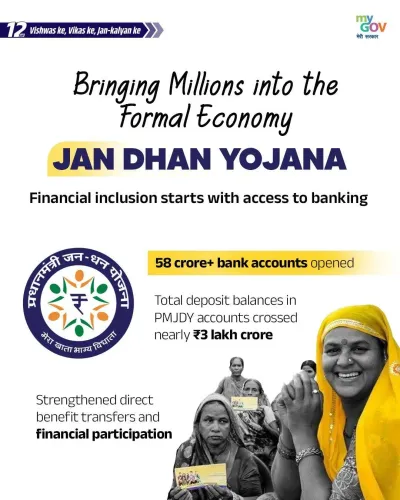
The government's welfare narrative centres on flagship schemes: Jan Dhan Yojana , Ujjwala Yojana , and Pradhan Mantri Awas Yojana .
NITI Aayog's 2023 Multidimensional Poverty Index claimed over 135 million people were lifted out of poverty between 2015-16 and 2019-21 .
The NDA government completed 12 years in office since its first election victory in May 2014 .
The next key data point will be an updated NITI Aayog poverty index covering the post-2021 period.
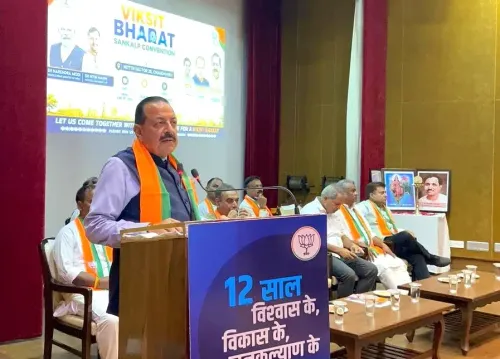
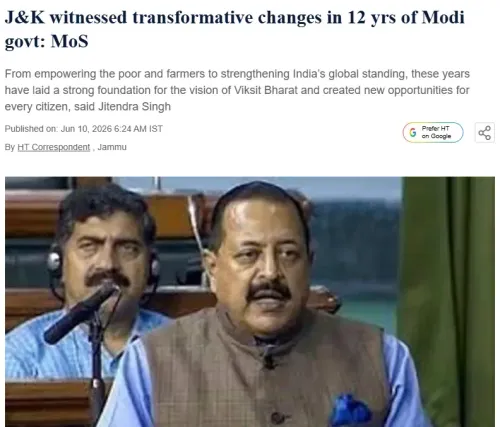
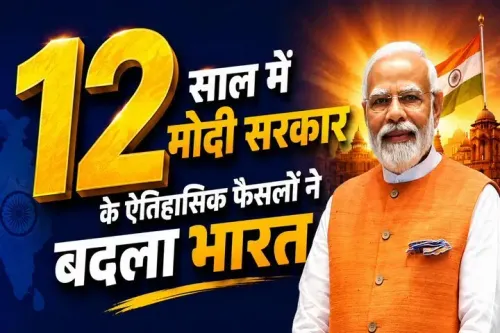
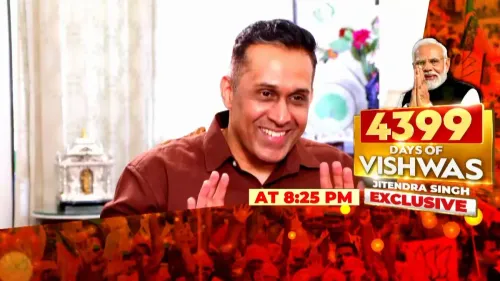
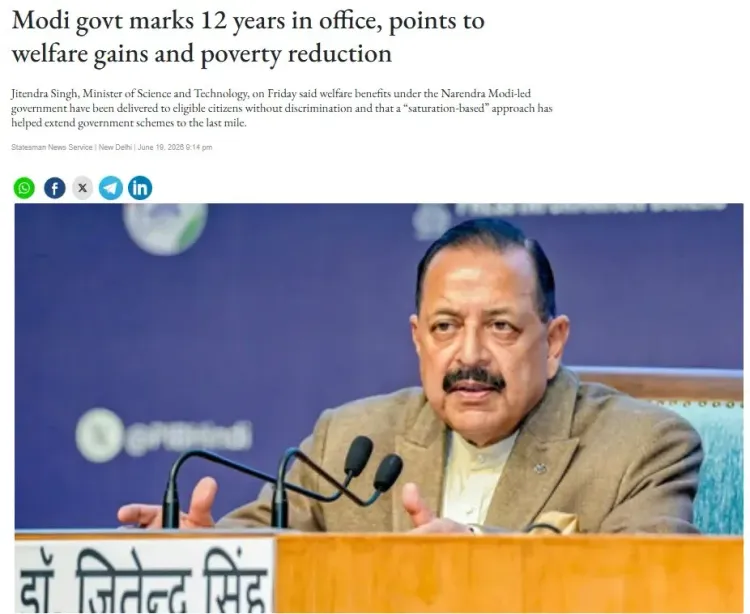
Union Minister of State (Independent Charge) for Science and Technology Dr. Jitendra Singh on Saturday, June 20, 2026, shared coverage highlighting the Modi government's 12-year record in office, pointing to welfare gains and poverty reduction as defining achievements of the NDA's tenure. The minister shared the article under the hashtag #12YearsOfSeva, amplifying the government's anniversary communications across social media.
Context
The post references an article published by the Kolkata-based English daily The Statesman, which examined the Narendra Modi-led government's performance since May 2014, with a focus on welfare scheme delivery and poverty alleviation. Dr. Jitendra Singh, who also serves as Minister of State in the Prime Minister's Office, routinely amplifies cross-ministerial achievements on social media, particularly around governance milestones.
The hashtag #12YearsOfSeva — translating broadly to '12 years of service' — has been adopted by ministers and party functionaries to mark the government completing 12 years in power following the NDA's first election victory in May 2014.
Policy Backdrop
The Modi government's welfare narrative rests on a cluster of flagship programmes launched after 2014, including Jan Dhan Yojana for financial inclusion, Pradhan Mantri Ujjwala Yojana for LPG access, and Pradhan Mantri Awas Yojana (PMAY) for rural and urban housing. These schemes, together with direct-benefit transfer infrastructure, have been central to the government's claim of reaching the last mile of the welfare chain.
NITI Aayog's Multidimensional Poverty Index, updated in 2023, asserted that more than 135 million people were lifted out of poverty between 2015-16 and 2019-21, a figure the government has cited repeatedly in its development narrative. The anniversary communications cycle builds on this data to reinforce the inclusive-growth argument ahead of parliamentary budget discussions.
Stakeholders and Impact
The primary beneficiaries of the welfare architecture highlighted in the government's 12-year account are low-income rural and urban households — those targeted by direct-benefit transfers, subsidised cooking gas, and affordable housing schemes. For these segments, the measurable outcomes of scheme delivery — bank account penetration, LPG connections, pucca housing — form the empirical basis of the government's poverty-reduction claims.
Ministerial social-media amplification of such milestones also serves a political communications function, reinforcing the government's record in the public discourse as the 2026-27 Union Budget session approaches and welfare allocations come under parliamentary scrutiny.
What's Next
The next significant data point in this policy arc will be the updated NITI Aayog Multidimensional Poverty Index, expected to cover the period beyond 2019-21 and provide fresh evidence — or challenge — to the government's poverty-reduction claims. Parliamentary debates during the 2026-27 budget session are also likely to revisit welfare spending levels and scheme outcomes. The #12YearsOfSeva communications push signals that the government intends to keep its development record at the centre of its public narrative in the months ahead.
Point of View
The messaging also pre-positions the government's record ahead of parliamentary debate on welfare allocations. The #12YearsOfSeva hashtag, deployed uniformly across ministries, signals a coordinated top-down communications push rather than a portfolio-specific announcement.
NationPress
20 Jun 2026
Frequently Asked Questions
What is #12YearsOfSeva?
#12YearsOfSeva is a hashtag used by the Modi government and NDA ministers to mark 12 years in office since the party's first election victory in May 2014, highlighting welfare and development achievements.
What welfare schemes does the Modi government point to in its 12-year record?
The government's 12-year welfare record highlights Jan Dhan Yojana for financial inclusion, Pradhan Mantri Ujjwala Yojana for LPG access, and Pradhan Mantri Awas Yojana for affordable housing as flagship instruments of poverty reduction.
How many people did India lift out of poverty under the Modi government?
According to NITI Aayog's 2023 Multidimensional Poverty Index, over 135 million people were lifted out of poverty between 2015-16 and 2019-21. More recent figures are yet to be officially published.
Why did Dr. Jitendra Singh post about the Modi government's 12 years when his portfolio is Science and Technology?
As Minister of State in the Prime Minister's Office, Dr. Jitendra Singh routinely amplifies cross-ministerial government achievements on social media, particularly around governance milestones, as part of a coordinated communications strategy.
When will the next NITI Aayog poverty index update be released?
The next updated NITI Aayog Multidimensional Poverty Index covering the period beyond 2019-21 is anticipated but no official release date has been confirmed as of June 2026.