Dr. Jitendra Singh Visits ICGEB Trieste, Highlights India's Biotech Push
Synopsis
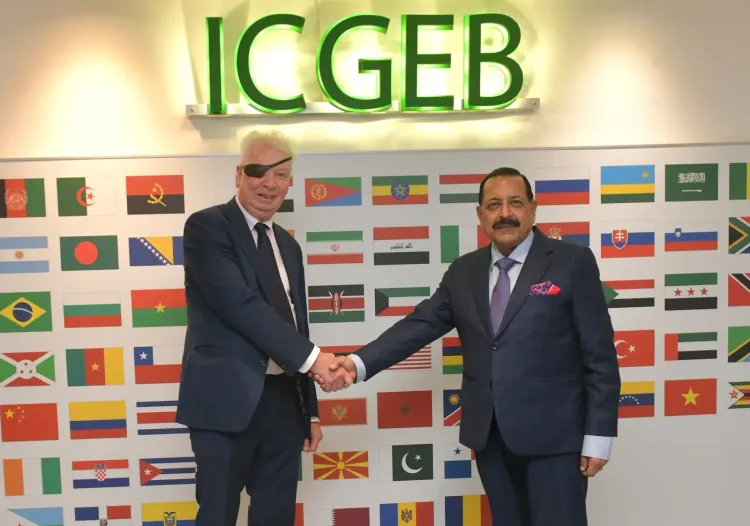
Union Science Minister Dr. Jitendra Singh concluded his Italy tour with a visit to ICGEB Trieste, spotlighting India's growing role in the intergovernmental biotech body and citing 67 international researchers trained in New Delhi under the BioE3 policy framework between 2023 and 2026.
Key Takeaways
Jitendra Singh visited the ICGEB headquarters in Trieste on 16 November 2026 as the final stop of his Italy tour.
ICGEB is an intergovernmental body founded in 1983 with components in Trieste, New Delhi, and Cape Town .
India's Department of Biotechnology (DBT) backs ICGEB's R&D, innovation incubation, and human resource development programmes.
Between 2023 and 2026 , 67 researchers from 22 countries trained at the New Delhi component of ICGEB.
Training exchanges have covered frontier areas including AI in biology, genome editing, drug development, and carbon capture .
The visit explicitly links this multilateral engagement to PM Modi's BioE3 biotechnology policy .
India's scientific diplomacy took centre stage in Trieste, Italy on Monday, 16 November 2026, as Union Science and Technology Minister Dr. Jitendra Singh wrapped up his Italy tour with a visit to the International Centre for Genetic Engineering and Biotechnology (ICGEB) — the intergovernmental research body that quietly underpins some of the world's most consequential work in life sciences, and where India holds a seat at the table that matters.
What ICGEB Is — and Why Trieste Is Only Part of the Story
Founded in 1983 as an autonomous intergovernmental organisation, ICGEB was built to do something ambitious: give developing nations a genuine foothold in the fast-moving world of genetic engineering and biotechnology. It operates across three components — Trieste, New Delhi, and Cape Town — creating a triangular architecture that connects research, training, and technology transfer across its international network. The Trieste component serves as the headquarters; New Delhi is India's operational anchor within the system.
The minister described ICGEB as 'an international, intergovernmental research organisation promoting excellence in advanced research, higher education, training and technology transfer in genetic engineering, biotechnology and life sciences.' That is not boilerplate — it is a precise description of what the centre actually delivers to member countries.
India's DBT and the New Delhi Component's Global Reach
India's engagement with ICGEB runs deep and is backed by real institutional weight. The Department of Biotechnology (DBT), operating under the Ministry of Science and Technology, funds research and development programmes, innovation incubation, and human resource development through the centre. The New Delhi component of ICGEB has emerged as a hub for international scientific training and South-South cooperation — connecting Indian researchers with counterparts across Africa, Asia, and Latin America through the Cape Town node.
The numbers Dr. Jitendra Singh cited on Monday give concrete shape to that engagement: between 2023 and 2026, 67 researchers from 22 countries undertook or began training at the New Delhi component. That is a steady pipeline of international scientific talent flowing through Indian infrastructure — not a talking point, a track record.
BioE3 Policy's Shadow Over the Trieste Visit
The minister explicitly anchored these figures within the BioE3 biotechnology policy launched by Prime Minister Narendra Modi. BioE3 — focused on economy, environment, and employment — represents the government's most articulated framework yet for applied biotechnology as a driver of national priorities. The Trieste visit, coming near the end of an Italy tour, signals that the policy is not just a domestic agenda but one being actively projected through multilateral scientific institutions.
The workshops and exchanges that have complemented the training programmes span a striking range of frontier areas: Artificial Intelligence in biology, drug development, genome editing, carbon capture, microscopy and flow cytometry. That breadth reflects exactly the kind of cross-disciplinary ambition BioE3 was designed to catalyse.
What the Ministerial Stop in Trieste Signals
Ending an Italy tour at ICGEB's Trieste headquarters is a deliberate choice. It frames India's bilateral engagement with Italy not merely through trade or diplomacy, but through the lens of science and technology partnership. With BioE3 now driving domestic biotech ambition, India's presence inside multilateral research bodies like ICGEB becomes a force multiplier — turning international networks into pipelines for talent, technology, and global credibility.
The question now is whether the ministerial visit translates into new bilateral instruments between India and Italy on life-sciences cooperation — or whether the momentum stays parked inside ICGEB's existing framework. Either way, the science is already moving.
Point of View
The government signals that its biotech ambitions are not merely aspirational but already embedded in global scientific infrastructure. The choice to highlight 67 researchers from 22 countries trained in New Delhi is quietly strategic: it repositions India from a recipient of capacity-building to a provider of it, strengthening the South-South cooperation narrative the government has pursued across multilateral forums. Watch whether this visit produces any formal India-Italy life-sciences instrument — that would mark a step-change from soft engagement to hard partnership.
NationPress
16 Nov 2026
Frequently Asked Questions
What is ICGEB and where is it located?
ICGEB, the International Centre for Genetic Engineering and Biotechnology, is an intergovernmental research organisation founded in 1983 to promote advanced research and training in life sciences. It has three components: Trieste (headquarters), New Delhi, and Cape Town.
What is India's role in ICGEB?
India has a significant presence in ICGEB through the Department of Biotechnology, which funds R&D, innovation incubation, and human resource development. The New Delhi component also hosts international researchers for training and scientific exchange.
What is the BioE3 policy launched by PM Modi?
BioE3 is a Government of India biotechnology policy initiative focused on economy, environment, and employment objectives, aimed at making applied biotechnology a driver of national priorities.
How many researchers has the ICGEB New Delhi component trained recently?
Between 2023 and 2026, 67 researchers from 22 countries undertook or began training at the New Delhi component of ICGEB, as cited by Minister Dr. Jitendra Singh during his Trieste visit.
Why did Dr. Jitendra Singh visit Italy in November 2026?
Dr. Jitendra Singh undertook an Italy tour, concluding with a visit to the ICGEB headquarters in Trieste on 16 November 2026 to review India's engagement with the intergovernmental biotech body and highlight the country's scientific cooperation under the BioE3 policy.