Env Minister Yadav Flags Off 150 Electric Buses in Delhi

Synopsis
Union Environment Minister Bhupender Yadav flagged off 150 electric buses at Anand Vihar, Delhi under the Sewa Sankalp Abhiyaan on October 13, 2026, alongside Delhi CM Rekha Gupta and Delhi Environment Minister Manjinder Singh Sirsa. Five public EV charging stations were also virtually inaugurated, advancing India's clean-mobility agenda ahead of the capital's smog season.
Key Takeaways
150 electric buses were flagged off at Anand Vihar, Delhi on October 13, 2026 under the Sewa Sankalp Abhiyaan .
The event was jointly attended by Union Environment Minister Bhupender Yadav , Delhi CM Rekha Gupta , and Delhi Environment Minister Manjinder Singh Sirsa .
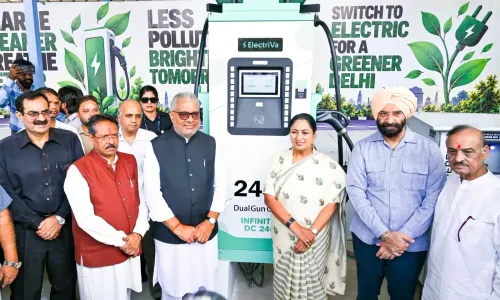
Five public EV charging stations at separate locations across Delhi were virtually inaugurated on the same day.
The initiative is part of India's broader commitment under the FAME scheme (2015) and updated NDCs (2022) targeting 50 percent non-fossil power by 2030.
Delhi has been a priority city for electric public transport given its severe winter air-pollution crisis and heavy reliance on diesel buses.
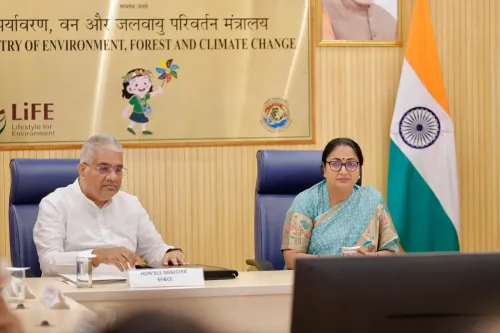
Delhi's battle against its notorious winter smog got a concrete boost on Tuesday, October 13, 2026, as Union Environment Minister Bhupender Yadav flagged off 150 electric buses at Anand Vihar — one of the capital's busiest transit hubs — under the Sewa Sankalp Abhiyaan.
150 buses roll out of Anand Vihar
The flag-off ceremony at Anand Vihar, Delhi was attended by Delhi Chief Minister Smt. Rekha Gupta and Delhi Environment Minister Shri Manjinder Singh Sirsa, underscoring the joint central-state commitment behind the push. The event marked a visible convergence of national climate targets and city-level air-quality imperatives — Delhi having earned an unenviable reputation as one of the world's most polluted capitals, particularly during the October-to-January smog season.
The 150 zero-emission buses will join Delhi's public transport network, directly displacing diesel vehicles that have long been a major contributor to the city's particulate load. Every electric bus added to a high-density urban fleet is not just a vehicle swap — it is a daily emissions calculation rewritten across hundreds of kilometres of route.
Five new public EV charging stations go live
Alongside the bus flag-off, Minister Yadav virtually inaugurated public EV charging stations at five locations across Delhi, adding to the charging backbone that private and commercial electric vehicle owners depend on. Without reliable public charging infrastructure, consumer confidence in EVs stalls — making these five nodes as strategically important as the buses themselves.
India's electric-mobility push has a clear policy spine. The FAME (Faster Adoption and Manufacturing of Electric Vehicles) scheme, launched in 2015, provided the foundational subsidy architecture that made large-scale electric bus procurement financially viable for state transport undertakings. India's updated Nationally Determined Contributions submitted in 2022 further committed the country to sourcing 50 percent of its cumulative electric power from non-fossil sources by 2030 — targets that only become achievable if transport electrification scales rapidly.
Delhi as the proving ground for India's clean-transport ambition
Delhi has consistently been the frontline for India's electric public transport experiments, precisely because the stakes are highest here. Its recurring winter smog crises — driven by a lethal mix of vehicular exhaust, stubble burning, and stagnant cold air — have made the political and public-health case for clean mobility impossible to ignore. Central and state governments have steadily grown the electric bus fleet and charging grid in major cities, but the pace of expansion is now being tested against both emission deadlines and commuter demand.
Minister Yadav framed Tuesday's events within Prime Minister Narendra Modi's Viksit Bharat ('Developed India') vision, stating that these initiatives reflect 'our collective commitment to reducing emissions, promoting electric mobility and building a Viksit Bharat that grows in harmony with nature.' The language is deliberate: it ties local infrastructure spending to a national identity project, positioning clean growth not as a trade-off with development but as its defining feature.
With winter weeks away and pollution forecasts already trending upward, the timing of 150 new zero-emission buses hitting Delhi's roads carries urgency well beyond the ceremonial.
Point of View
On-ground fleet deployment — with Delhi serving as the flagship proving ground. Framing the initiative under the 'Sewa Sankalp Abhiyaan' and the 'Viksit Bharat' umbrella signals a deliberate effort by the BJP-led government to tie infrastructure delivery to its broader development narrative ahead of the winter pollution season. The simultaneous inauguration of EV charging nodes alongside the bus fleet addresses a long-standing chicken-and-egg problem in EV adoption: supply without supporting infrastructure rarely sticks. The real test, however, will be whether these deployments accelerate into other cities and whether budget allocations to state transport undertakings scale to match the ambition.
NationPress
13 Oct 2026
Frequently Asked Questions
What is the Sewa Sankalp Abhiyaan?
The Sewa Sankalp Abhiyaan is a government initiative under which the October 13, 2026 flag-off of 150 electric buses in Delhi was organised; specific operational details of the programme are not yet fully part of the established public record.
How many electric buses were flagged off in Delhi on October 13, 2026?
150 electric buses were flagged off at Anand Vihar, Delhi by Union Environment Minister Bhupender Yadav on October 13, 2026.
Where were the new EV charging stations inaugurated in Delhi?
Five public EV charging stations were virtually inaugurated at five separate locations across Delhi, though the specific site names were not detailed in the minister's announcement.
What is India's FAME scheme and how does it relate to Delhi's electric buses?
The FAME (Faster Adoption and Manufacturing of Electric Vehicles) scheme, launched in 2015 , provides subsidy support that makes large-scale electric bus procurement viable for state transport undertakings, forming the policy backbone behind deployments like the one in Delhi.
Why is Delhi a focus for electric bus expansion in India?
Delhi is prioritised because of its severe recurring winter smog crisis, driven partly by vehicular emissions, and its heavy historical dependence on diesel buses — making it both the highest-stakes and highest-visibility city for clean-transport reform.