CM Fadnavis Gives Fresh Push to Jal Jeevan Mission in Maharashtra
Synopsis
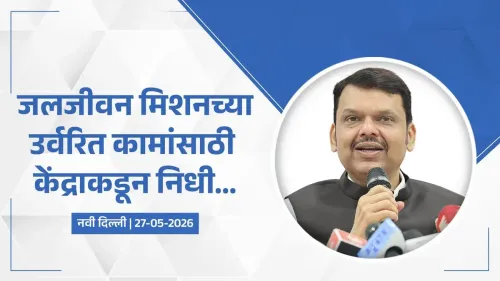
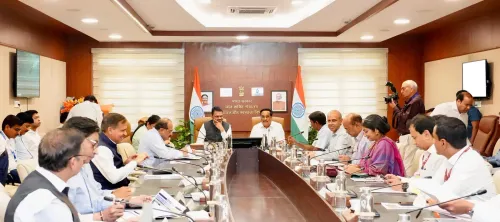
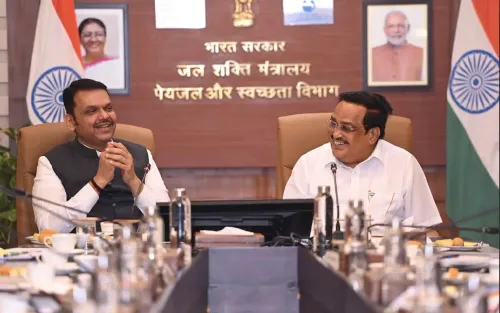
The Chief Minister's Office of Maharashtra announced on 28 May 2026 that CM Devendra Fadnavis has infused fresh momentum into the Jal Jeevan Mission, framing the state's action as a 'sanjeevani' — a reviving force — for the national rural drinking water scheme.
Key Takeaways
The Chief Minister's Office of Maharashtra posted on 28 May 2026 that CM Devendra Fadnavis has given renewed momentum to the Jal Jeevan Mission .
The state described its action as a 'sanjeevani' (lifeline) for the mission, signalling a high-level political push for faster implementation.
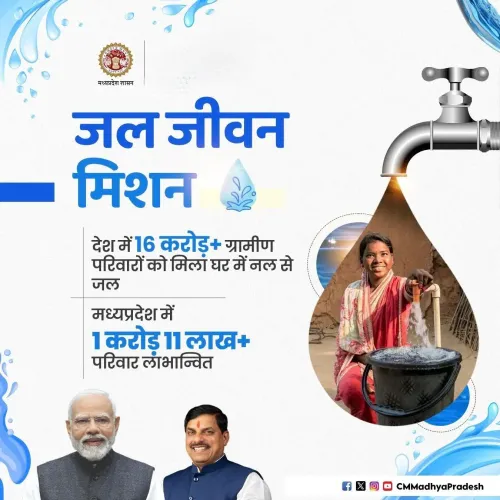
The Jal Jeevan Mission was launched by the Government of India in 2019 to provide functional household tap connections to all rural households.
Maharashtra implements JJM alongside state-level schemes such as the earlier Jalyukt Shivar water conservation programme.
Rural households, gram panchayats, and district water supply departments are the primary stakeholders affected by any acceleration in the mission.
District-level coverage data and future state budget allocations will indicate how substantive the renewed push proves to be.
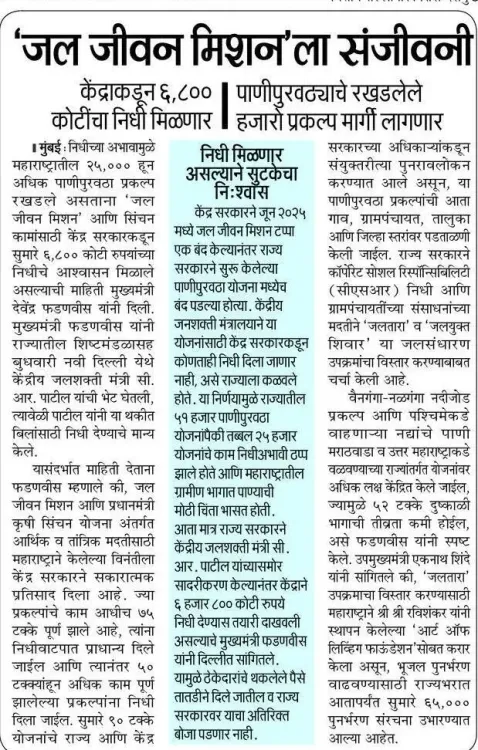
The Chief Minister's Office of Maharashtra shared on Thursday, 28 May 2026 that Chief Minister Devendra Fadnavis has given renewed momentum to the Jal Jeevan Mission, describing the development as a 'lifeline' — sanjeevani — for the flagship rural water scheme in the state.
Context
The CMO's post, captioned 'Jal Jeevan Mission'la Sanjeevani ('A lifeline for Jal Jeevan Mission'), signals a fresh state-level push to accelerate the implementation of the central scheme in Maharashtra. The framing — invoking the word sanjeevani, meaning a reviving force — suggests the state government is positioning its recent action as a corrective or energising intervention for the mission's on-ground delivery.
The post tags Chief Minister Devendra Fadnavis directly, indicating his personal involvement in the initiative. Fadnavis, who previously served as Chief Minister and has a record of prioritising rural water conservation and infrastructure, has made water access a recurring policy theme across his tenures.
Policy Backdrop
The Jal Jeevan Mission (JJM) was launched by the Government of India in 2019 with the objective of providing a functional household tap connection (FHTC) for drinking water to every rural household in the country. The scheme operates as a centrally sponsored programme, with states responsible for planning, execution, and co-funding.
Maharashtra has been an active participant in the national mission while simultaneously running complementary state-level conservation programmes, most notably the earlier Jalyukt Shivar initiative. Successive state governments have periodically reported increases in tap-water coverage under JJM, though district-level implementation has remained uneven across the state's diverse geography.
The state's water supply departments work in tandem with village-level committees to commission pipelines, source water, and maintain infrastructure — a multi-tiered delivery chain that has at times slowed progress in remote or hilly districts.
Stakeholders and Impact
Rural households across Maharashtra are the primary beneficiaries of any acceleration in JJM implementation. Access to piped drinking water directly reduces the burden on women and children who traditionally travel long distances for water, and has downstream effects on health, school attendance, and agricultural productivity.
State and district water supply departments, gram panchayats, and contracted infrastructure agencies are the key implementation actors whose capacity and accountability determine how quickly coverage targets are met. A renewed political signal from the Chief Minister's level can unlock administrative bottlenecks and expedite fund releases at the district tier.
What's Next
Observers will watch for district-level JJM coverage data releases in the coming months to assess whether the state's renewed push translates into measurable gains in functional tap connections. Any supplementary state budget provisions earmarked for water infrastructure in the next fiscal cycle will be a key indicator of the government's follow-through.
If Maharashtra accelerates its coverage rate, it could position the state as a model for other large states still working to close their rural water access gaps under the national mission's framework.
Point of View
The Fadnavis government is making a deliberate political claim: that the mission needed — and has now received — a state-level rescue. This framing serves a dual purpose, reinforcing the Chief Minister's rural-development credentials while also subtly distancing the current administration from any prior implementation gaps. The move fits a broader pattern in which state governments seek to co-own central welfare schemes at moments of political salience. Whether the signal converts into measurable coverage gains will determine whether the 'lifeline' narrative holds up to scrutiny in the months ahead.
NationPress
11 Oct 2026
Frequently Asked Questions
What is the Jal Jeevan Mission in Maharashtra?
The Jal Jeevan Mission is a centrally sponsored scheme launched in 2019 to provide functional household tap connections for drinking water to every rural household. Maharashtra implements the mission through its state water supply departments and village-level committees.
What did CM Devendra Fadnavis do for Jal Jeevan Mission?
The Chief Minister's Office of Maharashtra announced on 28 May 2026 that CM Devendra Fadnavis has given fresh momentum — described as a 'sanjeevani' or lifeline — to the Jal Jeevan Mission's implementation in the state.
What does 'sanjeevani' mean in the context of this announcement?
'Sanjeevani' is a Hindi word meaning a reviving or life-giving force. The CMO used it to describe the state government's action as an energising push that breathes new life into the Jal Jeevan Mission's delivery in Maharashtra.
How many rural households benefit from Jal Jeevan Mission in Maharashtra?
Exact current figures were not specified in the announcement. District-level coverage data releases are expected to reflect any gains from the renewed state push in the coming months.
What is the difference between Jal Jeevan Mission and Jalyukt Shivar?
Jal Jeevan Mission is a national scheme focused on piped drinking water connections to rural households, launched by the Government of India in 2019. Jalyukt Shivar was an earlier Maharashtra state-level programme focused on water conservation and drought-proofing, running primarily under the previous Fadnavis government.