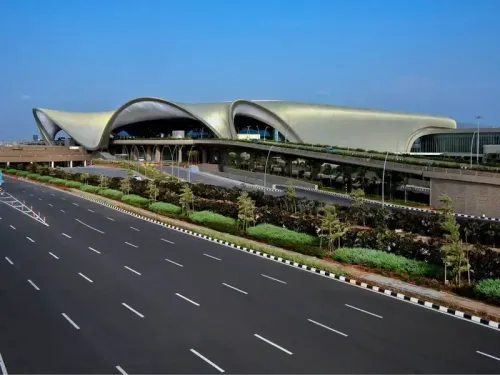
Fadnavis urges Centre: No international flights to shift from Mumbai to Navi Mumbai airport
Synopsis
Maharashtra CM Devendra Fadnavis has formally asked the Centre not to divert a single international flight from Mumbai's CSMIA to Navi Mumbai Airport, countering an airport operator plan to shift 265 flights from Summer 2027. His alternative: a phased three-step rebuild of Terminal 1 that keeps flights — and passengers — in Mumbai throughout construction.
Key Takeaways
Maharashtra CM Devendra Fadnavis has written to the Union Ministry of Civil Aviation opposing any diversion of international flights from CSMIA Mumbai to Navi Mumbai International Airport .
The Mumbai Airport operator had proposed shifting 33% of international operations — approximately 265 flights — to Navi Mumbai from the Summer 2027 schedule.
The diversion was intended to facilitate demolition and rebuilding of Terminal 1 , which handles 15 million passengers annually and is targeted for complete demolition by December 2030 .
IndiGo , Air India , and Akasa Air agreed to relocate; foreign carriers continue to oppose the shift.
Fadnavis has proposed a three-phase redevelopment — build Terminal 1B first, transfer operations, then demolish old Terminal 1A — eliminating any need to reroute flights.
Both airports, the CM insists, must operate independently at full respective capacities .
Maharashtra Chief Minister Devendra Fadnavis has written to the Union Ministry of Civil Aviation, formally requesting that no international flights be diverted from Chhatrapati Shivaji Maharaj International Airport (CSMIA), Mumbai, to the upcoming Navi Mumbai International Airport. The letter, confirmed by the Chief Minister's office on 11 November 2026, directly counters a proposal by the Mumbai Airport operator to shift 33% of international operations — roughly 265 flights — to Navi Mumbai starting from the Summer 2027 schedule.
What Triggered the Move
The proposal to reroute flights originated from plans to overhaul Terminal 1 at CSMIA, described by authorities as old and structurally unsafe. The terminal currently handles 15 million passengers annually and requires a complete rebuild, with the Mumbai Airport operator targeting full demolition by December 2030. To facilitate construction, the airport authority proposed shifting 265 international flights — covering routes to 14 destinations including Doha, Dubai, Jeddah, Muscat, and Riyadh — to Navi Mumbai from the Summer 2027 schedule onward.
Airline Reactions: Domestic Yes, Foreign No
The proposal drew a split response from carriers. Domestic airlines initially opposed the shift but eventually relented — IndiGo, Air India, and Akasa Air agreed to relocate certain services to Navi Mumbai Airport. Foreign carriers, however, continue to oppose any change to their operational base, adding weight to Fadnavis's argument that the diversion would create significant disruption for international passengers.
Fadnavis Proposes Phased Redevelopment
Rather than accept a wholesale shift of flights, Chief Minister Fadnavis has put forward a three-phase redevelopment plan for Terminal 1 that he argues would eliminate the need to divert any aircraft. Under Phase 1, construction of a new Terminal 1B would be completed first. In Phase 2, existing operations from Terminal 1A would be shifted to the newly built Terminal 1B, keeping passenger services uninterrupted. Phase 3 would then see the demolition and full reconstruction of the old Terminal 1A.
State officials argue that this incremental approach would keep passenger amenities fully functional throughout the construction period, without compromising safety or forcing airlines to alter their operational bases. Shutting down Terminal 1 all at once, the Chief Minister warned, would severely disrupt flight services for three years or more.
Key Demand: Independent Operation of Both Airports
Fadnavis has asserted that Mumbai Airport and Navi Mumbai International Airport must operate independently and at their full respective capacities — neither functioning as a relief valve for the other. His letter to the Civil Aviation Ministry explicitly asks that no international flights or operations be diverted from CSMIA to Navi Mumbai under any schedule, including the proposed Summer 2027 reallocation.
What Happens Next
The Union Ministry of Civil Aviation is yet to respond publicly to the Chief Minister's letter. The Summer 2027 schedule — when the proposed diversion was set to begin — is now a key deadline, and the Centre's decision will determine whether Mumbai Airport's international capacity is preserved in full or partially redistributed. With foreign airlines already resistant and the Maharashtra government formally opposed, the pressure on the Centre to side with the status quo is considerable.
Point of View
But diverting established international routes there before it proves its operational credibility risks passenger inconvenience and airline pushback — both of which the Maharashtra government would have to answer for. The phased Terminal 1 redevelopment plan he proposes is sensible on paper, but it defers a genuinely unsafe infrastructure problem rather than resolving it. The Centre will have to weigh airport safety obligations against the political cost of overruling a sitting chief minister from its own party — a tension that mainstream coverage of this story has largely glossed over.
NationPress
11 Nov 2026
Frequently Asked Questions
Why did Maharashtra CM Fadnavis write to the Civil Aviation Ministry?
Chief Minister Devendra Fadnavis wrote to the Union Ministry of Civil Aviation to formally oppose a proposal to divert 33% of Mumbai Airport's international operations — around 265 flights — to Navi Mumbai International Airport from the Summer 2027 schedule. He argued that both airports should operate independently at full capacity, with no flights rerouted.
Why was the flight diversion to Navi Mumbai proposed in the first place?
The Mumbai Airport operator proposed shifting 265 international flights to Navi Mumbai to facilitate the demolition and rebuilding of Terminal 1 at CSMIA, which is described as old and structurally unsafe. Terminal 1 handles 15 million passengers annually and is slated for complete demolition by December 2030.
Which airlines agreed to move to Navi Mumbai, and who opposed it?
Domestic carriers IndiGo, Air India, and Akasa Air eventually agreed to relocate certain services to Navi Mumbai Airport. Foreign airlines, however, continue to oppose any shift of their operations away from CSMIA Mumbai.
What alternative plan has CM Fadnavis proposed for Terminal 1 redevelopment?
Fadnavis has proposed a three-phase approach: first, complete construction of a new Terminal 1B; second, shift current operations from Terminal 1A to the newly built Terminal 1B; and third, demolish and reconstruct the old Terminal 1A. This phased method, he argues, would keep passenger services running without any need to divert flights to Navi Mumbai.
What routes were proposed to be shifted to Navi Mumbai Airport?
The Mumbai Airport operator had proposed moving flights to 14 international destinations — including Doha, Dubai, Jeddah, Muscat, and Riyadh — to Navi Mumbai Airport under the Summer 2027 schedule. Chief Minister Fadnavis has opposed this diversion in its entirety.