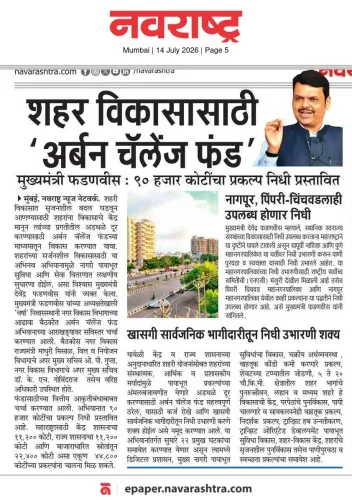
Fadnavis pitches ₹90,000 crore Urban Challenge Fund for Maharashtra cities
Synopsis
Maharashtra CM Devendra Fadnavis has proposed a ₹90,000 crore Urban Challenge Fund — with ₹44,800 crore earmarked for the state — to let cities raise capital through bonds and PPPs rather than wait on subsidy pipelines. The pitch lands just days after the Sixth Finance Commission raised local body devolution to 27.3% of SOTR, making this the most ambitious push for urban financial autonomy in Maharashtra in recent memory.
Key Takeaways
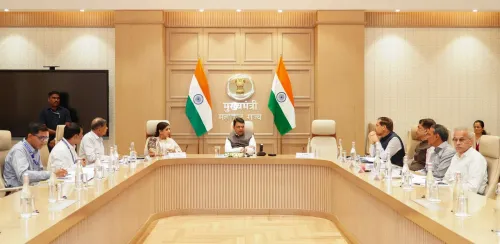
CM Devendra Fadnavis proposed the 'Urban Challenge Fund' on 13 July at an Urban Development Department review meeting in Mumbai .
Total project outlay is ₹90,000 crore ; Maharashtra's share is ₹44,800 crore — split between Centre ( ₹11,200 crore ), state ( ₹11,200 crore ), and market mechanisms ( ₹22,400 crore ).
The fund will enable cities to raise capital via municipal bonds and PPPs , covering approximately 22 focus areas.
Nashik and Pune Municipal Corporations have already raised funds for water and sanitation; Pimpri-Chinchwad and Nagpur are next in line.
The Sixth Maharashtra Finance Commission (chaired by Nitin Kareer ) has proposed raising local body devolution to 27.3% of SOTR, up from 26.3% .
Devolved funds will be split 55% to Urban Local Bodies and 45% to Rural Local Bodies, with 5% reserved as performance grants.
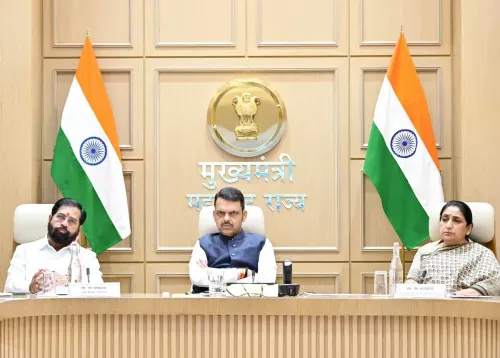
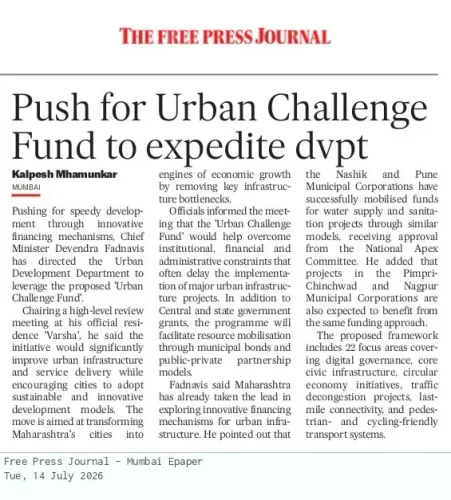
Maharashtra Chief Minister Devendra Fadnavis on Monday, 13 July called for the creation of an 'Urban Challenge Fund' aimed at transforming cities into engines of economic growth and clearing systemic bottlenecks that delay urban infrastructure projects. The proposal, carrying a total project outlay of ₹90,000 crore, was discussed in depth at an Urban Development Department review meeting chaired by Fadnavis in Mumbai.
Financial Structure of the Fund
Of the total ₹90,000 crore corpus, a target mobilisation framework of ₹44,800 crore has been mapped out specifically for Maharashtra. This comprises ₹11,200 crore from the Central Government, ₹11,200 crore from the State Government, and ₹22,400 crore to be sourced through market-based mechanisms including municipal bonds and Public-Private Partnerships (PPP).
The fund is designed to address a long-standing structural problem: while central and state subsidy-based urban schemes exist, institutional, financial, and administrative constraints routinely delay infrastructure delivery. The Urban Challenge Fund is intended to enable cities to bypass these bottlenecks by accessing capital markets directly.
Maharashtra's Track Record in Municipal Finance
Fadnavis pointed to existing precedents within the state to underscore the fund's viability. The Nashik and Pune Municipal Corporations have already successfully raised dedicated funds for water supply and sanitation projects, and those initiatives have received approval from the National Executive Committee (NEC). Similar mechanisms are set to be extended to the Pimpri-Chinchwad and Nagpur Municipal Corporations in the near term.
Key Focus Areas of the Campaign
The Urban Challenge Fund campaign is expected to cover approximately 22 focus areas. These include digital governance, core civic infrastructure, circular economy initiatives, de-congestion and traffic management, last-mile connectivity, revitalisation of urban zones spanning 5 to 20 sq km, development of small and medium towns as growth centres, marketplace redevelopment, pedestrian and bicycle-friendly transport, upgradation of transit hubs, Transit-Oriented Development (TOD) infrastructure, and water supply and sanitation projects, according to the government release.
Sixth Finance Commission Backdrop
The push for the Urban Challenge Fund comes days after the Sixth Maharashtra Finance Commission, chaired by Nitin Kareer, was tabled in the Maharashtra Legislature. The Commission has recommended an annual devolution of 27.3 per cent of the State's Own Tax Revenue (SOTR) to local bodies — up from the existing 26.3 per cent, an increase of 1.0 per cent. The combined devolution will be split 55 per cent to Urban Local Bodies and 45 per cent to Rural Local Bodies, with 5 per cent strictly reserved as performance grants and another 5 per cent allocated to Rural-Urban transition management.
Together, the Urban Challenge Fund and the Finance Commission's revised devolution framework signal a broader strategic shift in Maharashtra towards financial decentralisation and market-linked urban financing — a model that, if implemented, could redefine how Indian cities fund their growth.
Point of View
400 crore market-mobilisation target is the hardest part of that equation. Indian municipal bond markets remain thin outside a handful of cities, and Nashik and Pune are outliers, not the norm. The real question is whether smaller urban local bodies in Maharashtra have the credit ratings, revenue visibility, and governance capacity to actually attract institutional investors. Without that, the market tranche risks becoming a placeholder that gets quietly replaced by more state borrowing. The Finance Commission's devolution uptick to 27.3% of SOTR is a welcome signal, but performance grants at just 5% of the pool are unlikely to drive the accountability reforms that make market financing credible.
NationPress
12 Oct 2026
Frequently Asked Questions
What is the Urban Challenge Fund proposed by CM Devendra Fadnavis?
The Urban Challenge Fund is a proposed financing mechanism to help Maharashtra's cities raise capital for infrastructure projects through municipal bonds and Public-Private Partnerships, rather than relying solely on government subsidies. It carries a total project outlay of ₹90,000 crore, with ₹44,800 crore specifically mapped for Maharashtra.
How will the ₹44,800 crore Maharashtra allocation be funded?
The ₹44,800 crore will come from three sources: ₹11,200 crore from the Central Government, ₹11,200 crore from the Maharashtra State Government, and ₹22,400 crore through market-based mechanisms such as municipal bonds and PPPs.
Which cities in Maharashtra have already raised funds through similar mechanisms?
The Nashik and Pune Municipal Corporations have already successfully raised dedicated funds for water supply and sanitation projects, with approval from the National Executive Committee (NEC). Similar mechanisms are set to be extended to Pimpri-Chinchwad and Nagpur Municipal Corporations.
What did the Sixth Maharashtra Finance Commission recommend?
The Sixth Maharashtra Finance Commission, chaired by Nitin Kareer, recommended raising the annual devolution to local bodies to 27.3% of the State's Own Tax Revenue (SOTR), up from the existing 26.3%. The devolved funds will be split 55% to Urban Local Bodies and 45% to Rural Local Bodies, with 5% reserved as performance grants.
What are the key focus areas of the Urban Challenge Fund campaign?
The campaign covers approximately 22 focus areas including digital governance, civic infrastructure, circular economy, traffic de-congestion, last-mile connectivity, revitalisation of urban zones of 5–20 sq km, small and medium town development, marketplace redevelopment, pedestrian and cycling infrastructure, transit hub upgradation, Transit-Oriented Development, and water supply and sanitation.