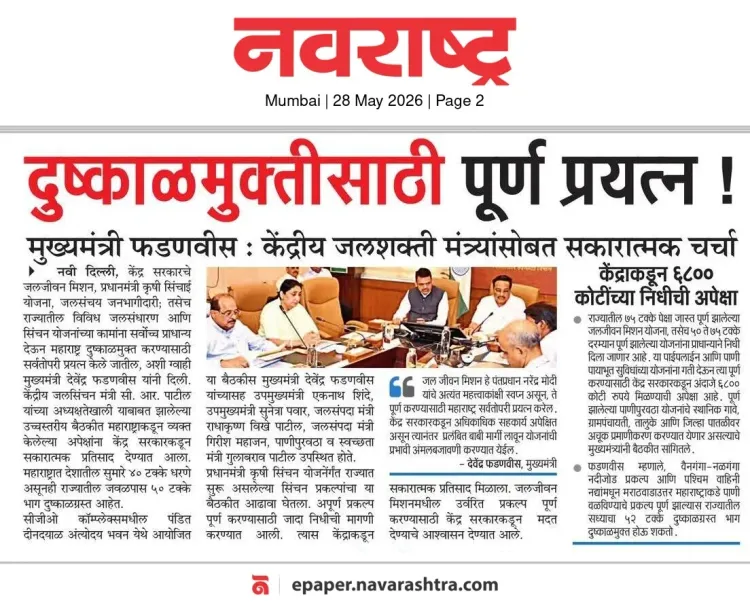
CM Fadnavis Pledges Full Effort for Drought-Free Maharashtra
Synopsis
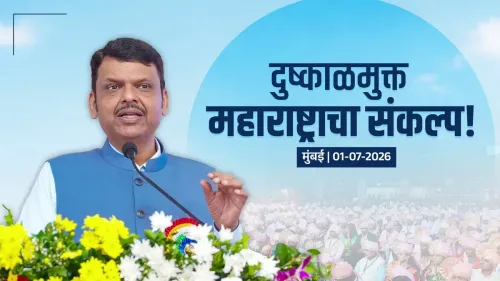
The Chief Minister's Office of Maharashtra declared 'full effort for drought freedom' on 28 May 2026, reaffirming CM Devendra Fadnavis's commitment to water conservation as the southwest monsoon approaches drought-vulnerable districts across Marathwada and Vidarbha.
Key Takeaways
The CMO Maharashtra posted on 28 May 2026 pledging 'full effort for drought freedom,' tagging CM Devendra Fadnavis .
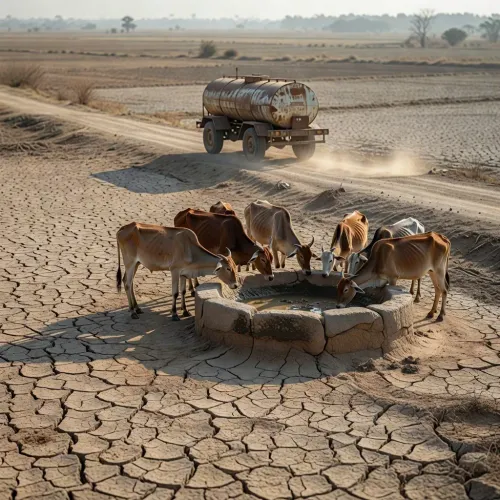
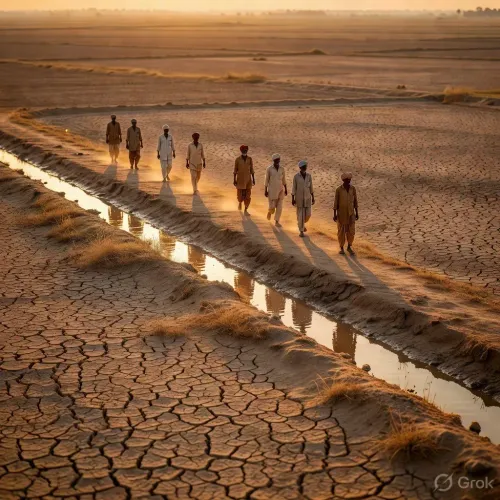
Maharashtra's rain-shadow regions — particularly Marathwada and Vidarbha — face recurrent drought affecting millions of farmers.
Jalyukt Shivar Abhiyan , launched in 2015 , targeted making 25,000 villages drought-free through decentralised watershed works.
The Maharashtra State Water Policy (2019) emphasises integrated river-basin management and micro-irrigation expansion.
The statement comes ahead of the critical southwest monsoon 2026 season, when kharif crop sowing begins.
The Water Resources Department's district-level water-budget targets will be a key indicator of follow-through.
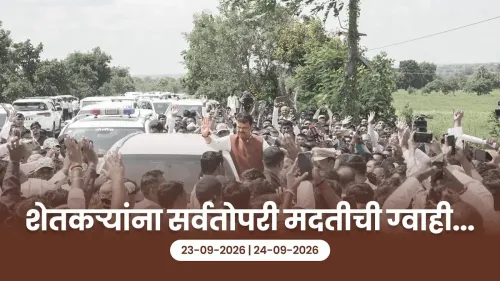
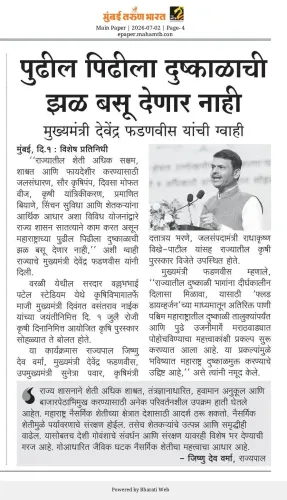
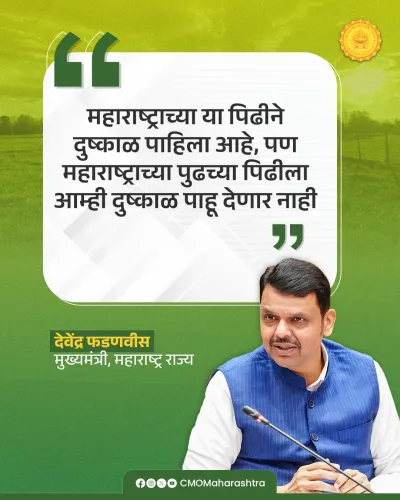
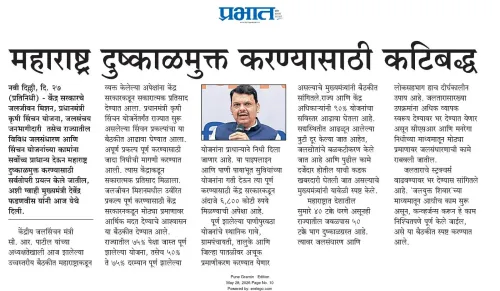
The Chief Minister's Office of Maharashtra on Thursday, 28 May 2026 reaffirmed the state government's commitment to eliminating drought, with Chief Minister Devendra Fadnavis pledging complete efforts toward drought relief and water security across the state.
Context
The post, shared from the official CMO Maharashtra account, carries the Marathi declaration 'दुष्काळमुक्तीसाठी पूर्ण प्रयत्न!' — meaning 'Full effort for drought freedom!' — tagging Chief Minister Devendra Fadnavis directly. The message signals a renewed push on water conservation as the southwest monsoon of 2026 approaches, a period critical for Maharashtra's rain-shadow districts and kharif agriculture.
Maharashtra encompasses large arid and semi-arid belts — particularly across Marathwada and Vidarbha — where recurring drought has historically devastated farm incomes and rural livelihoods. Water security has therefore remained a central governance priority across successive state administrations.
Policy Backdrop
The state's most prominent watershed initiative, Jalyukt Shivar Abhiyan, was launched in 2015 with the target of making 25,000 villages drought-free through decentralised water conservation structures including farm ponds, nala deepening, and check dams. The programme was closely associated with Fadnavis during his earlier tenure as Chief Minister.
The Maharashtra State Water Policy, revised in 2019, further reinforced integrated river-basin management and the expansion of micro-irrigation to improve water-use efficiency at the farm level. Together, these frameworks form the policy spine on which current drought-mitigation efforts rest.
Stakeholders and Impact
The communities most directly affected by drought-relief policy are Maharashtra's millions of drought-prone farmers and rural households who depend on the southwest monsoon for drinking water and kharif crop viability. Inadequate or delayed rainfall in districts such as Latur, Osmanabad, Beed and parts of Amravati division routinely triggers demands for tanker water supply, crop-loss compensation, and employment through rural works schemes.
Water conservation infrastructure also has downstream benefits for urban water security, with many smaller towns in Marathwada reliant on reservoirs fed by watershed works. The government's stated commitment to 'full effort' indicates continued budgetary and administrative focus on these programmes heading into the monsoon season.
What's Next
Attention will now turn to the Water Resources Department's district-level water-budget targets and any new scheme announcements ahead of the 2026 kharif sowing season. The performance of the monsoon 2026 across Marathwada and Vidarbha will be the key variable determining how much pressure the administration faces to activate drought-relief mechanisms. Sustained political messaging from the CMO suggests the government is positioning water security as a flagship governance deliverable for this term.
Point of View
Not merely a bureaucratic exercise. By invoking the same water-conservation idiom associated with his first term, Fadnavis is drawing a direct line from the Jalyukt Shivar Abhiyan legacy to present governance, reinforcing continuity and ownership. The timing — just before kharif sowing — maximises visibility among the farming communities most exposed to rainfall variability. Whether the pledge translates into measurable outcomes will depend on both monsoon performance and the pace of departmental implementation, making the next three months a credibility test for the government.
NationPress
11 Oct 2026
Frequently Asked Questions
What does 'drought-free Maharashtra' mean and what is the government doing?
'Drought-free Maharashtra' refers to the state government's goal of eliminating recurring drought through water conservation, watershed development, and micro-irrigation. The Fadnavis administration has reaffirmed this commitment ahead of the 2026 monsoon season.
What is Jalyukt Shivar Abhiyan and is it still active?
Jalyukt Shivar Abhiyan is a Maharashtra government watershed programme launched in 2015 to make 25,000 villages drought-free by building decentralised water storage structures. It was a flagship initiative of CM Devendra Fadnavis's earlier tenure.
Which districts in Maharashtra are most affected by drought?
Districts in the Marathwada region — including Latur, Osmanabad (Dharashiv), and Beed — and parts of Vidarbha such as Amravati division are historically the most drought-prone areas of Maharashtra.
What is the Maharashtra State Water Policy?
The Maharashtra State Water Policy, revised in 2019, focuses on integrated river-basin management, equitable water distribution, and expansion of micro-irrigation to improve agricultural water-use efficiency across the state.
When does drought relief become critical in Maharashtra?
Drought risk peaks during the kharif season (June to September) when farmers depend on the southwest monsoon. Insufficient or delayed rainfall in rain-shadow districts triggers government activation of relief measures including water tankers and crop-loss compensation.