MSP for Rabi crops 2027-28 hiked; safflower gets highest ₹675/quintal rise

Synopsis
The Modi-chaired CCEA has approved MSP hikes for six Rabi crops ahead of the 2027-28 season, with safflower receiving the steepest jump at ₹675 per quintal. While farmers have welcomed the move, the real test lies in procurement volumes and state-level implementation — factors that have historically diluted the on-ground impact of headline MSP increases.
Key Takeaways
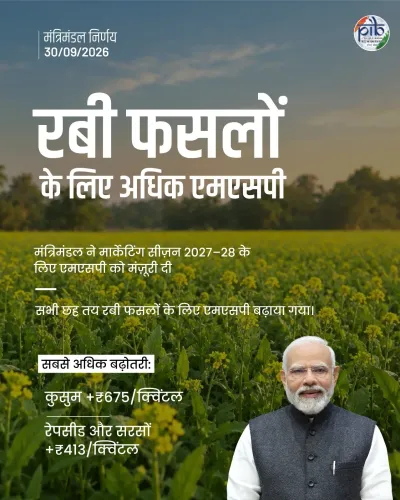
The CCEA , chaired by PM Narendra Modi , approved MSP hikes for six Rabi crops for the 2027-28 marketing season on 30 September .
Safflower received the highest increase at ₹675 per quintal ; wheat the lowest at ₹25 per quintal .
Rapeseed and mustard MSP rose by ₹413/quintal ; lentil (Masur) by ₹390/quintal ; barley by ₹136/quintal ; gram by ₹83/quintal .
The hike aligns with the Union Budget 2018-19 pledge to set MSP at least 1.5 times the weighted average cost of production.
Farmers welcomed the move but flagged that actual relief depends on procurement prices and volumes at the state level.
The revision complements schemes such as PM-KISAN and PMFBY as part of the Centre’s broader agricultural support framework.
The Cabinet Committee on Economic Affairs (CCEA), chaired by Prime Minister Narendra Modi, on Wednesday, 30 September approved a hike in the Minimum Support Price (MSP) for six major Rabi crops for the 2027-28 marketing season, drawing expressions of gratitude from farmers across the country. The decision is aimed at ensuring remunerative returns for growers at a time when cultivation costs continue to rise.
Crop-wise MSP Increases
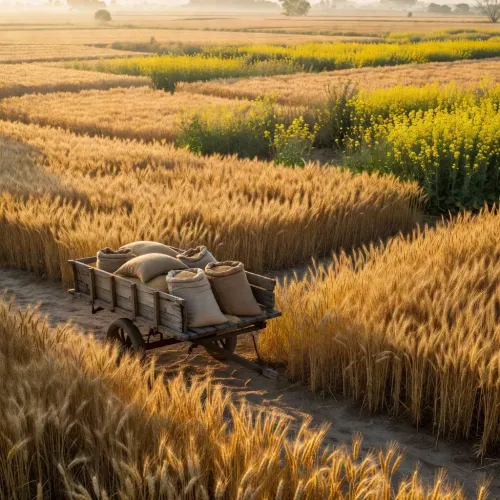
The steepest hike was announced for safflower, with an increase of ₹675 per quintal, followed by rapeseed and mustard at ₹413 per quintal. For lentil (Masur), the increase stands at ₹390 per quintal, while barley received a hike of ₹136 per quintal. Gram saw an increase of ₹83 per quintal, and wheat — the most widely cultivated Rabi crop — received the smallest increase at ₹25 per quintal, according to an official government statement.
What the Government Said
According to the official statement, the MSP revision for Rabi crops for the 2027-28 marketing season is consistent with the Union Budget 2018-19 commitment to fix support prices at a minimum of 1.5 times the all-India weighted average cost of production. The government noted that in recent years it has deliberately promoted the cultivation of pulses and oilseeds — crops other than cereals — by offering comparatively higher MSPs for those categories, as part of a broader push to diversify the agricultural basket.
Farmers React
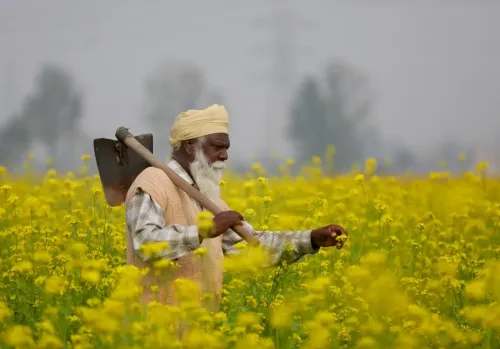
Farmers who spoke to reporters welcomed the announcement with cautious optimism. Rambilas, a farmer, said: “The government has done a really good thing for the farmers…we are extremely thankful.” Another farmer added: “The government should keep encouraging farmers like this…it is a welcome step as the farmers will also feel respected with this.”
However, farmers also noted that the actual relief will depend on the price at which their produce is procured in practice and the volume of government procurement — factors that have historically varied across states and seasons.
Broader Support Ecosystem
The MSP revision sits alongside a wider set of Central government schemes targeting agricultural welfare. The Pradhan Mantri Kisan Samman Nidhi (PM-KISAN) provides direct income support, the Pradhan Mantri Fasal Bima Yojana (PMFBY) covers crop insurance, and several other agriculture-linked initiatives have been extended in recent years. Notably, rising input costs — including fertilisers, labour, and fuel — mean that the headline MSP increase does not always translate into equivalent net income gains for farmers.
What to Watch
The extent to which the revised MSP benefits farmers on the ground will hinge on procurement efficiency and state-level implementation. Agricultural economists have consistently argued that a higher announced MSP is meaningful only when backed by robust physical procurement infrastructure — a gap that persists in several states. The next key milestone will be the onset of the Rabi sowing season and early signals on procurement readiness from state agencies.
Point of View
But the gap between announced prices and effective farmer income remains the structural blind spot in India’s agricultural policy. Safflower and mustard receiving the steepest hikes signals a deliberate push toward oilseed self-sufficiency — a strategic priority given India’s large edible oil import bill. Yet wheat, the crop most widely grown by small and marginal farmers, received only ₹25 per quintal — well below the increases for niche crops. The real accountability test is procurement: without state agencies absorbing produce at MSP, the announced figure is an aspiration, not a guarantee.
NationPress
1 Oct 2026
Frequently Asked Questions
Which Rabi crops received an MSP hike for the 2027-28 season?
Six Rabi crops received MSP increases for the 2027-28 marketing season: safflower, rapeseed and mustard, lentil (Masur), barley, gram, and wheat. The hikes were approved by the CCEA on 30 September.
Which crop got the highest MSP increase and by how much?
Safflower received the highest MSP increase at ₹675 per quintal for the 2027-28 marketing season. Rapeseed and mustard followed with a hike of ₹413 per quintal.
What is the MSP hike for wheat in 2027-28?
Wheat received the smallest increase among the six Rabi crops, at ₹25 per quintal for the 2027-28 marketing season, according to the official government statement.
Why does the government offer higher MSP for pulses and oilseeds than cereals?
The Centre has in recent years deliberately offered higher MSPs for pulses and oilseeds to encourage farmers to diversify away from cereals such as wheat and rice. This is part of a broader policy to boost domestic production of these crops and reduce India’s dependence on imports.
Will the MSP hike actually benefit farmers on the ground?
Farmers themselves have noted that the benefit of any MSP hike depends on the actual procurement price and the volume of produce the government buys. Rising cultivation costs mean the net income gain may be smaller than the headline increase suggests, and procurement infrastructure varies significantly across states.