Gadkari Salutes Postal Workers on National Postal Worker Day
Synopsis
Union Minister Nitin Gadkari marked National Postal Worker Day on 1 July 2026 by saluting India's postal workers for their dedication and reliability in connecting millions of citizens, highlighting the enduring importance of the country's vast postal network.
Key Takeaways
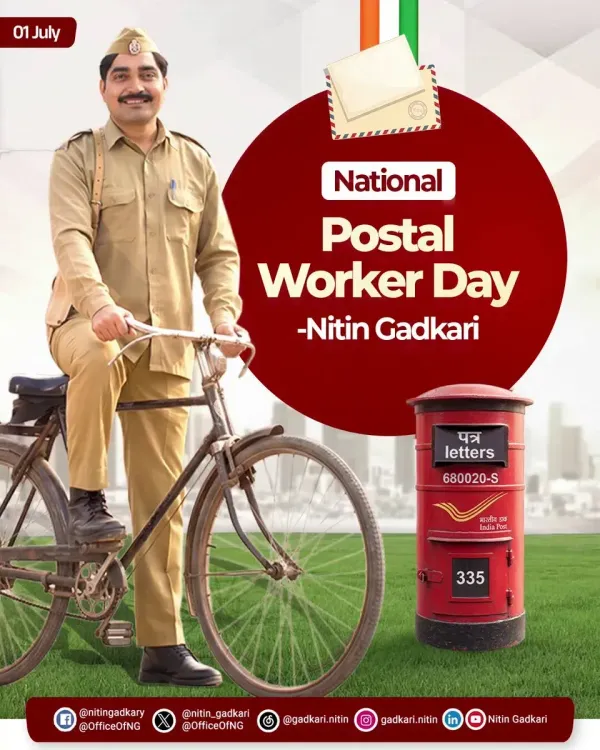
Union Minister Nitin Gadkari posted a tribute on 1 July 2026 to mark National Postal Worker Day .
He praised postal workers for ensuring letters, parcels, and messages reach every destination with 'trust, care, and reliability.' India operates one of the world's largest postal networks, with over 1.5 lakh post offices , the majority in rural areas.
Gramin Dak Sevaks (GDS) — contractual rural postal workers — form a large share of the postal workforce and have long sought better service conditions.
India Post serves dual roles as a logistics operator and a financial inclusion channel through India Post Payments Bank .
The tribute comes amid ongoing modernisation efforts at the postal department and continued advocacy for worker regularisation.
Union Road Transport and Highways Minister Nitin Gadkari on Wednesday, 1 July 2026, took to social media to mark National Postal Worker Day, paying tribute to postal workers across India for their dedication, integrity, and selfless service in connecting millions of citizens.
Context
National Postal Worker Day, observed on 1 July each year, is an occasion to recognise the contributions of postal employees who form the backbone of communication and logistics networks in countries around the world, including India. Gadkari's post highlighted the role postal workers play in ensuring that 'every letter, parcel, and message reaches its destination with trust, care, and reliability.'
The minister's message underscored the human element behind India's vast postal infrastructure — the men and women who traverse remote villages, hill terrain, and urban sprawl to fulfil delivery commitments that digital networks alone cannot always reach.
Policy Backdrop
India's postal network, operated by the Department of Posts under the Ministry of Communications, is one of the largest in the world, with over 1.5 lakh post offices spread across the country — the majority in rural areas. The network serves not just as a mail delivery system but as a financial services channel through India Post Payments Bank (IPPB) and a logistics arm through India Post Parcels.
In recent years, the postal department has been integrated into broader government schemes, including last-mile delivery of documents under the DigiLocker framework and delivery of welfare benefits in areas with limited banking access. Postal workers have been central to this expanded mandate, often acting as the state's most trusted interface with citizens in underserved regions.
Stakeholders and Impact
India's postal workforce numbers in the hundreds of thousands, including both departmental employees and Gramin Dak Sevaks (GDS) — contractual workers who serve rural post offices and represent a significant share of the total postal staff. GDS workers have long sought regularisation of service and improved pay parity, making public acknowledgements of their contribution by senior ministers politically significant.
For ordinary citizens — particularly in Tier-3 cities, semi-urban towns, and remote villages — postal workers remain a primary link to government services, financial instruments, and personal correspondence. The minister's tribute reflects an awareness of this continued relevance even as e-commerce logistics and private courier services grow rapidly.
What's Next
While Gadkari's post is ceremonial in nature, it arrives at a time when the postal department is navigating a dual mandate: modernising its technology stack and logistics capabilities while preserving universal service obligations. Advocacy groups representing postal workers are likely to use such high-profile recognition to renew calls for improved service conditions and formal regularisation of contractual staff. The broader conversation around the future of India Post — as a logistics player, a financial inclusion vehicle, and a public service institution — will continue to shape policy in the months ahead.
Point of View
While ceremonial, carries weight given the political visibility of postal workers — particularly Gramin Dak Sevaks — as a constituency that has persistently sought formal recognition and service parity. Senior ministers publicly acknowledging this workforce on a designated day can serve as soft political signalling ahead of any policy decisions on GDS regularisation. The post also reflects a broader government pattern of using social media to maintain visibility across public-sector worker communities. For the postal department, such recognition from a Cabinet minister reinforces its relevance at a time when it is competing with private logistics players for both commercial contracts and public trust.
NationPress
29 Sept 2026
Frequently Asked Questions
What is National Postal Worker Day and when is it observed?
National Postal Worker Day is observed on 1 July each year to honour the contributions of postal employees who deliver mail and provide essential services to communities, including in remote and rural areas.
Why did Nitin Gadkari post about postal workers?
Nitin Gadkari posted on 1 July 2026 to mark National Postal Worker Day, saluting postal workers across India for their dedication, integrity, and role in connecting millions of citizens.
How large is India's postal network?
India's postal network, run by the Department of Posts , includes over 1.5 lakh post offices , making it one of the largest in the world, with the majority of offices located in rural areas.
Who are Gramin Dak Sevaks and why are they significant?
Gramin Dak Sevaks (GDS) are contractual postal workers who staff rural post offices across India. They form a large share of the total postal workforce and have long advocated for regularisation of their employment and improved pay parity.
What services does India Post provide beyond mail delivery?
Beyond mail delivery, India Post provides financial services through India Post Payments Bank (IPPB) , handles parcel logistics, and supports last-mile delivery of government scheme benefits in areas with limited banking access.