Gadkari Announces Rs 40,000 Cr Highway Projects for Meghalaya
Synopsis
Union Minister Nitin Gadkari has announced new national highway projects worth Rs 40,000 crore for Meghalaya, tagging Chief Minister Conrad Sangma. The package falls under the PM Gati Shakti and Bharatmala frameworks and signals a major Centre push to improve all-weather road connectivity in the northeastern hill state.
Key Takeaways
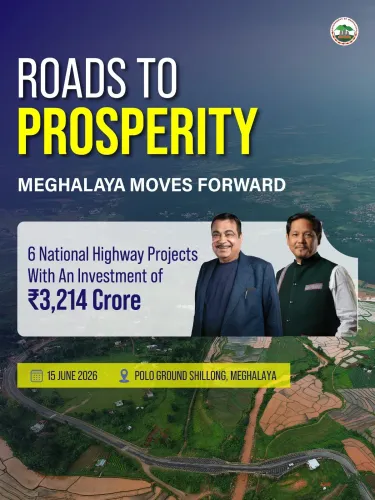
Union Minister Nitin Gadkari announced national highway projects worth Rs 40,000 crore for Meghalaya on 15 June 2026 .
The announcement was tagged to Meghalaya Chief Minister Conrad Sangma , indicating active Centre-state coordination.
Projects are positioned under the PM Gati Shakti National Master Plan (launched October 2021) and the Bharatmala Pariyojana (approved 2017).
Meghalaya's hilly terrain and border proximity to Bangladesh and Bhutan make highway connectivity both a logistical and strategic priority.
Detailed project reports, alignment maps and phased budget allocations are yet to be formally notified.
Land acquisition and environmental clearances in hill terrain remain the key execution bottlenecks to watch.
Union Road Transport and Highways Minister Nitin Gadkari on Monday, 15 June 2026 announced a package of new national highway projects worth Rs 40,000 crore for Meghalaya, marking one of the largest single-state road infrastructure commitments for the northeastern region. The announcement, made via a post on X tagged to Meghalaya Chief Minister Conrad Sangma, invoked the #GatiShakti and #PragatiKaHighway banners under which the Ministry has been consolidating its Northeast infrastructure push.
Context
Gadkari's post declared — 'मेघालय में 40,000 करोड़ की लागत वाली नई राष्ट्रीय राजमार्ग परियोजनाओं की घोषणा!' ('Announcement of new national highway projects worth Rs 40,000 crore in Meghalaya!') — signalling a significant scale-up of road investment in the hill state. The announcement was directed at Conrad Sangma, Chief Minister of Meghalaya and head of the National People's Party, underscoring the Centre-state coordination that underpins large infrastructure rollouts in the Northeast. Meghalaya's hilly terrain and its proximity to international borders with Bangladesh and Bhutan have historically made all-weather road connectivity both a logistical challenge and a strategic priority.
Policy Backdrop
The projects sit within two overlapping policy frameworks. The Bharatmala Pariyojana, approved in 2017, earmarked dedicated Northeast corridors as part of a national target of 34,800 km of new and upgraded national highways, with special provisions for hill and border states. Layered on top of this is PM Gati Shakti, the National Master Plan launched in October 2021 to synchronise roads, railways, ports and logistics infrastructure across central ministries and state governments through a unified digital platform. The #GatiShakti hashtag in Gadkari's post explicitly situates the Meghalaya announcement within this integrated planning architecture. The Ministry of Road Transport and Highways has in recent years set successive annual construction records, and special financial packages for hill states have become a recurring instrument to accelerate project clearance and land acquisition.
Stakeholders and Impact
The most direct beneficiaries of the proposed projects would be Meghalaya's approximately 32 lakh residents, many of whom depend on national highways for access to markets, healthcare and education facilities across the state's rugged landscape. Transporters and logistics operators serving the broader Northeast corridor stand to gain from reduced transit times and lower vehicle operating costs once improved highway stretches become operational. The announcement also carries trade implications: better road infrastructure linking Meghalaya to neighbouring states and border crossings can facilitate commerce with Bangladesh, with which India has been expanding land-port connectivity. The tagging of Chief Minister Conrad Sangma suggests that state-level coordination on land acquisition and right-of-way clearances — historically the most time-consuming bottleneck for highway projects in hill states — is already part of the conversation.
What's Next
The announcement sets the headline figure but the critical details — project-wise breakdown, alignment maps, detailed project reports, and phased budget allocations — are expected to follow through formal notifications from the Ministry and subsequent disclosures in Union Budget documents or revised estimates. Land acquisition timelines and environmental clearances in ecologically sensitive hill terrain will be closely watched by both project planners and civil society groups. Progress under the PM Gati Shakti portal, which tracks multimodal infrastructure projects in near real time, will offer a public window into how quickly the announced package translates into ground-level activity. With the Northeast remaining a showcase region for the government's infrastructure narrative, the Meghalaya highway package is likely to feature prominently in the Ministry's annual performance reporting.
Point of View
000 crore announcement for Meghalaya is the latest in a sustained pattern of large-ticket highway packages for Northeastern states, a region the current government has used as a visible proof-point for its infrastructure delivery record. By publicly tagging Chief Minister Conrad Sangma — whose National People's Party is an NDA ally — Gadkari simultaneously advances a policy goal and reinforces a political alliance, a dual-purpose signalling that has become characteristic of the Ministry's social media communications. The invocation of PM Gati Shakti is also notable: it frames a state-level road announcement within a whole-of-government coordination architecture, lending institutional weight beyond a single ministry's pledge. The real test, as with earlier Northeast highway packages, will be the pace of land acquisition and the conversion of announced figures into awarded and completed contracts.
NationPress
25 Sept 2026
Frequently Asked Questions
What is the Meghalaya highway project announced by Nitin Gadkari?
Union Minister Nitin Gadkari announced a package of new national highway projects worth Rs 40,000 crore for Meghalaya on 15 June 2026, aimed at improving all-weather road connectivity in the northeastern hill state.
What is PM Gati Shakti and how does it relate to this announcement?
PM Gati Shakti is a National Master Plan launched in October 2021 to integrate planning of roads, railways, ports and logistics across central ministries. Gadkari's Meghalaya announcement is positioned under this framework, signalling coordinated multimodal infrastructure planning.
Who is Conrad Sangma and why was he tagged in Gadkari's post?
Conrad Sangma is the Chief Minister of Meghalaya and leader of the National People's Party, an NDA ally. His tagging in the post indicates Centre-state coordination on the highway package, particularly for land acquisition and right-of-way processes.
What is Bharatmala Pariyojana and does it cover Meghalaya?
Bharatmala Pariyojana is an umbrella national highway development programme approved in 2017 targeting 34,800 km of roads, with dedicated Northeast corridors that include Meghalaya. The Meghalaya projects announced by Gadkari fall within this broader programme.
What are the next steps after Gadkari's Meghalaya highway announcement?
Formal notifications detailing project alignments, detailed project reports and phased budget allocations are expected next. Land acquisition, environmental clearances and subsequent Union Budget provisions will determine how quickly the Rs 40,000 crore package moves to execution.