Mission Drishti: GalaxEye's OptoSAR satellite proves India's private space reforms

Synopsis
GalaxEye's Mission Drishti isn't just India's largest privately built satellite — it's the world's first to fuse optical and radar sensors on a single platform. The Indian Space Association says it proves India's private space reforms have moved well beyond testing, and into sovereign, all-weather surveillance territory.
Key Takeaways
GalaxEye successfully launched Mission Drishti , the world's first OptoSAR satellite , on 3 May 2025 .
The satellite weighs 190 kilograms , making it the largest ever built by a private Indian company .
It is the first satellite globally to combine Electro-Optical (EO) and Synthetic Aperture Radar (SAR) sensors on a single platform.
The Indian Space Association called it a definitive proof-of-concept for India's private space sector reforms.
Mission Drishti is a dual-use satellite covering defence, agriculture, disaster management, maritime monitoring , and infrastructure planning .
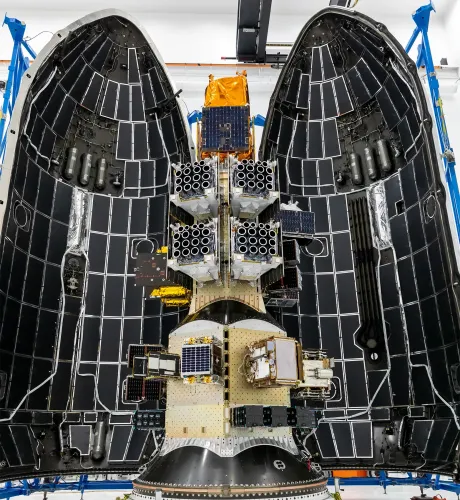
Bengaluru-based startup GalaxEye has successfully launched Mission Drishti, the world's first OptoSAR satellite — a 190-kilogram Earth observation platform that combines Electro-Optical (EO) and Synthetic Aperture Radar (SAR) sensors into a single unit, enabling all-weather, day-and-night surveillance. The Indian Space Association (ISpA) on 3 May 2025 called the launch a definitive proof-of-concept for India's private space sector reforms and a signal of the country's transition from small-scale testing to sovereign surveillance capabilities.
A Historic First for India's Private Space Sector
Mission Drishti is the largest satellite ever built by a private Indian company, marking a watershed moment for the domestic space ecosystem. Prior to this, Indian private players had largely confined themselves to smaller demonstration payloads. The satellite's 190 kg mass and its dual-sensor architecture place it in a category occupied by only a handful of global players.
The mission was developed by GalaxEye, a Bengaluru-based deep-tech startup, and its successful deployment underscores the growing maturity of India's new-space industry — one that has been steadily gaining momentum since the government opened the sector to private participation.
What Makes OptoSAR a Technological Breakthrough
Conventional optical satellites are rendered ineffective by cloud cover and low-light conditions, while radar-based satellites lack the visual resolution of optical systems. Mission Drishti's OptoSAR architecture resolves both limitations by seamlessly integrating the two sensor types on a single platform — a feat described as the first of its kind globally.
This enables persistent, all-weather intelligence — a capability that has direct applications in national security, border monitoring, and maritime domain awareness. The satellite is designed to deliver high-resolution imagery and consistent data streams even in challenging environmental conditions such as monsoon cloud cover or night-time scenarios.
What the Indian Space Association Said
Lt. Gen. AK Bhatt (Retd.), Director General of the Indian Space Association, said the milestone reflects a pivotal shift in India's approach to Earth observation and underlines the growing maturity of the private space ecosystem.
Point of View
Critics questioned whether Indian private players could move beyond small demonstration missions to deliver operationally relevant, sovereign capabilities. GalaxEye's OptoSAR architecture answers that directly. The deeper signal, however, is in the downstream economy: as Lt. Gen. Bhatt noted, value in the new space era will be defined by decision-grade data, not just hardware in orbit. India's ability to monetise that data layer — through defence contracts, agricultural analytics, and disaster response — will determine whether Mission Drishti becomes a template or a one-off.
NationPress
22 Sept 2026
Frequently Asked Questions
What is Mission Drishti?
Mission Drishti is India's largest privately built Earth observation satellite, developed by Bengaluru-based startup GalaxEye. It is the world's first OptoSAR satellite, combining Electro-Optical and Synthetic Aperture Radar sensors on a single 190-kilogram platform to enable all-weather, day-and-night imaging.
What makes the OptoSAR technology unique?
OptoSAR integrates optical and radar imaging capabilities on a single satellite, overcoming the individual limitations of each — optical sensors are blocked by cloud cover and darkness, while radar sensors lack optical resolution. Mission Drishti is the first satellite globally to achieve this integration.
What are the applications of Mission Drishti?
The satellite is designed as a dual-use platform supporting defence and national security, agriculture monitoring, disaster management, maritime surveillance, and infrastructure planning. Its all-weather imaging capability makes it particularly valuable for India's monsoon-affected geography.
What did the Indian Space Association say about Mission Drishti?
The Indian Space Association called the launch a definitive proof-of-concept for India's private space sector reforms. Director General Lt. Gen. AK Bhatt (Retd.) said it signals a transition from small-scale testing to sovereign, all-weather surveillance capabilities critical for national security and disaster response.
Who built Mission Drishti and where is GalaxEye based?
Mission Drishti was built by GalaxEye, a deep-tech space startup headquartered in Bengaluru, India. The company developed the satellite as its first commercial mission, and it is the largest satellite ever constructed by a private Indian firm.