India space startups: GalaxEye, Pixxel lead deep tech push in 2025
Synopsis
India's private space sector just crossed a symbolic threshold — GalaxEye launched the world's first OptoSAR satellite while Pixxel reportedly landed a US intelligence contract. Together, they signal that India's state–startup space partnership is no longer aspirational. With a $44 billion target by 2033 and IN-SPACe lowering entry barriers, the country's 2% global market share looks set to be contested seriously.
Key Takeaways
GalaxEye successfully launched the world's first OptoSAR satellite , combining optical and SAR imaging for all-weather earth observation.
Pixxel reportedly secured a contract linked to the US National Reconnaissance Office (NRO) , marking deep global integration of Indian space startups.
India's space market is currently valued at approximately $8.4 billion , representing about 2% of the global space economy.
The government has set a target of growing India's space economy to $44 billion by 2033 .
IN-SPACe was established to bridge ISRO and private companies, providing infrastructure, technical support, and regulatory access.
Policy reforms since 2020 have been central to enabling private participation in India's space sector.
India's space sector is undergoing a structural transformation, with private startups emerging as frontline players in deep technology innovation — a marked departure from the country's decades-long state-dominated model, according to a report by The Diplomat. The shift signals the rise of a state–startup developmental partnership that is reshaping how India competes in the global space economy.
GalaxEye's Historic OptoSAR Launch
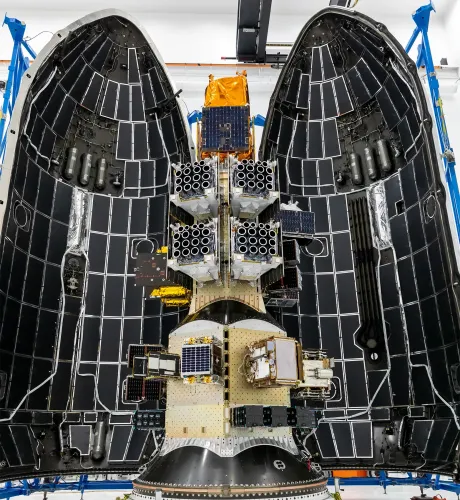
Bengaluru-based startup GalaxEye made headlines by successfully launching the world's first OptoSAR satellite — a milestone that has drawn wide attention as proof of the maturing capabilities of India's private space industry. The OptoSAR technology fuses optical imaging with synthetic aperture radar (SAR), enabling high-resolution earth observation even under dense cloud cover. This capability is particularly valuable for tropical regions, where persistent cloud interference has historically limited satellite imaging utility.
Pixxel Secures US Intelligence Contract
Pixxel, another Bengaluru-based deep tech firm, has gained global recognition for its hyperspectral imaging satellites, which serve applications across agriculture, climate monitoring, mining, defence, and environmental analysis. The company recently drew international attention after reportedly securing a contract linked to the US National Reconnaissance Office (NRO) — underscoring the extent to which Indian space startups are now embedded in strategic technology ecosystems at a global level. This is a significant signal that Indian private space firms are no longer peripheral vendors but trusted partners in sensitive intelligence infrastructure.
Policy Reforms That Unlocked Private Participation
For decades, the Indian Space Research Organisation (ISRO) functioned as the near-exclusive institution for satellite development, research, and launch operations. Private sector involvement was largely confined to manufacturing and ancillary support. That model began shifting after 2020, when a series of policy liberalisations opened the sector to private players in a more substantive way.
Central to this transition is the Indian National Space Promotion and Authorisation Centre (IN-SPACe), established as a regulatory and facilitation body to bridge the gap between ISRO and private companies. IN-SPACe provides access to government infrastructure, technical expertise, and regulatory guidance — lowering the barriers that had previously kept private capital out of high-stakes space missions.
India's Space Economy: From $8.4 Billion to $44 Billion
India currently accounts for approximately 2% of the global space market, valued at around $8.4 billion, according to the report. The global space economy is projected to exceed $1 trillion by the 2040s. Against that backdrop, the Indian government has set an ambitious target of growing its share to $44 billion by 2033 — a more than five-fold increase in under a decade.
Space technology is now viewed not only as a strategic domain but also as a critical enabler of national security, digital infrastructure, artificial intelligence development, and broader economic competitiveness. This framing has elevated the sector's priority within government policy circles considerably.
What Comes Next for India's Space Ecosystem
The emergence of firms like GalaxEye and Pixxel suggests that India's deep tech space ecosystem is moving beyond demonstration projects toward commercially and strategically viable products. With IN-SPACe continuing to streamline access and global contracts beginning to materialise, the trajectory points toward India capturing a meaningfully larger slice of the space economy — provided execution on the $44 billion target is backed by sustained policy consistency and funding depth.
Point of View
But the harder question is whether India's state–startup model can sustain momentum beyond early wins. IN-SPACe has reduced friction, but deep tech space ventures require patient capital and long procurement cycles — areas where India's private funding ecosystem still lags the US and China. The $44 billion target by 2033 implies a compounded growth rate that will demand more than policy liberalisation; it will require anchor domestic contracts, export pipelines, and a talent base that can scale. The NRO link for Pixxel is a proof point, not a pattern — yet.
NationPress
26 Oct 2026
Frequently Asked Questions
What is GalaxEye's OptoSAR satellite?
GalaxEye's OptoSAR satellite is the world's first to integrate optical imaging with synthetic aperture radar (SAR), enabling high-resolution earth observation regardless of cloud cover or weather conditions. This makes it especially relevant for tropical regions where cloud interference limits conventional satellite imaging.
What contract did Pixxel secure with the US NRO?
Bengaluru-based Pixxel reportedly secured a contract linked to the US National Reconnaissance Office (NRO), according to a report by The Diplomat. The contract signals that Indian private space startups are now participants in strategic global intelligence infrastructure, not just commercial markets.
What is India's target for its space economy by 2033?
The Indian government has set a target of growing the country's space economy to $44 billion by 2033, up from its current valuation of approximately $8.4 billion. This would represent a more than five-fold increase and raise India's share of the global space market well above its current 2%.
What role does IN-SPACe play in India's space sector?
The Indian National Space Promotion and Authorisation Centre (IN-SPACe) acts as a bridge between ISRO and private companies, providing access to government infrastructure, technical support, and regulatory guidance. It was established as part of post-2020 policy reforms to lower barriers for private participation in India's space ecosystem.
How has India's space policy changed since 2020?
Policy liberalisations introduced after 2020 opened India's space sector to meaningful private participation beyond manufacturing and support roles. The creation of IN-SPACe and broader regulatory reforms have enabled startups like GalaxEye and Pixxel to develop and launch independent satellite missions and compete for international contracts.