Giriraj Singh Hails C-295 Rollout as Defence Milestone
Synopsis
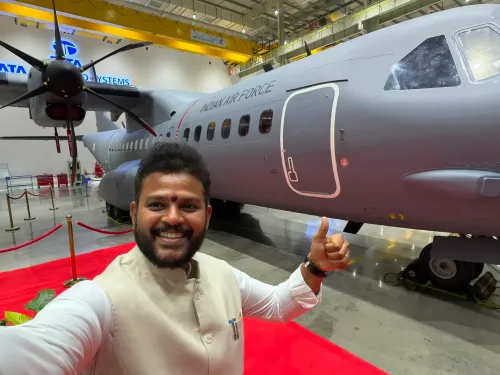
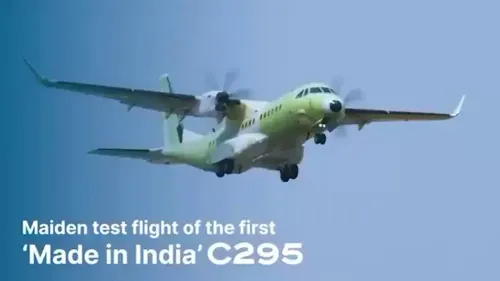
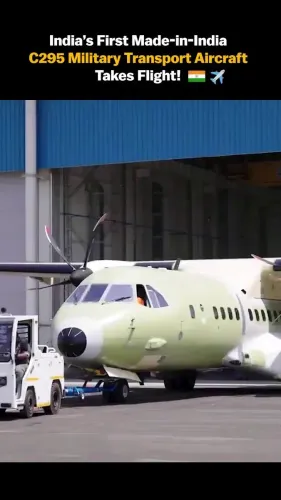
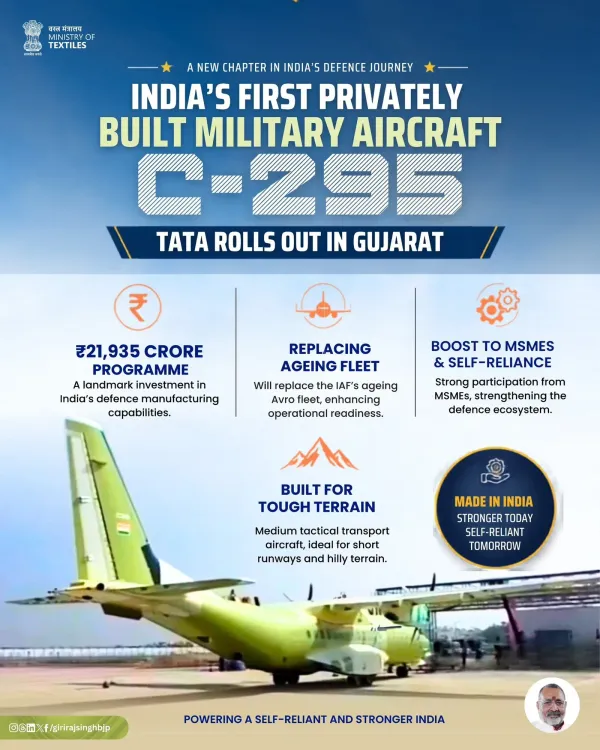
Union Textiles Minister Giriraj Singh hailed the rollout of India's first privately manufactured military transport aircraft, the C-295, in Gujarat as a landmark moment for Atmanirbhar Bharat and Make in India, citing a ₹21,935 crore project that will modernise the Indian Air Force fleet and strengthen MSMEs.
Key Takeaways
Union Textiles Minister Giriraj Singh posted on June 2, 2026 , calling the C-295 rollout a historic milestone in India's defence manufacturing.
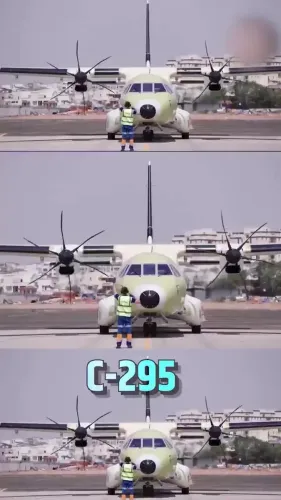
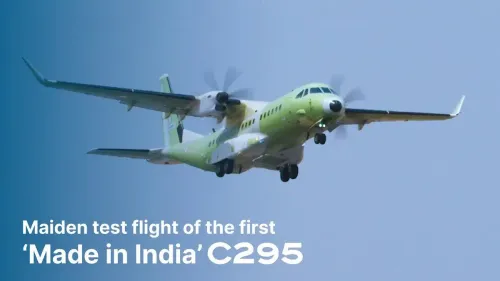
The C-295 is described as India's first privately manufactured military transport aircraft, produced at a facility in Gujarat .
The project is valued at ₹21,935 crore and covers the procurement and domestic production of 56 aircraft for the Indian Air Force .
The contract for the programme was signed in 2021 , establishing a public-private partnership framework with technology transfer provisions.
MSMEs are identified as key downstream beneficiaries through their role in the aircraft's component supply chain.
The rollout is positioned as a convergence of the Make in India (2014) and Atmanirbhar Bharat (2020) policy frameworks.
Union Textiles Minister Giriraj Singh on Tuesday, June 2, 2026, took to X to describe the rollout of India's first privately manufactured military transport aircraft, the C-295, in Gujarat as a historic milestone in the country's defence manufacturing journey, citing the project's scale and its alignment with the Atmanirbhar Bharat (self-reliant India) vision.
In his post, Singh wrote: 'Gujarat mein desh ke pehle niji taur par nirmit sainya viman C-295 ka roll-out Bharat ki raksha vinirman kshamata ka ek mil ka patthar hai' — 'The rollout of the C-295, the country's first privately manufactured military aircraft in Gujarat, is a milestone in India's defence manufacturing capability.' He credited the achievement to the leadership of Prime Minister Narendra Modi and the resolve of the Atmanirbhar Bharat mission.
Context
The C-295 programme represents a significant departure from India's historically import-heavy approach to military aviation. The aircraft, a medium tactical transport, is being produced at a facility in Gujarat under a public-private partnership — a model that marks the first time a private Indian entity has manufactured a complete military aircraft domestically. Singh described the development as 'writing history' in the defence sector.
The minister also highlighted the project's financial scale, noting it as a ₹21,935 crore undertaking. He stated it would not only modernise the Indian Air Force's fleet but also strengthen MSMEs and take the Make in India initiative to 'new heights.'
Policy Backdrop
The contract for the procurement and domestic production of 56 C-295 aircraft was signed in 2021, establishing a framework for in-country manufacturing under a public-private partnership. The agreement was structured to ensure technology transfer and progressive indigenisation of components, with a significant role envisaged for the MSME ecosystem in the supply chain.
The Make in India initiative, launched in 2014, had set the stage for private sector entry into defence manufacturing — a domain previously dominated by public sector undertakings. The Atmanirbhar Bharat campaign, announced in 2020, sharpened this focus by emphasising strategic self-reliance, particularly in sectors such as aerospace and defence where import dependence had long been a vulnerability.
Stakeholders and Impact
The Indian Air Force stands as the primary beneficiary, with the C-295 intended to replace ageing transport aircraft in its inventory and enhance tactical airlift capability. The induction of domestically produced aircraft is expected to reduce procurement lead times and lifecycle costs over the long term.
Beyond the Air Force, the programme has drawn attention for its downstream industrial impact. MSMEs across the aerospace supply chain — producing components ranging from structural assemblies to avionics sub-systems — are positioned to benefit from sustained orders tied to the multi-aircraft production run. Singh's post specifically underlined this linkage, framing MSME strengthening as integral to the project's national significance.
What's Next
The rollout marks the transition from assembly setup to actual aircraft production, but the programme's broader success will be measured against delivery timelines and the pace of Indian Air Force squadron induction. Observers will watch whether subsequent aircraft roll off the production line on schedule and whether the indigenisation targets embedded in the contract are met across successive units.
The C-295 programme is also being watched as a template for future private-sector defence manufacturing proposals. If the production model proves replicable, it could accelerate the clearance of additional aerospace and defence projects under updated procurement procedures, deepening India's industrial base in a sector long considered strategically critical.
Point of View
Signalling a whole-of-government communication effort around a high-profile manufacturing milestone. The framing — linking the C-295 rollout to MSME strengthening — is deliberate: it bridges the defence narrative with the broader industrial policy constituency that the BJP has cultivated since 2014. The C-295 programme is one of the most visible test cases for India's private-sector defence manufacturing ambitions, and the rollout gives the government a concrete deliverable to cite ahead of any electoral or policy cycle. Whether the programme sustains its momentum through the full 56-aircraft production run will determine whether it becomes a replicable model or a one-off showcase.
NationPress
16 Oct 2026
Frequently Asked Questions
What is the C-295 aircraft and why is its rollout significant for India?
The C-295 is a medium tactical military transport aircraft. Its rollout in Gujarat is significant because it is the first military aircraft to be privately manufactured in India, marking a shift from import dependence to domestic production under the Atmanirbhar Bharat and Make in India frameworks.
How much does the C-295 project cost and how many aircraft are involved?
The project is valued at ₹21,935 crore and covers the procurement and domestic production of 56 C-295 aircraft for the Indian Air Force under a public-private partnership contract signed in 2021.
Where is the C-295 aircraft being manufactured in India?
The C-295 aircraft is being manufactured at a facility in Gujarat, making it the first privately operated military aircraft production plant in the country.
How does the C-295 programme benefit Indian MSMEs?
MSMEs participate in the C-295 supply chain by producing structural components, sub-assemblies, and other parts for the aircraft. The sustained multi-aircraft production run is expected to generate long-term orders for small and medium enterprises in the aerospace sector.
What is the Atmanirbhar Bharat initiative and how does it relate to defence manufacturing?
Atmanirbhar Bharat, launched in 2020, is a government campaign promoting self-reliance in strategic sectors. In defence, it has accelerated private sector entry into manufacturing, of which the C-295 programme is a leading example, reducing India's dependence on foreign military equipment imports.