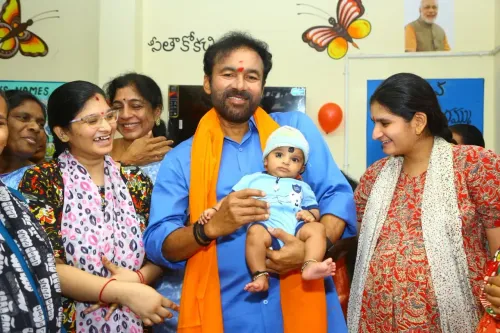
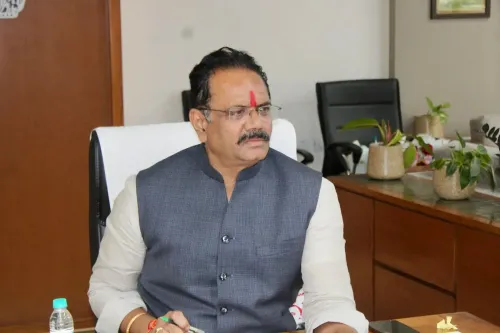
Giriraj Singh hails state-led nutrition drives, POSHAN Tracker
Synopsis
Union Textiles Minister Giriraj Singh highlighted India's grassroots anti-malnutrition efforts — including state-level moringa, millet and kitchen-garden drives — on Mann Ki Baat day, calling POSHAN Tracker-linked Anganwadi services the backbone of a growing national nutrition movement.
Key Takeaways
Union Textiles Minister Giriraj Singh posted on 27 September 2026 , coinciding with Mann Ki Baat , praising community-led nutrition initiatives across Indian states.
He highlighted three state-level models: Chhattisgarh's moringa campaign , Gujarat's millet-based dishes , and Mizoram's nutrition kitchen gardens (poshan vatikas).
Singh identified the POSHAN Tracker — a digital platform digitising Anganwadi records and enabling real-time monitoring — as strengthening these community efforts.
POSHAN Abhiyan , launched in March 2018 , forms the national policy backbone, encouraging states to use locally trusted foods to achieve nutrition targets.
The post used the hashtag #कुपोषण_मुक्त_भारत (Malnutrition-Free India), framing the initiative as a people's movement rather than a top-down government programme.
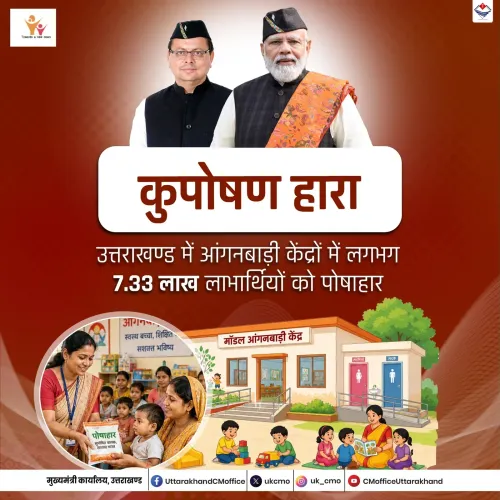
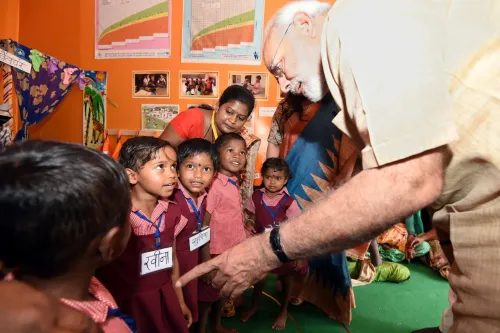
Anganwadi centres under Integrated Child Development Services provide supplementary nutrition, health check-ups and preschool education as the frontline delivery layer.
From moringa campaigns in Chhattisgarh to millet kitchens in Gujarat and nutrition gardens in Mizoram, India's fight against malnutrition is increasingly being waged with local ingredients and local energy — and Union Textiles Minister Giriraj Singh marked Poshan Maah 2026 on Sunday, 27 September by spotlighting these grassroots efforts, urging citizens to see nutrition as a mass movement rather than a government programme.
Posting in Hindi on the occasion of Mann Ki Baat — Prime Minister Narendra Modi's monthly radio address that regularly showcases citizen-led initiatives — Singh wrote: 'कुपोषण के खिलाफ देशभर में जनभागीदारी से नए प्रयास हो रहे हैं' ('New efforts are being made across the country through public participation against malnutrition'). He invoked the hashtag #कुपोषण_मुक्त_भारत — 'Malnutrition-Free India' — framing community action as the path to that goal.
POSHAN Tracker and the Anganwadi backbone
At the structural centre of the effort is the POSHAN Tracker, the digital platform rolled out nationally from 2021 to digitise Anganwadi records and enable real-time monitoring of nutrition service delivery. Singh specifically cited it as the force multiplying community-level work. Anganwadi centres — the frontline units of the Integrated Child Development Services — provide supplementary nutrition, health check-ups and preschool education to children, pregnant women and lactating mothers. Linking them to a live digital dashboard shifts the mission from periodic reporting to continuous accountability.
The broader scaffolding dates to March 2018, when the POSHAN Abhiyan (National Nutrition Mission) was launched to reduce stunting, undernutrition and anaemia through inter-ministerial convergence across health, women and child development, and rural development. The mission's explicit design philosophy — encouraging states to adapt national goals using local foods and traditions — is precisely what Singh's post celebrates eight years on.
Why local foods are becoming policy instruments
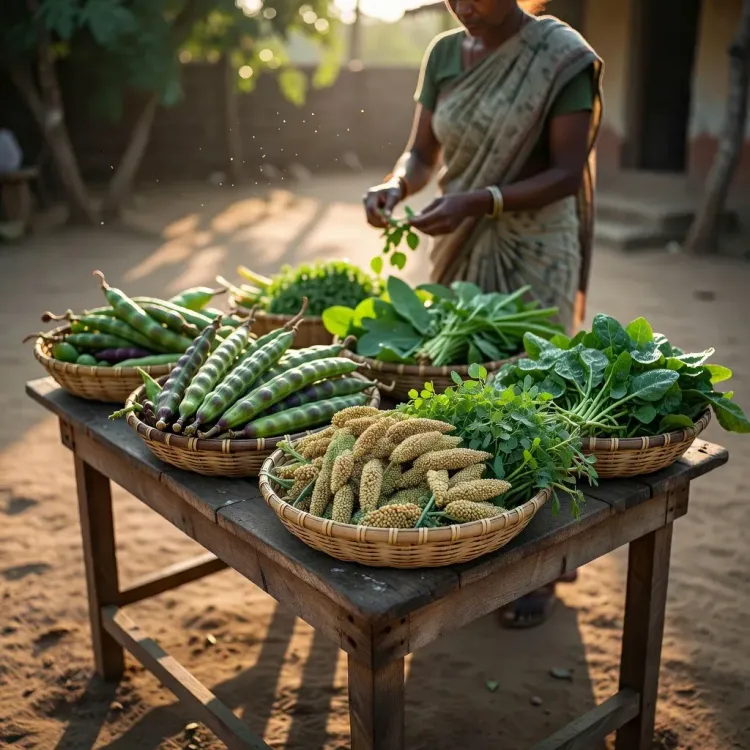
The state-level examples Singh highlights follow a deliberate logic: rather than imposing a uniform supplement, POSHAN Abhiyan incentivises states to embed nutrition into foods and practices communities already trust. Millets, a climate-resilient staple promoted nationally after India's 2023 International Year of Millets push, are nutritionally dense and culturally familiar in Gujarat. Kitchen gardens — 'poshan vatikas' — turn household spaces into micro-nutrient sources without supply-chain dependence. The Chhattisgarh moringa drive leverages a locally abundant, protein-rich crop.
The watchword across all three approaches is ownership: when the food is familiar and the garden is yours, sustained behaviour change becomes possible in a way that top-down distribution rarely achieves.
Mann Ki Baat as amplifier for nutrition messaging
Singh's post is timed to Mann Ki Baat, which since its launch in 2014 has served as a broadcast amplifier for exactly this category of story — verified, scalable citizen-led models that the Centre wants replicated. For a minister sharing the platform's hashtag, the signal is clear: these state innovations are being marked for national visibility, and potentially for policy scale-up.
With quarterly POSHAN Tracker coverage reports and upcoming parliamentary sessions on nutrition metrics on the horizon, the real test will be whether this community-mobilisation energy shows up in the numbers — in stunting rates, in Anganwadi attendance, in anaemia prevalence. The movement has momentum. The data will tell whether it has mass.
Point of View
Shifting accountability toward community agency and away from departmental metrics. The timing also signals that the Centre wants to showcase POSHAN Abhiyan's decentralised model as a replicable success story ahead of likely parliamentary scrutiny of nutrition data. Whether the grassroots energy translates into measurable improvements in stunting and anaemia rates will determine how durable this political narrative proves.
NationPress
27 Sept 2026
Frequently Asked Questions
What is POSHAN Abhiyan and when was it launched?
POSHAN Abhiyan, or the National Nutrition Mission, was launched in March 2018 to reduce stunting, undernutrition and anaemia in children, pregnant women and lactating mothers through convergence across multiple central ministries.
What is POSHAN Tracker?
POSHAN Tracker is a digital monitoring platform rolled out nationally from 2021 to digitise Anganwadi records and provide real-time tracking of nutrition service delivery under the Ministry of Women and Child Development.
What did Giriraj Singh say about malnutrition on Mann Ki Baat day?
Giriraj Singh posted that community-led efforts — including Chhattisgarh's moringa campaign, Gujarat's millet dishes and Mizoram's nutrition kitchen gardens — have turned nutrition into a mass movement, with POSHAN Tracker-linked Anganwadi services strengthening the drive.
What is Mann Ki Baat and why is it significant for government schemes?
Mann Ki Baat is Prime Minister Narendra Modi's monthly radio address, running since 2014, that highlights citizen-led and government initiatives; it serves as a national amplifier for scalable community models the Centre wants promoted.
How do Anganwadi centres fight malnutrition in India?
Anganwadi centres, the frontline units of the Integrated Child Development Services, provide supplementary nutrition, health check-ups and preschool education to children under six, pregnant women and lactating mothers across the country.