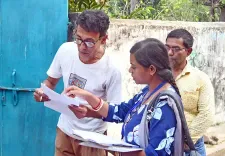
Giriraj Singh Salutes Kalamkari Artist P. Vijay Lakshmi
Synopsis
Union Textiles Minister Giriraj Singh has saluted Kalamkari artisan P. Vijay Lakshmi, winner of the National Award 2023, for 28 years of preserving the Sri Kalahasti tradition and training over 60 students in Ramayana-themed cloth painting.
Key Takeaways
Vijay Lakshmi received the National Award 2023 from the Ministry of Textiles for Kalamkari work in the Sri Kalahasti style .
She has practised and promoted Kalamkari for more than 28 years .
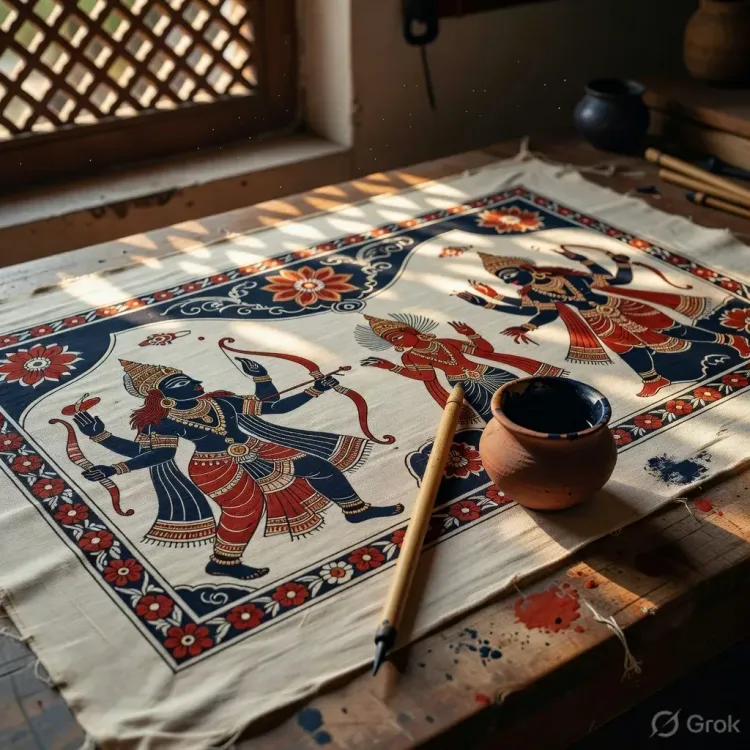
Her signature work depicts the Ramayana — The Journey of Lord Ram in traditional hand-drawn cloth painting.
She has trained over 60 students , sustaining the guru-shishya chain of craft transmission.
The tribute aligns with the Ministry of Textiles' Vocal for Local and National Awards framework for master crafts persons.
Sri Kalahasti in Andhra Pradesh is one of India's two principal Kalamkari centres, known for freehand mythological paintings using natural dyes.
Twenty-eight years of devotion to a centuries-old art form — and now a national stage to match. Union Textiles Minister Giriraj Singh on Friday, 21 August 2026, paid tribute to P. Vijay Lakshmi, a Kalamkari artisan from the Sri Kalahasti tradition who received the 'National Award 2023' from the Ministry of Textiles for her sustained contribution to India's handicraft heritage.
In his post, the Minister wrote: 'Rashtriya Puraskar 2023 se sammanit shilpi P. Vijay Lakshmi ji' — honoured artisan P. Vijay Lakshmi — has, through more than 28 years of dedicated effort, carried the rich mythological and cultural legacy of Kalamkari art to the next generation. He highlighted her work titled 'Ramayana — Bhagwan Ram Ki Yatra' (Ramayana — The Journey of Lord Ram), rendered in the Sri Kalahasti style, and noted that she has trained over 60 students in the craft.
Sri Kalahasti's living tradition and what makes it distinct
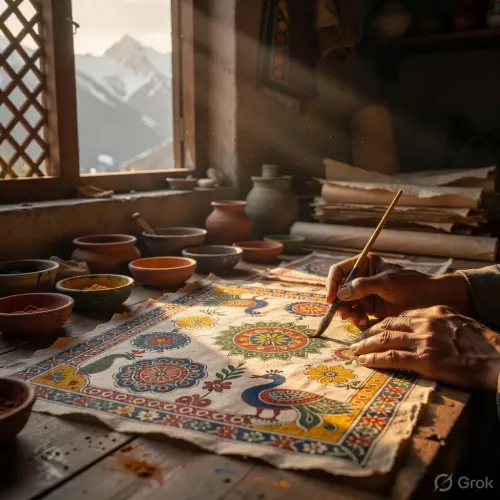
Sri Kalahasti, a town in Andhra Pradesh, is one of two principal centres of Kalamkari — the other being Machilipatnam. The Sri Kalahasti style is distinguished by its freehand drawing technique using a bamboo pen dipped in natural fermented dyes, with mythological narratives — from the Ramayana and Mahabharata — forming the dominant subject matter. Unlike its block-printed counterpart, every Sri Kalahasti piece is essentially a hand-drawn painting on cloth, making each work singular.
Vijay Lakshmi's choice of the Ramayana as her primary canvas places her squarely within this tradition's most celebrated lineage. Her body of work is not merely decorative — it is an act of cultural transmission, encoding sacred stories in a visual grammar that has survived for centuries.
National Awards and the Ministry's push to preserve craft lineages
The Ministry of Textiles has long institutionalised the National Awards for Master Crafts Persons as its most prestigious recognition for artisans who demonstrate exceptional skill and commitment to keeping traditional techniques alive. The awards carry both a cash component and, crucially, a platform — the kind of visibility that can attract younger practitioners and buyers to a craft that might otherwise fade quietly.
Vijay Lakshmi's recognition sits within a broader ministerial pattern: the Vocal for Local campaign, championed aggressively since 2020, has made the celebration of indigenous craft a consistent part of the government's public communication. The Ministry has paired that messaging with economic schemes for handlooms and handicrafts clusters, though the real multiplier, officials argue, is the guru-shishya chain — master artisans passing skills directly to students. Vijay Lakshmi's 60-plus trained students are precisely that chain in action.
Minister Singh closed his post with the hashtags #VocalForLocal, #SupportArtisans, #Handicrafts, #Kalamkari, and #IndianCrafts — signalling that the tribute is also a nudge to consumers to seek out and buy authentic handcrafted work.
For a craft that lives and dies by the hands that practice it, a national award and a ministerial spotlight may be the most practical form of preservation there is.
Point of View
Which seeks to link artisan welfare with national pride and consumer behaviour. The emphasis on student training underscores a policy shift from passive preservation to active skill transmission as the metric of a craft's survival. For the Ministry of Textiles, spotlighting individual award winners doubles as low-cost, high-credibility outreach to both domestic buyers and export markets seeking authentic Indian handcraft. The Sri Kalahasti Kalamkari tradition's Ramayana themes also carry an unmistakable civilisational resonance that fits the broader cultural politics of the current administration.
NationPress
5 Oct 2026
Frequently Asked Questions
Who is P. Vijay Lakshmi and why is she in the news?
P. Vijay Lakshmi is a Kalamkari artisan from the Sri Kalahasti tradition in Andhra Pradesh who received the National Award 2023 from India's Ministry of Textiles. She is in the news after Union Textiles Minister Giriraj Singh publicly praised her 28-year contribution to the craft and her training of over 60 students.
What is Sri Kalahasti Kalamkari?
Sri Kalahasti Kalamkari is a centuries-old hand-drawn painting tradition from Sri Kalahasti town in Andhra Pradesh. Artisans use a bamboo pen dipped in natural fermented dyes to draw mythological scenes — especially from the Ramayana and Mahabharata — directly onto cloth, making each piece unique.
What is the National Award for Master Crafts Persons?
The National Award for Master Crafts Persons is the Ministry of Textiles' highest recognition for artisans who demonstrate exceptional skill and long-term commitment to preserving traditional Indian handicraft techniques. It includes a cash prize and provides national visibility to the awardee and their craft.
What is the Vocal for Local initiative?
Vocal for Local is a campaign promoted by the Indian government since 2020 that encourages citizens to buy and promote indigenous Indian products, including handloom and handicraft items. The Ministry of Textiles has used it to spotlight artisans and traditional crafts as both cultural assets and economic opportunities.
How many students has P. Vijay Lakshmi trained in Kalamkari?
According to Union Textiles Minister Giriraj Singh's post, P. Vijay Lakshmi has trained more than 60 students in Kalamkari, specifically in the Sri Kalahasti style, over the course of her 28-year career.