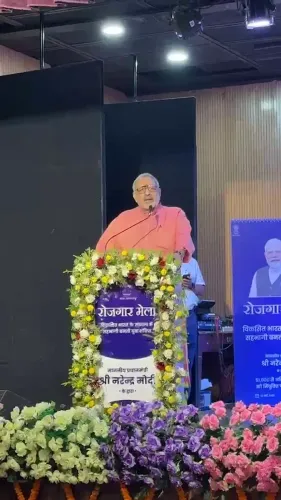
Giriraj Singh Flags 17% Rise in Bank Credit to Industry
Synopsis
Union Textiles Minister Giriraj Singh has highlighted a 17 per cent rise in bank credit to industries as a marker of accelerating manufacturing and infrastructure activity, attributing the trend to PM Modi's industry-friendly policies and the Viksit Bharat 2047 vision.
Key Takeaways
Union Textiles Minister Giriraj Singh posted on 7 July 2026 citing a 17 per cent rise in bank credit to industries.
He attributed the growth to infrastructure development, energy-sector expansion and industry-friendly policies under PM Narendra Modi .
The post is framed within the Viksit Bharat 2047 vision of making India a developed nation by the centenary of independence.
The Make in India programme (launched September 2014 ) and the PM Gati Shakti National Master Plan (2021) form the policy backbone behind the credit trend.
Quarterly RBI credit-deployment statistics and upcoming Union Budget infrastructure outlays will be key indicators of whether this lending momentum is sustained.
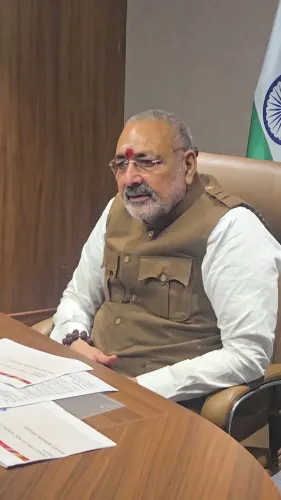
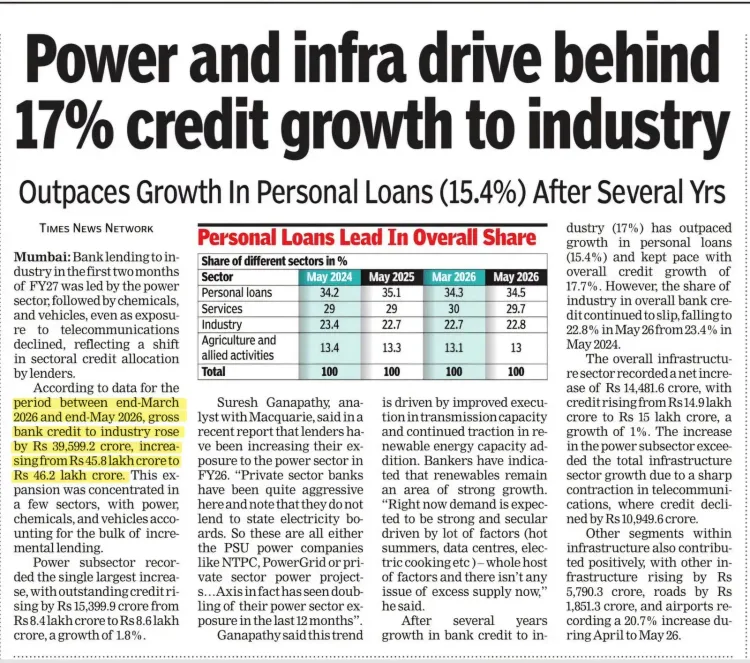
Union Textiles Minister Giriraj Singh on Tuesday, 7 July 2026, cited a 17 per cent rise in bank credit to industries as evidence that India's manufacturing and infrastructure sectors are gaining fresh momentum under the leadership of Prime Minister Narendra Modi.
Context
Posting on X, the senior BJP leader wrote in Hindi: 'उद्योगों को बैंक ऋण में 17% की वृद्धि' ('a 17 per cent growth in bank credit to industries'), calling it a signal that 'production, investment and industrial activity are receiving new strength.' He linked the trend to infrastructure development, energy-sector expansion and industry-friendly policies pursued by the Modi government.
The post was accompanied by an image and tagged with the hashtags #ViksitBharat2047, #Infrastructure, #Industry and #NewIndia, situating the credit data within the government's long-term economic narrative.
Policy Backdrop
The Viksit Bharat 2047 vision — India's official roadmap to achieve developed-nation status by the centenary of independence — has been the overarching framework under which successive Union Budgets have linked infrastructure spending with credit facilitation and regulatory easing. The Make in India programme, launched in September 2014, sought to raise manufacturing's share in GDP and attract domestic and foreign investment into productive sectors.
The PM Gati Shakti National Master Plan, unveiled in 2021, further coordinated multimodal infrastructure projects across ministries, aiming to reduce logistics costs and accelerate industrial output. Government spokespersons have repeatedly used bank lending data as a proxy indicator of reviving capital expenditure cycles, particularly after the 2020 economic slowdown.
Stakeholders and Impact
A sustained uptick in credit to the industrial sector would benefit manufacturers, infrastructure contractors and energy companies that depend on affordable bank financing to fund expansion and working capital. For the broader economy, higher industrial credit typically signals rising private investment, which feeds into job creation and output growth.
Bank borrowers in the micro, small and medium enterprise (MSME) segment — a constituency the Textiles Ministry directly oversees through schemes supporting handloom, powerloom and garment clusters — stand to gain if the lending momentum extends to smaller units alongside large industry.
What's Next
Quarterly credit-deployment data from the Reserve Bank of India (RBI) will be the key metric to watch in coming months, as analysts and policymakers assess whether the reported 17 per cent lending growth is sustained or accelerates further. The next Union Budget's infrastructure outlay and any revisions to the Production-Linked Incentive (PLI) scheme allocations will also indicate the government's commitment to maintaining this trajectory.
If the industrial credit trend holds, it would strengthen the government's case that its infrastructure-first, ease-of-doing-business approach is translating into measurable private-sector confidence — a claim that will carry weight in the political and economic discourse leading up to 2047.
Point of View
Using a macroeconomic data point — industrial bank credit growth — to reinforce the BJP's core governance narrative ahead of what remains a contested economic debate. By anchoring the figure in the Viksit Bharat 2047 framework, the minister connects a single lending metric to a decade-long policy arc, making it harder for critics to dispute without engaging the entire infrastructure-investment thesis. The choice of a Textiles Minister to amplify broad industrial credit data also reflects a coordinated BJP communications strategy where cabinet members amplify economy-wide positives regardless of their specific portfolio. Whether the 17 per cent figure reflects durable capex revival or a cyclical credit uptick will ultimately be adjudicated by sustained RBI data — not political posts.
NationPress
5 Oct 2026
Frequently Asked Questions
What is the 17% bank credit growth to industries that Giriraj Singh mentioned?
Union Textiles Minister Giriraj Singh cited a 17 per cent year-on-year rise in bank credit extended to industrial borrowers as evidence of strengthening manufacturing and investment activity in India. The figure was highlighted in his post on 7 July 2026 as a marker of economic momentum under the Modi government.
What is Viksit Bharat 2047?
Viksit Bharat 2047 is India's official vision to become a developed nation by 2047, the centenary of independence. It serves as the overarching framework for government policies on infrastructure, manufacturing, energy and economic growth.
What is the PM Gati Shakti National Master Plan?
The PM Gati Shakti National Master Plan, unveiled in 2021, is a multimodal infrastructure coordination initiative that aligns projects across central ministries and state governments to reduce logistics costs and accelerate industrial output.
How does bank credit growth relate to India's industrial output?
Higher bank credit to industry typically signals rising capital expenditure by manufacturers and infrastructure firms, which feeds into increased production, employment and GDP growth. The government has used lending data as a proxy for reviving private investment, especially after the 2020 economic slowdown.
What is Giriraj Singh's role in the Indian government?
Giriraj Singh is the Union Minister of Textiles in the Indian government and a senior BJP leader. He is a Lok Sabha Member of Parliament from the Begusarai constituency in Bihar.