Giriraj Singh flags Rs 650 cr ECLGS 5.0 loan applications
Synopsis
Union Textiles Minister Giriraj Singh shared data on 29 May 2026 showing MSME clients have applied for loans worth over ₹650 crore under ECLGS 5.0, the latest tranche of the government's flagship collateral-free credit guarantee scheme launched in 2020 to support small businesses.
Key Takeaways
MSME clients have applied for loans worth over ₹650 crore under ECLGS 5.0 , according to data shared by Union Textiles Minister Giriraj Singh on 29 May 2026 .
The Emergency Credit Line Guarantee Scheme was first launched in May 2020 under the Atmanirbhar Bharat package with an initial ₹3 lakh crore outlay and a 100% government guarantee.
The scheme has been expanded through four previous tranches, raising the overall cap to ₹5 lakh crore and widening coverage to more sectors and borrower categories.
Textile MSMEs, which are heavily dependent on working capital, are among the key beneficiaries of the government-backed credit guarantee mechanism.
Disbursement data from SIDBI and banks will determine how much of the ₹650 crore in applications converts into actual loan sanctions.
Union Textiles Minister Giriraj Singh on Friday, 29 May 2026, shared data indicating that MSME clients have applied for loans worth over ₹650 crore under the latest tranche of the Emergency Credit Line Guarantee Scheme (ECLGS 5.0), highlighting continued demand for government-backed credit among small businesses.
Context
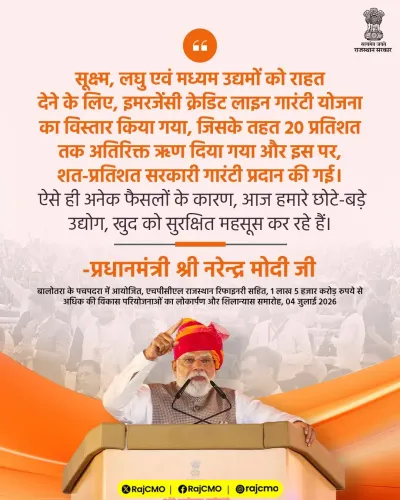
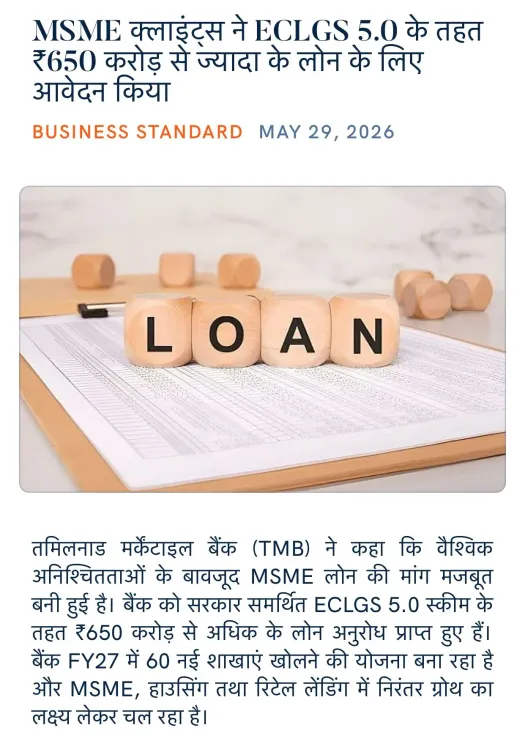
The minister's post, shared via the NaMo App, flagged the headline figure — 'MSME क्लाइंट्स ने ECLGS 5.0 के तहत ₹650 करोड़ से ज्यादा के लोन के लिए आवेदन किया' ('MSME clients have applied for loans worth over Rs 650 crore under ECLGS 5.0') — drawing attention to the scheme's uptake. The post comes as the government continues to monitor credit flow to Micro, Small and Medium Enterprises (MSMEs), which are central to India's manufacturing and employment landscape.
As Union Minister of Textiles, Giriraj Singh oversees a sector heavily populated by MSMEs, where working-capital access remains a persistent challenge. His amplification of this data signals the government's emphasis on credit-backed revival for labour-intensive industries.
Policy Backdrop
The Emergency Credit Line Guarantee Scheme was first launched in May 2020 as a flagship component of the Atmanirbhar Bharat economic stimulus package, with an initial outlay of ₹3 lakh crore and a 100% government guarantee on collateral-free loans to pandemic-hit MSMEs. The scheme was progressively expanded through successive versions — ECLGS 2.0, 3.0, and 4.0 — between 2021 and 2023, raising the overall guarantee cap to ₹5 lakh crore and widening sectoral coverage.
Each iteration was designed to address specific gaps: broadening eligibility, raising per-borrower limits, and extending the scheme's reach to stressed accounts in manufacturing, hospitality, and other sectors. ECLGS 5.0 represents the latest extension of this credit guarantee architecture, continuing to channel liquidity through banks and non-banking financial companies (NBFCs) to small enterprises.
Stakeholders and Impact
MSMEs contribute significantly to India's manufacturing output, exports, and employment — particularly in the textiles sector, where millions of workers depend on small and mid-sized units for livelihoods. Access to collateral-free, government-guaranteed credit has been a critical lifeline for these enterprises, many of which lack the balance-sheet strength to secure conventional loans.
The ₹650 crore application figure, if disbursed, would represent fresh liquidity injected into businesses that form the backbone of supply chains in garments, handlooms, and allied industries. Textile MSMEs, which depend heavily on working capital for raw material procurement and wage payments, stand to benefit directly from the scheme's latest tranche.
What's Next
Analysts and industry bodies will watch for disbursement data from SIDBI and scheduled commercial banks to assess how much of the ₹650 crore in applications translates into actual loan sanctions. Non-performing asset (NPA) trends under earlier ECLGS tranches will also be a key metric for policymakers evaluating the scheme's health.
Any announcement in the forthcoming Union Budget or through MSME Ministry notifications regarding a further extension or successor scheme will be closely tracked by small-business federations and financial institutions. The sustained demand visible in ECLGS 5.0 applications suggests that credit constraints among MSMEs have not fully eased despite years of government intervention.
Point of View
Measurable instrument of MSME support — particularly in election-sensitive, labour-intensive sectors like textiles. The ₹650 crore figure, while modest relative to the scheme's overall cap, signals continued grassroots demand for government-backed liquidity even six years after ECLGS's launch. This pattern of successive scheme extensions reflects both the scheme's political utility and the structural credit gaps that formal banking channels have yet to fully bridge for small enterprises. The data point also positions the Textiles Ministry as an active stakeholder in MSME finance policy, beyond its conventional mandate of sector regulation and export promotion.
NationPress
14 Oct 2026
Frequently Asked Questions
What is ECLGS 5.0 and who is eligible?
ECLGS 5.0 is the fifth iteration of the Emergency Credit Line Guarantee Scheme, which provides collateral-free, government-guaranteed loans to MSME borrowers through banks and NBFCs. Eligibility criteria are set by the Finance Ministry and typically cover existing MSME borrowers with stressed or standard accounts.
How much has been applied for under ECLGS 5.0?
According to data shared by Union Textiles Minister Giriraj Singh on 29 May 2026, MSME clients have applied for loans worth over ₹650 crore under ECLGS 5.0.
What was the original ECLGS scheme about?
The original ECLGS was launched in May 2020 as part of the Atmanirbhar Bharat stimulus to provide collateral-free additional credit to MSMEs hit by COVID-19 disruptions, with an initial government guarantee of ₹3 lakh crore.
Why is the Textiles Minister talking about an MSME credit scheme?
The textiles sector is dominated by MSMEs and is highly dependent on working-capital credit. As Union Textiles Minister, Giriraj Singh oversees policy for an industry where ECLGS-type schemes have a direct bearing on enterprise survival and employment.
What happens after an MSME applies under ECLGS 5.0?
After application, banks and NBFCs review the loan request and, upon sanction, the credit is backed by a government guarantee. Disbursement data is tracked by institutions such as SIDBI and reported periodically to assess scheme utilisation and NPA trends.