Giriraj Singh: 5F Vision drives textile jobs, global reach
Synopsis
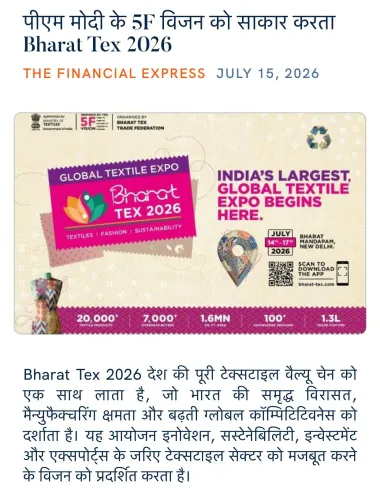
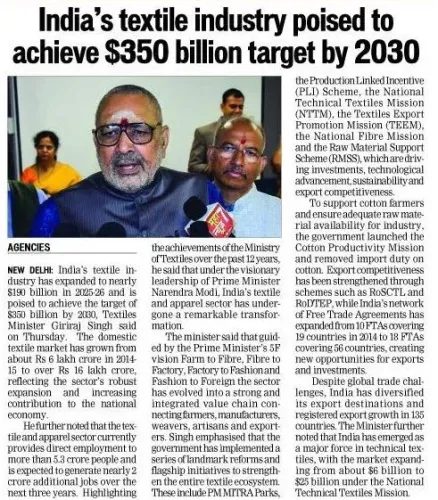
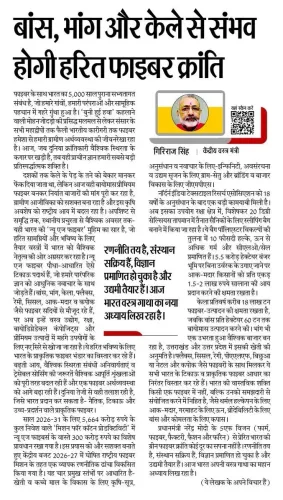
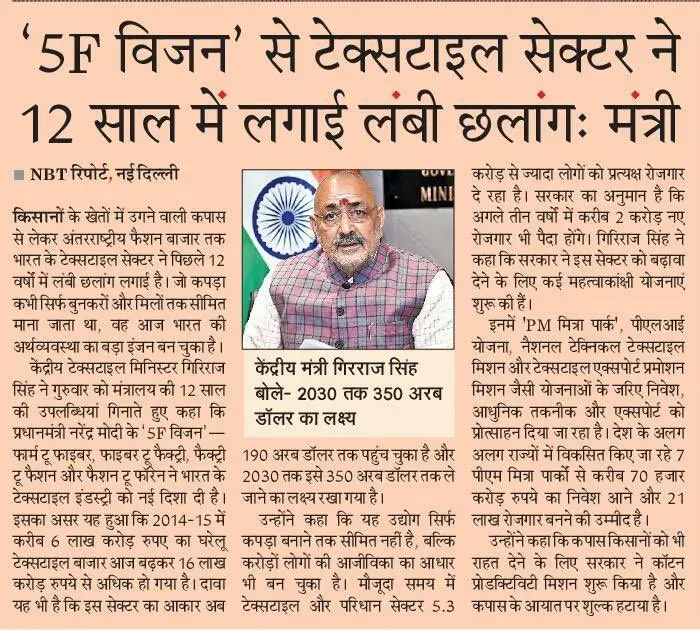
Union Textiles Minister Giriraj Singh has highlighted PM Modi's 5F Vision — Farm to Fiber, Fiber to Factory, Factory to Fashion, Fashion to Foreign — as the backbone of India's textile growth, citing 5.3 crore direct jobs and a target of 2 crore new jobs over three years.
Key Takeaways
Union Textiles Minister Giriraj Singh credited PM Narendra Modi 's 5F Vision as the primary driver of India's textile sector development.
The 5F framework links Farm to Fiber, Fiber to Factory, Factory to Fashion, and Fashion to Foreign , creating an end-to-end domestic value chain.
The textile sector currently provides direct employment to 5.3 crore people , according to the minister's statement.
The government projects 2 crore new jobs to be created in the sector over the next three years .
The PLI scheme for man-made fibres (2021) and seven PM MITRA textile parks (2021-22) are the key policy instruments supporting the 5F vision.
India aims to raise its share in global textile and apparel exports, competing with Bangladesh, Vietnam, and China .
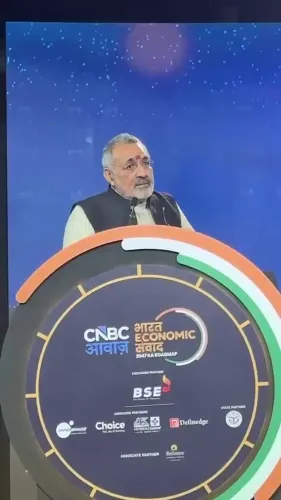
Union Textiles Minister Giriraj Singh on Friday, June 12, 2026, highlighted Prime Minister Narendra Modi's 5F Vision as the central pillar of India's textile sector growth, stating that the framework is directly employing 5.3 crore people and is on course to generate 2 crore additional jobs in the next three years.
Context
In his post, Minister Singh wrote that PM Modi's 5F Vision — Farm to Fiber, Fiber to Factory, Factory to Fashion, Fashion to Foreign — 'has today become the main foundation of the development of the country's textile sector.' He described the integrated chain, from farmers' fields to global fashion markets, as giving the sector 'a new direction.'
Singh further stated that this policy has positioned Indian textiles to 'increase India's pride in the global market,' framing the 5F framework as both an employment engine and an export catalyst.
Policy Backdrop
Prime Minister Narendra Modi publicly outlined the 5F Vision in 2022 as the guiding framework for textile sector modernisation and export growth. The five Fs — Farm, Fiber, Factory, Fashion, Foreign — are designed to build a seamless domestic value chain from raw agricultural produce to finished goods sold in international markets.
Complementing this framework, the Production Linked Incentive (PLI) scheme for man-made fibres and technical textiles was notified in 2021, aimed at incentivising investment along the value chain. The government also approved seven PM MITRA textile parks in 2021-22 to create integrated manufacturing clusters that anchor the 5F model on the ground.
India's textile and apparel sector has historically been one of the country's largest employers, particularly in tier-2 and tier-3 towns, making it a focal point of the broader push to raise manufacturing's share in GDP.
Stakeholders and Impact
Cotton farmers, textile mill workers, and MSME exporters are the primary stakeholders in the 5F chain. For farmers, the vision promises stronger demand linkages and better price realisation as raw fibre is processed domestically rather than exported in raw form.
For workers and small manufacturers, the model's emphasis on completing the value chain within India is intended to create formal employment at each stage — spinning, weaving, processing, garmenting, and export logistics. India's approach mirrors similar farm-to-market integration efforts pursued in sectors such as food processing and leather over the past two decades.
What's Next
The progress of the seven PM MITRA textile parks will be a key indicator of whether the 5F framework translates from policy vision into on-ground manufacturing capacity. Any revision to export incentives ahead of the next foreign trade policy review will also shape how competitive Indian textiles remain against rivals such as Bangladesh, Vietnam, and China in global fashion supply chains.
With Minister Singh repeatedly amplifying the 5F narrative in official communications, the framework is likely to remain central to the government's pre-budget and trade-negotiation messaging as India pushes to expand its share of global textile and apparel exports.
Point of View
While not independently verified against official statistical releases, are being deployed to counter any perception that manufacturing-led job creation has stalled. The 5F framework also fits into a broader pattern of the BJP government presenting sectoral policy as an integrated, farmer-to-exporter story, which resonates with both rural and urban constituencies. Whether the PM MITRA parks and PLI disbursements deliver on the projected two-crore job target will ultimately determine if the vision survives as policy or retreats into rhetoric.
NationPress
26 Oct 2026
Frequently Asked Questions
What is PM Modi's 5F Vision for the textile sector?
PM Modi's 5F Vision stands for Farm to Fiber, Fiber to Factory, Factory to Fashion, and Fashion to Foreign — a framework designed to build an integrated domestic textile value chain from raw agricultural produce all the way to finished goods sold in global markets.
How many jobs does India's textile sector currently provide?
According to Union Textiles Minister Giriraj Singh, the sector currently provides direct employment to 5.3 crore people , with a target of generating 2 crore additional jobs over the next three years.
What are PM MITRA textile parks?
PM MITRA (PM Mega Integrated Textile Region and Apparel) parks are seven government-approved integrated manufacturing clusters, sanctioned in 2021-22, intended to anchor the 5F value chain by co-locating spinning, weaving, processing, and garmenting units in single locations.
What is the PLI scheme for textiles?
The Production Linked Incentive scheme for man-made fibres and technical textiles was notified in 2021 to incentivise investment in higher-value segments of the textile value chain, complementing the 5F Vision's goals of domestic value addition and export growth.
How does India's 5F textile policy compare to other countries?
India's 5F approach mirrors value-chain integration strategies pursued by competitors such as Bangladesh, Vietnam, and China, but distinguishes itself by explicitly linking farm-level cotton and fibre production to export-stage fashion goods, aiming to retain more economic value domestically at every stage.