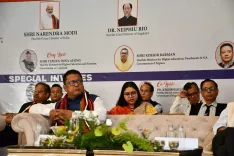
Giriraj Singh flags new-age fibres driving textile green push
Synopsis
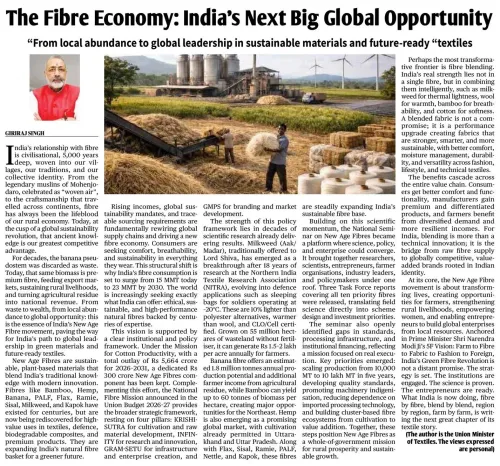
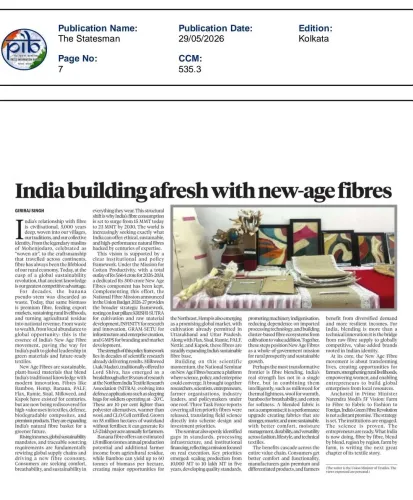
Union Textiles Minister Giriraj Singh says bamboo, hemp and banana fibres are sparking a green revolution in India's textile sector. Invoking PM Modi's 5F vision, he points to the National Fibre Mission under Budget 2026-27 as the policy driver for rural livelihood growth and global competitiveness.
Key Takeaways
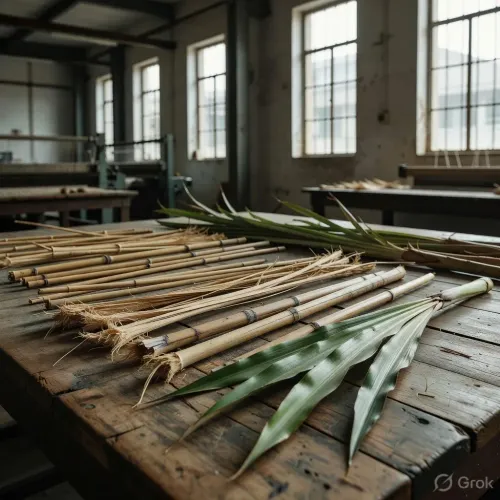
Giriraj Singh identified bamboo, hemp and banana as 'new-age fibres' central to India's textile green revolution.
The National Fibre Mission under Union Budget 2026-27 is the stated policy vehicle for scaling these fibres.
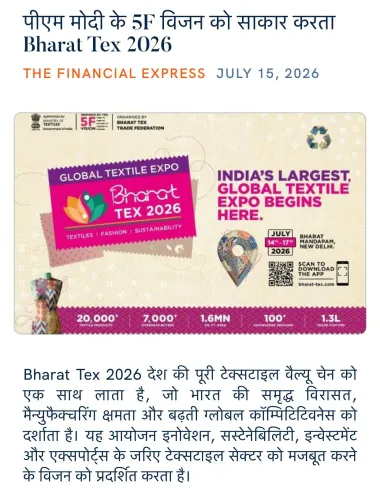
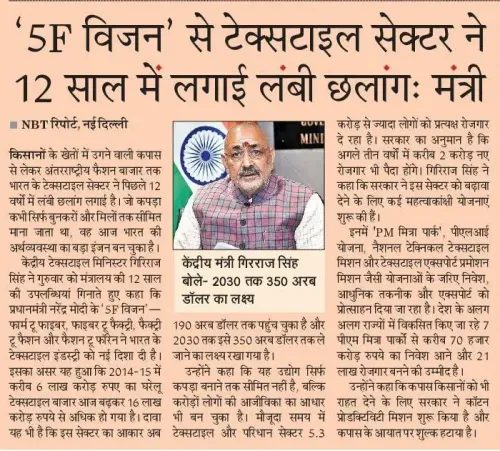
PM Modi's 5F vision — Farm, Fiber, Factory, Fashion, Foreign — frames the strategic direction for the sector.
The PLI Scheme for Textiles , approved in September 2021 with an outlay of Rs 10,683 crore , forms part of the broader policy lineage.
Rural fibre cultivators, textile MSMEs and handloom clusters are the primary intended beneficiaries.
Global demand for certified sustainable fibres, especially from EU markets, provides an export opportunity India is seeking to capture.
Union Textiles Minister Giriraj Singh on Sunday, 31 May 2026 said that 'new-age fibres' such as bamboo, hemp and banana are ushering in a green revolution in India's textile sector, boosting rural livelihoods and sustainability. The minister linked the push to Prime Minister Narendra Modi's 5F vision and cited the proposed National Fibre Mission under the Union Budget 2026-27 as the policy vehicle driving this transformation.
Context
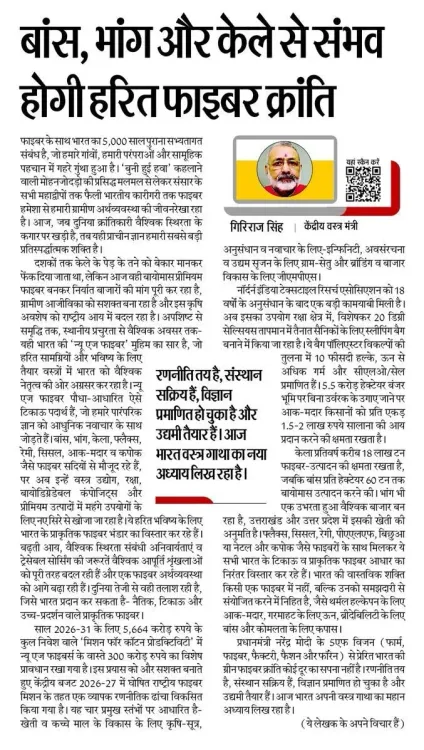
Posting in Hindi on X (formerly Twitter), Singh wrote that 'बांस, भांग और केले जैसे न्यू एज फाइबर्स भारत के कपड़ा क्षेत्र में एक नई हरित क्रांति ला रहे हैं' — ('New-age fibres like bamboo, hemp and banana are bringing a new green revolution to India's textile sector'). He argued that India's rich traditional heritage, skilled workforce and modern scientific research together position the country to lead the global textile market.
The minister credited PM Modi's 5F vision — Farm, Fiber, Factory, Fashion, Foreign — as the ideological anchor for what he described as a new chapter of self-reliance in global textile trade. The 5F framework seeks to integrate the full textile value chain from raw-material cultivation through to export markets.
Policy Backdrop
India's textile policy has progressively sought to diversify raw-material sources beyond conventional cotton and synthetic polyester. The Make in India initiative, launched in September 2014, placed textiles at the centre of domestic manufacturing ambitions and global value-chain integration. The Atmanirbhar Bharat campaign, announced in May 2020, reinforced this by targeting raw-material security and import substitution in the sector.
The Production Linked Incentive (PLI) Scheme for Textiles, approved in September 2021 with an outlay of Rs 10,683 crore, provided further momentum by incentivising man-made fibre apparel, technical textiles and garment manufacturing at scale. The National Fibre Mission now being discussed under the 2026-27 Budget is positioned as the next step in this policy lineage, with a specific focus on lignocellulosic and bast fibres such as bamboo and hemp that have historically been underutilised in industrial textile production.
Successive administrations have explored bast and plant-based fibres as instruments of both agricultural diversification and resource efficiency. Bamboo cultivation, in particular, has been promoted through the National Bamboo Mission as a dual-purpose crop serving both construction and textile processing industries.
Stakeholders and Impact
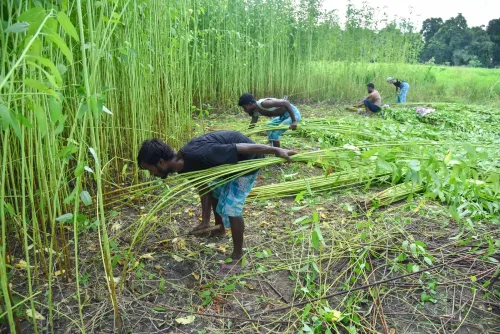
The primary beneficiaries identified by the minister are rural fibre cultivators, textile MSMEs and handloom clusters that stand to gain from upstream demand for alternative plant fibres. Bamboo, hemp and banana-fibre cultivation is concentrated in states including Assam, Meghalaya, Uttarakhand and parts of South India, making the mission relevant to geographically dispersed farming communities.
From an export perspective, global apparel brands and retailers have intensified sourcing of certified sustainable fibres in response to tightening environmental regulations in the European Union and other major markets. An organised National Fibre Mission could help Indian processors meet traceability and certification requirements, improving their competitiveness in premium sustainable-textile segments.
What's Next
Attention will now turn to the detailed allocation and operational guidelines for the National Fibre Mission once the Union Budget 2026-27 documents are formally tabled. Industry stakeholders will watch for state-level bamboo and hemp cultivation cluster announcements, technology-transfer programmes for small processors, and any export-incentive linkages under the mission framework.
If implemented at scale, the shift toward new-age fibres could meaningfully raise India's share of the global sustainable-textile trade — a segment growing rapidly as international buyers align procurement with ESG commitments and circular-economy mandates.
Point of View
The minister is simultaneously pitching to domestic agricultural constituencies and international sustainability-conscious buyers. The emphasis on bamboo and hemp also signals a quiet pivot away from the cotton-versus-synthetic binary that has dominated Indian textile policy debates for decades. Whether the mission translates into on-ground cluster development and technology transfer will determine if this remains political messaging or becomes a structural shift in India's fibre economy.
NationPress
19 Sept 2026
Frequently Asked Questions
What is the National Fibre Mission India 2026?
The National Fibre Mission is a proposed initiative under the Union Budget 2026-27 aimed at scaling the production and processing of new-age plant-based fibres such as bamboo, hemp and banana to boost India's textile sector and rural incomes.
What is PM Modi's 5F vision for textiles?
PM Modi's 5F vision stands for Farm, Fiber, Factory, Fashion and Foreign — an integrated framework that seeks to connect raw-material cultivation all the way through manufacturing and fashion to export markets, building a self-reliant textile value chain.
How does bamboo fibre help India's textile industry?
Bamboo is a fast-growing, low-input crop that can be processed into soft, biodegradable textile fibre. Its cultivation supports rural farmer incomes, reduces dependence on water-intensive cotton, and meets growing global demand for sustainable fabrics.
What is the PLI Scheme for Textiles?
The Production Linked Incentive Scheme for Textiles was approved in September 2021 with an outlay of Rs 10,683 crore to incentivise large-scale production of man-made fibre apparel, technical textiles and garments and to boost India's export competitiveness.
Who benefits from new-age fibre policy in India?
Rural fibre cultivators — particularly bamboo and hemp farmers in states like Assam, Uttarakhand and parts of South India — along with textile MSMEs and handloom clusters are the primary beneficiaries of policies promoting new-age fibres.