Plant-based fibre push: Govt schemes to lift rural income, eye 23 mn MT by 2030
Synopsis
India's government is betting ₹300 crore — within a ₹5,664 crore programme — on reviving ancient fibres like milkweed, bamboo, and hemp for defence gear, exports, and rural income. After 18 years of NITRA research, milkweed sleeping bags are already in soldiers' hands at minus 20°C. The real question is whether this policy architecture reaches the farmers who grow the raw material.
Key Takeaways
India's fibre consumption is projected to rise from 15 million metric tonnes to 23 million metric tonnes by 2030 .
The Centre has allocated ₹300 crore for New Age Fibres under the Mission for Cotton Productivity , part of a ₹5,664 crore programme for 2026–31 .
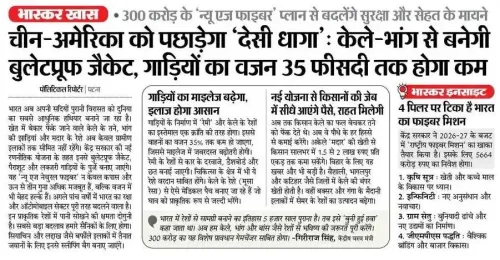
The National Fibre Mission (Budget 2026–27) operates through four pillars: KRISHI-SUTRA , INFINITY , GRAM-SETU , and GMPS .
Milkweed — researched for 18 years at NITRA — is now used in defence sleeping bags rated for minus 20°C , and is 10% lighter than polyester.
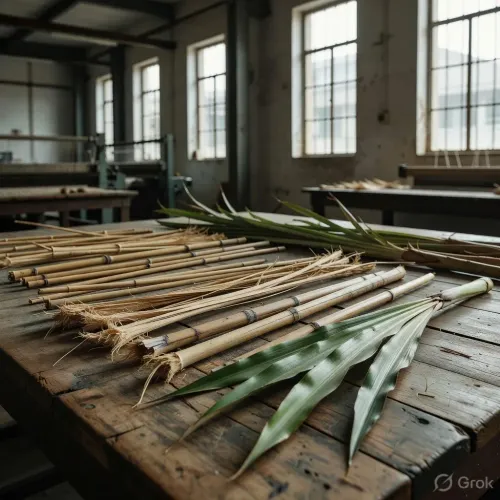
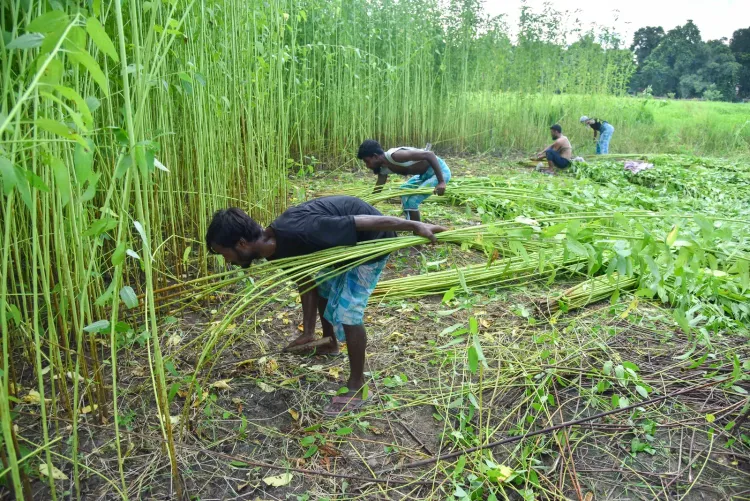
Target fibres include banana, bamboo, hemp, flax, ramie, sisal, milkweed , and kapok for textiles, defence, and biodegradable composites.
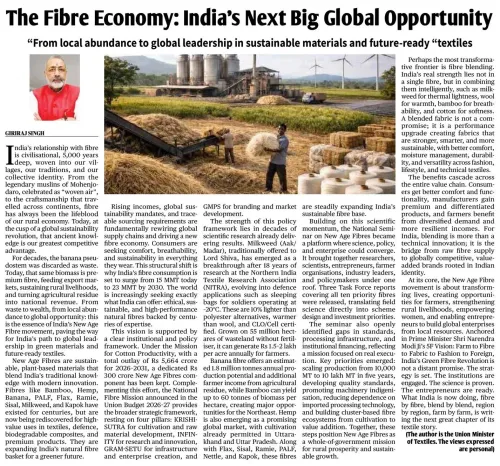
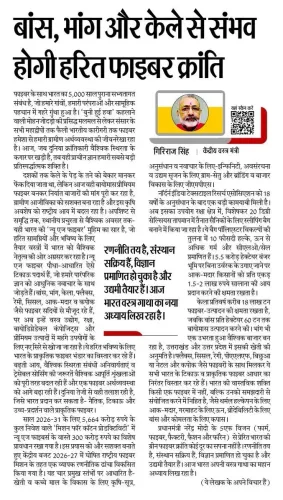
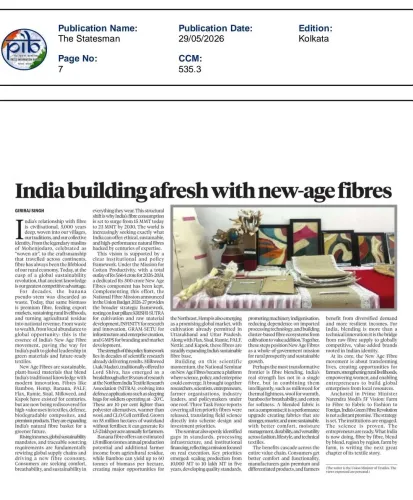
India's fibre consumption is projected to climb from roughly 15 million metric tonnes today to 23 million metric tonnes by 2030, with a government-backed 'New Age Fibre movement' positioning sustainable, plant-based materials as the engine of rural income growth and agricultural residue monetisation, according to a new report.
What the New Age Fibre Movement Covers
The movement seeks to revive traditional fibres — including banana, bamboo, hemp, flax, ramie, sisal, milkweed, and kapok — for high-value applications in textiles, defence gear, biodegradable composites, and premium consumer products. According to the report, these fibres blend India's traditional knowledge with modern innovation, giving the country a differentiated edge in global sustainability markets.
'Today, at the cusp of a global sustainability revolution, India's ancient knowledge of fibre is our greatest competitive advantage,' the report stated.
Policy Framework and Budget Allocation
The Centre has embedded a dedicated ₹300 crore component for New Age Fibres within the Mission for Cotton Productivity, itself part of a broader ₹5,664 crore programme spanning 2026–31. The National Fibre Mission, announced in the 2026–27 Union Budget, further structures this push through four pillars: KRISHI-SUTRA for cultivation and raw material development; INFINITY for research and innovation; GRAM-SETU for infrastructure and enterprise creation; and GMPS for branding and market development.
This multi-pronged architecture signals a shift from ad hoc support to a coordinated, decade-long industrial policy for natural fibres.
Decades of Research Behind the Push
The report underlines that the policy framework draws on substantial scientific groundwork. Milkweed, for instance, underwent 18 years of research at the Northern India Textile Research Association (NITRA) before being cleared for defence applications — specifically sleeping bags for soldiers operating at minus 20 degrees Celsius. The resulting product is reportedly 10 per cent lighter than polyester alternatives, warmer than wool, and CLO/Cell certified.
Fibre blending is identified as a particular Indian strength: combining milkweed for thermal lightness, wool for warmth, bamboo for breathability, and cotton for softness into composite materials suited for both civilian and strategic use.
Historical Context and Export Opportunity
The report traces India's relationship with fibre back over 5,000 years — citing the legendary muslins of Mohenjo-daro — and argues that this civilisational depth is now a commercial asset. With global demand for ethical, sustainable, and high-performance natural fibres rising, India is positioned to convert agricultural residue that currently goes to waste into export revenue and higher rural earnings.
Notably, this comes as international brands face mounting pressure to demonstrate sustainable sourcing, creating a structural demand pull for verified natural-fibre supply chains of the kind India is now trying to build.
What Comes Next
With the National Fibre Mission now budgeted and its four operational pillars defined, implementation timelines and sectoral targets will be the next critical test. Industry observers note that past agricultural-processing schemes have often stalled at the infrastructure and market-linkage stage — precisely the gaps that GRAM-SETU and GMPS are designed to address. Whether disbursements reach rural cultivators at scale will determine if the projected 23 million metric tonne consumption target translates into genuine income gains by 2030.
Point of View
But coherence on paper has rarely been India's problem — last-mile execution has. The milkweed-to-defence-gear pipeline, built on 18 years of NITRA research, is a genuine proof of concept. The harder task is replicating that from a single lab success to a supply chain that reliably pays banana-fibre or sisal cultivators in rural Assam or Tamil Nadu. The ₹300 crore New Age Fibre carve-out is meaningful but modest relative to the scale of residue conversion needed to move the needle on rural income by 2030. Watch whether GRAM-SETU's infrastructure spending reaches primary processing centres, or stalls at the scheme-design stage as so many predecessors have.
NationPress
25 Sept 2026
Frequently Asked Questions
What is the New Age Fibre movement in India?
The New Age Fibre movement is a government-backed initiative to revive sustainable, plant-based fibres — such as bamboo, hemp, milkweed, banana, and sisal — for high-value uses in textiles, defence, and biodegradable composites. It blends traditional Indian fibre knowledge with modern innovation to create rural income and export opportunities.
How much has the government allocated for New Age Fibres?
The Centre has set aside ₹300 crore specifically for New Age Fibres within the Mission for Cotton Productivity, which is part of a broader ₹5,664 crore programme running from 2026 to 2031. Additional support comes through the National Fibre Mission announced in the 2026–27 Union Budget.
What is India's fibre consumption target by 2030?
India's fibre consumption is projected to grow from approximately 15 million metric tonnes currently to 23 million metric tonnes by 2030, according to the report. The surge is expected to be driven largely by demand for sustainable, plant-based natural fibres.
How is milkweed being used in India's defence sector?
Milkweed, after 18 years of research at the Northern India Textile Research Association (NITRA), has been selected for defence sleeping bags designed for soldiers operating at minus 20 degrees Celsius. The product is 10 per cent lighter than polyester alternatives, warmer than wool, and CLO/Cell certified.
What are the four pillars of the National Fibre Mission?
The National Fibre Mission operates through KRISHI-SUTRA (cultivation and raw material development), INFINITY (research and innovation), GRAM-SETU (infrastructure and enterprise creation), and GMPS (branding and market development). Together they form a coordinated policy framework to scale India's natural fibre sector from farm to export market.