Giriraj Singh backs DigiDukaan drive to digitise 1.4 cr kiranas
Synopsis
Union Textiles Minister Giriraj Singh has backed the DigiDukaan campaign, which aims to digitise 1.4 crore kirana stores across India. The drive is positioned as a major step toward modernising the FMCG sector and transforming general trade through digital integration.
Key Takeaways
Union Textiles Minister Giriraj Singh amplified the DigiDukaan campaign on 14 June 2026 via the NaMo App.
The campaign targets digitisation of 1.4 crore kirana stores across India.
The stated goals include modernising India's FMCG sector and transforming the structure of general trade.
The initiative aligns with the Digital India programme (launched 2015 ) and the ONDC framework (piloted 2022 ).
Kirana stores account for the majority of India's retail grocery distribution, making them a critical node for any digital commerce expansion.
Rollout timelines and integration with ONDC or UPI infrastructure are yet to be formally detailed by the responsible ministries.
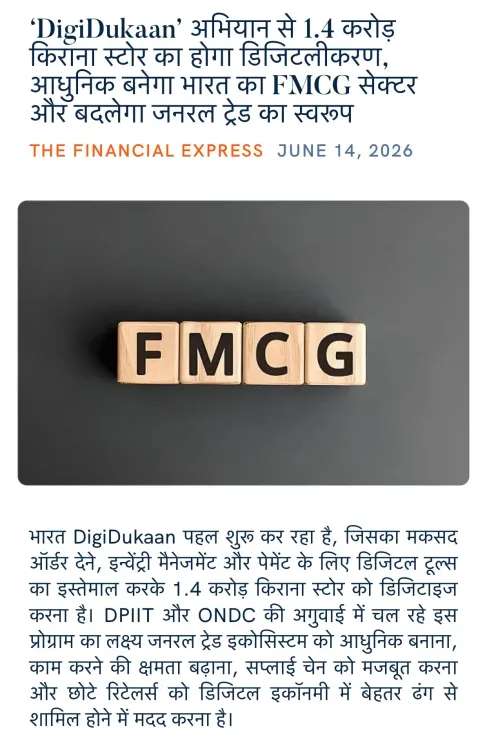
Union Textiles Minister Giriraj Singh on Sunday, 14 June 2026, amplified a campaign called 'DigiDukaan', sharing that the initiative is set to digitise 1.4 crore kirana stores across India, with the stated aim of modernising the country's FMCG sector and transforming the character of general trade.
Context
Singh shared the development via the NaMo App, posting in Hindi that the DigiDukaan campaign would bring digital capabilities to India's vast network of neighbourhood grocery and general stores. In translation, his post reads: 'DigiDukaan abhiyan se 1.4 crore kirana store ka hoga digitalikaran, aadhunik banega Bharat ka FMCG sector aur badlega general trade ka swaroop' — 'The DigiDukaan campaign will digitise 1.4 crore kirana stores, modernise India's FMCG sector and transform the face of general trade.'
Kirana stores — small, family-run neighbourhood retailers — form the backbone of India's fast-moving consumer goods (FMCG) distribution chain, accounting for the vast majority of retail grocery sales across urban and rural markets alike.
Policy Backdrop
The DigiDukaan push fits squarely within India's long-running Digital India programme, launched in July 2015, which sought to expand digital infrastructure and literacy across governance, commerce and services. The unorganised retail sector was identified early as a key frontier for formalisation and efficiency gains.
A significant subsequent milestone was the launch of the Open Network for Digital Commerce (ONDC) pilot in 2022, a government-backed initiative designed to integrate kirana stores and general trade into interoperable digital commerce networks. The expansion of UPI since 2016 further accelerated digital payment adoption among small businesses, particularly in the post-pandemic period when e-commerce and digital transactions surged among micro-retailers.
Cross-ministerial amplification of such digital retail campaigns is a common feature of the current government's communication strategy, even when primary operational responsibility rests with the commerce or information technology ministries.
Stakeholders and Impact
The stated target of 1.4 crore kirana stores represents one of the largest potential cohorts for any single digitisation drive in India's retail history. If achieved at scale, the campaign could significantly raise supply-chain efficiency, improve inventory management and bring millions of small traders into formal digital commerce networks.
FMCG companies — which depend on general trade for the bulk of their distribution reach — stand to benefit from better data visibility and order management at the last mile. Kirana store owners themselves could gain access to digital credit, loyalty platforms and direct-from-distributor ordering, reducing dependence on traditional intermediaries.
What's Next
Observers will watch for official rollout timelines, adoption targets and any formal integration of the DigiDukaan campaign with existing platforms such as ONDC or the UPI ecosystem. Announcements from the commerce or IT ministries, or at retail industry forums, are expected to provide operational detail on how the 1.4 crore target will be tracked and achieved.
The campaign's success will ultimately be measured by whether it translates political momentum into on-ground digital adoption among India's most dispersed and traditionally low-tech retail segment.
Point of View
Even as operational ownership of such drives sits with the commerce and IT ministries. The 1.4 crore kirana figure is a politically potent number — it invokes the scale of India's unorganised retail workforce and positions the government as its digital champion. This messaging pattern, where senior ministers across portfolios echo a single campaign, is a deliberate communications strategy designed to build cross-sectoral momentum. The real test will come when adoption metrics are published and scrutinised against the ambition.
NationPress
13 Sept 2026
Frequently Asked Questions
What is the DigiDukaan campaign in India?
DigiDukaan is a campaign aimed at digitising 1.4 crore kirana stores across India, with the goal of modernising the country's FMCG sector and transforming how general trade operates through digital tools and platforms.
What did Giriraj Singh say about DigiDukaan?
Union Textiles Minister Giriraj Singh shared on 14 June 2026 that the DigiDukaan campaign would digitise 1.4 crore kirana stores , modernise India's FMCG sector and change the face of general trade.
How many kirana stores are there in India?
India is estimated to have approximately 1.4 crore kirana or neighbourhood grocery stores, which form the backbone of the country's FMCG and general trade distribution network.
How does DigiDukaan relate to ONDC and Digital India?
DigiDukaan aligns with the broader Digital India programme launched in 2015 and the ONDC (Open Network for Digital Commerce) framework piloted in 2022 , both of which aim to integrate small retailers into formal digital commerce networks.
Which ministry is responsible for the DigiDukaan campaign?
While Giriraj Singh of the Textiles Ministry has backed the campaign, operational responsibility for kirana digitisation initiatives of this nature typically rests with the Ministry of Commerce or the Ministry of Electronics and Information Technology .