Giriraj Singh backs High Powered Task Force for exam reforms
Synopsis
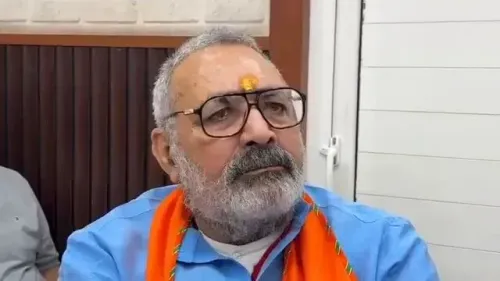
Union Textiles Minister Giriraj Singh has backed a newly formed High Powered Task Force aimed at making India's public examination system more transparent, secure, and future-ready, calling it proof that the Modi government will not compromise on youth futures.
Key Takeaways
Union Textiles Minister Giriraj Singh publicly endorsed the High Powered Task Force on 26 July 2026 .
The task force is positioned as a step toward making India's examination system more transparent, secure, and future-oriented .
Singh cited Prime Minister Narendra Modi's direct engagement with youth aspirations as the driving force behind the initiative.
The move follows years of public concern over paper leaks and irregularities in major national competitive examinations.
The National Testing Agency , set up in 2017 , and the National Education Policy 2020 form the existing policy foundation on which further reforms are being built.
The task force's composition, mandate, and recommendation timeline remain to be formally announced.
Union Textiles Minister Giriraj Singh on Sunday, 26 July 2026, welcomed the formation of a High Powered Task Force aimed at making India's public examination system more transparent, secure, and future-ready, calling it a clear signal that the government will not compromise on the futures of young people.
Posting on X, Singh wrote: 'परीक्षा प्रणाली को और अधिक पारदर्शी, सुरक्षित और भविष्य के अनुरूप बनाने की दिशा में यह एक और महत्वपूर्ण कदम है' — 'This is another important step towards making the examination system more transparent, secure and future-oriented.' He added that the formation of the High Powered Task Force is 'clear proof that the government will not make any compromise with the future of the youth.'
Context
Singh's post comes amid sustained public and political attention on the integrity of competitive examinations in India. Repeated incidents of paper leaks and irregularities in major national entrance and recruitment tests have eroded student confidence and triggered demands for structural reform. The minister framed the task force as a direct governmental response to those concerns.
He also invoked Prime Minister Narendra Modi, stating that Modi 'always communicates directly with the youth, understands their aspirations, and works by treating their dreams as his own resolve.' The reference positions the task force within the Prime Minister's broader outreach to India's large student population.
Policy Backdrop
The National Testing Agency (NTA), established in 2017, was set up to centralise and professionalise the conduct of competitive examinations that were previously administered by multiple bodies. The intent was to standardise testing and reduce malpractice, though the agency has itself faced scrutiny in subsequent years over examination conduct.
The National Education Policy (NEP) 2020 recommended structural changes to examination patterns, emphasising reduced high-stakes testing and greater transparency. Successive central governments have pursued technology-driven and oversight-heavy measures to secure public examinations, linking education integrity directly to employment opportunities for India's youth.
Stakeholders and Impact
The primary stakeholders are millions of students and competitive-exam aspirants across India who depend on the credibility of national entrance and recruitment tests for access to higher education and government employment. Any reform to examination architecture has cascading effects on coaching ecosystems, state-level testing bodies, and recruitment pipelines.
The broader administrative reform agenda emphasises centralised oversight and periodic high-level reviews rather than fragmented state-level approaches, a model that the proposed High Powered Task Force appears to reinforce.
What's Next
Attention will now turn to the formal constitution, composition, and mandate of the High Powered Task Force, as well as the timeline for its interim and final recommendations. Any legislative or regulatory changes flowing from the task force's report could reshape how major national examinations — from entrance tests to recruitment drives — are designed and administered. The government's stated commitment to youth welfare will be measured against the concrete reforms the task force ultimately proposes.
Point of View
The statement is as much political positioning as policy communication. The move fits a pattern of centralised, high-visibility review mechanisms deployed when public trust in an institution erodes. Whether the task force translates into durable structural reform or remains a signalling exercise will depend on the speed and substance of its recommendations.
NationPress
25 Oct 2026
Frequently Asked Questions
What is the High Powered Task Force on examinations in India?
The High Powered Task Force is a government-constituted body aimed at making India's public examination system more transparent, secure, and future-ready, as referenced by Union Textiles Minister Giriraj Singh on 26 July 2026. Its full composition and mandate are yet to be formally detailed.
Why is India reforming its examination system?
Repeated incidents of paper leaks and irregularities in major national entrance and recruitment tests have undermined student confidence, prompting the central government to pursue structural and oversight reforms to restore integrity to the examination process.
What is the National Testing Agency and why does it matter?
The National Testing Agency (NTA) is an autonomous body established in 2017 to centralise and standardise the conduct of major competitive examinations in India. It was created to reduce malpractice and bring uniformity to tests previously administered by multiple bodies.
What did Giriraj Singh say about PM Modi and youth?
Singh stated that Prime Minister Narendra Modi 'always communicates directly with the youth, understands their aspirations, and works by treating their dreams as his own resolve,' framing exam reform as a personal commitment of the Prime Minister to India's young population.
What does the National Education Policy 2020 say about examinations?
The National Education Policy 2020 recommended structural changes to examination patterns, including reducing dependence on high-stakes single tests and improving transparency, forming part of the policy foundation for ongoing examination reforms.