Giriraj Singh backs 'Kapas Darshan' bulletin for cotton farmers
Synopsis
Union Textiles Minister Giriraj Singh on 2 August 2026 endorsed 'Kapas Darshan', a dedicated information bulletin for cotton farmers, arguing that timely and accurate data directly improves farm-level decisions and strengthens India's broader textiles value chain.
Key Takeaways
Giriraj Singh , Union Textiles Minister, publicly backed the 'Kapas Darshan' bulletin on 2 August 2026 .
The bulletin is designed to deliver timely, accurate information to cotton farmers across India.
The Minister described it as a 'meaningful initiative' to empower farmers to keep pace with a changing world.
The move signals the Ministry of Textiles taking an active role in farm-level advisory services, a space traditionally led by the agriculture ministry.
Cotton is a critical link between India's farm sector and its textiles manufacturing chain, making farmer decision-making a supply-chain issue as much as an agricultural one.
When a cotton farmer makes a decision — to spray, to sell, to wait — the quality of that decision is only as good as the information in hand. On Sunday, 2 August 2026, Union Textiles Minister Giriraj Singh backed a new initiative called 'Kapas Darshan', a dedicated information bulletin aimed at putting timely, accurate data directly into the hands of India's cotton growers.
Posting in Hindi, the Minister captured the logic plainly: 'जानकारी जितनी सटीक और समय पर हो, किसान का निर्णय उतना ही बेहतर होता है' — 'The more precise and timely the information, the better the farmer's decision.' He described the 'Kapas Darshan' bulletin as a 'meaningful initiative' to deliver essential information to cotton farmers and empower them to keep pace with a changing world.
Where the cotton field meets the loom
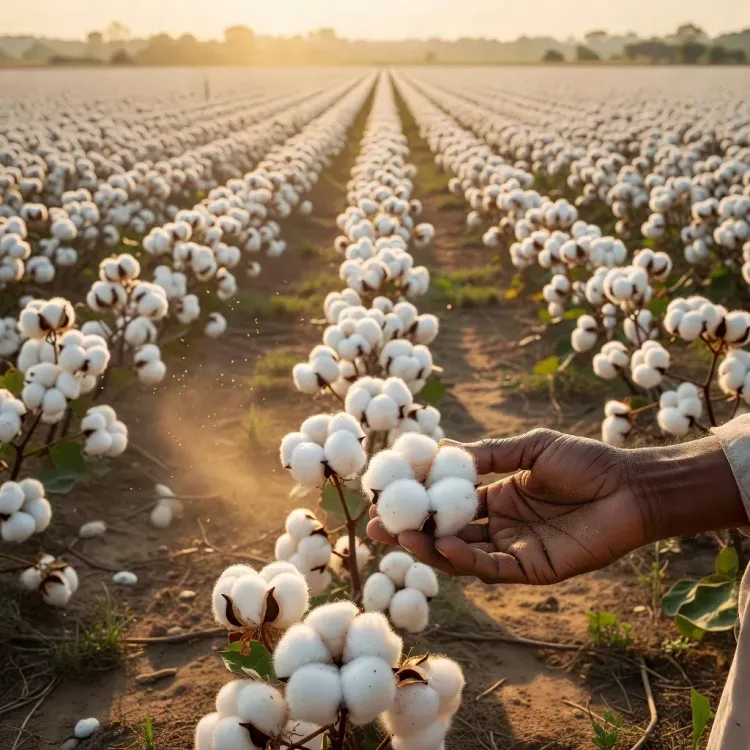
Cotton sits at a uniquely strategic junction in India's economy — it is simultaneously an agricultural commodity and the raw nerve of the entire domestic textiles value chain. A farmer who plants, sprays, or harvests on bad information does not just lose income; the disruption ripples upstream into spinning mills, weaving clusters, and garment factories. That is the structural argument behind a dedicated advisory bulletin: better farm-level decisions mean a more stable, predictable supply for an industry that employs tens of millions. Extension services and crop advisories have long been part of India's agricultural support architecture, but they have historically been driven by the Ministry of Agriculture. An initiative championed by the Ministry of Textiles signals an intent to close the gap between field and factory — treating cotton not just as a crop but as the first link in a manufacturing chain that the government is actively trying to strengthen.Timely information as a policy tool
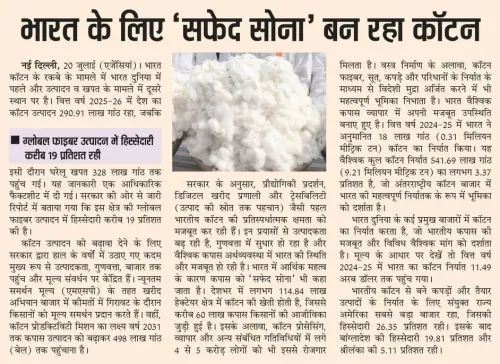
The framing of 'Kapas Darshan' as an empowerment tool — rather than a subsidy or a price-support mechanism — is deliberate. Information-based interventions are low-cost, scalable, and do not distort market prices. If the bulletin delivers reliable advisories on pest alerts, weather patterns, market rates, or best-practice techniques, it addresses one of the oldest complaints of Indian cotton farmers: that they are the last to know what the market already knows. India is among the world's largest producers and exporters of cotton, and the crop supports livelihoods across Maharashtra, Gujarat, Telangana, Andhra Pradesh, Madhya Pradesh, and Punjab. Any initiative that sharpens decision-making at the farm level carries consequences that stretch far beyond the field. The next question is reach — how the bulletin is distributed, in which languages, and whether it gets to small and marginal farmers who need it most. That is the test 'Kapas Darshan' will eventually have to pass.Point of View
Making them an attractive tool for a ministry that does not control agricultural pricing or procurement. The initiative also fits a pattern of the BJP government framing welfare measures in the language of empowerment rather than dependency. The real test will be implementation — whether the bulletin reaches marginal farmers in rain-fed cotton belts or remains an urban-digital product that misses the most vulnerable growers entirely.
NationPress
2 Aug 2026
Frequently Asked Questions
What is Kapas Darshan?
'Kapas Darshan' is an information bulletin promoted by the Union Ministry of Textiles to provide cotton farmers with timely and accurate data to improve their farming decisions.
Who launched Kapas Darshan?
Union Textiles Minister Giriraj Singh publicly endorsed and promoted the 'Kapas Darshan' bulletin on 2 August 2026 via a post on X.
What information does the Kapas Darshan bulletin provide to farmers?
The bulletin is designed to deliver essential information to cotton growers — potentially covering pest alerts, market conditions, weather patterns, and best-practice techniques — though full details of its content are yet to be widely confirmed.
Why is the Textiles Ministry involved in farmer advisories?
Cotton is the primary raw material for India's textiles industry. The Ministry of Textiles has a direct stake in stable, high-quality cotton supply, making farm-level advisory services a natural extension of its mandate.
Which states in India grow the most cotton?
India's major cotton-growing states include Maharashtra, Gujarat, Telangana, Andhra Pradesh, Madhya Pradesh , and Punjab , together accounting for the bulk of the country's cotton output.