Giriraj Singh Highlights India's Role in Asia-Pacific Air Traffic Growth
Synopsis
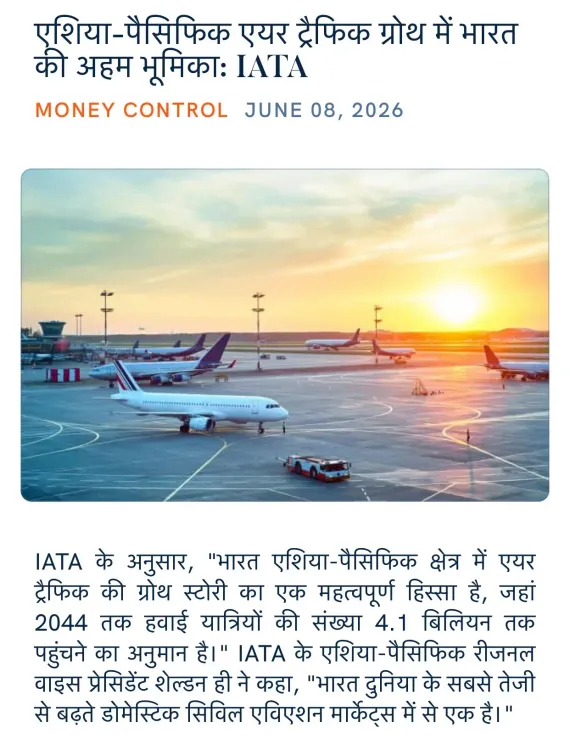
Union Textiles Minister Giriraj Singh amplified an IATA report on June 8, 2026, highlighting India's pivotal role in Asia-Pacific air traffic growth. The endorsement reflects India's rapid aviation expansion, backed by airport infrastructure investment and regional connectivity schemes over the past decade.
Key Takeaways
Union Textiles Minister Giriraj Singh shared an IATA report on June 8, 2026 calling India a 'significant player' in Asia-Pacific air traffic growth.
IATA is the global trade body representing airlines and is regarded as an authoritative source on international aviation statistics.
India's aviation growth has been supported by the National Civil Aviation Policy 2016 and the UDAN regional connectivity scheme.
New greenfield airports and Tier-2 city connectivity have added capacity driving India's rising share of Asia-Pacific passenger traffic.
India is projected to become one of the world's top-three aviation markets within this decade.
Policy focus areas going forward include route liberalisation, airspace management, and further airport capacity expansion.
Union Textiles Minister Giriraj Singh on Monday, June 8, 2026, shared a report by the International Air Transport Association (IATA) underscoring India's significant role in driving air traffic growth across the Asia-Pacific region, signalling cross-sectoral interest among senior BJP leaders in India's aviation trajectory.
Context
The post, shared via the NaMo App, highlighted an IATA assessment describing India as a 'significant player' in Asia-Pacific air traffic expansion. While Giriraj Singh holds the portfolio of Textiles, his amplification of the report reflects the broader enthusiasm within the ruling establishment for India's infrastructure and connectivity milestones.
IATA, the global trade body representing airlines worldwide, regularly publishes regional traffic data and forecasts. Its recognition of India's role in Asia-Pacific growth carries weight given the organisation's standing as an authoritative voice in global civil aviation.
Policy Backdrop
India's aviation sector has expanded rapidly over the past decade, underpinned by rising household incomes, a growing middle class, and sustained government investment in airport infrastructure. The National Civil Aviation Policy 2016 set out targets to increase the number of operational airports and make air travel more affordable, laying the groundwork for the growth IATA now acknowledges.
Government-led initiatives have focused on regional connectivity — particularly the UDAN (Ude Desh ka Aam Naagrik) scheme — and greenfield airport development to match surging passenger demand. New airports across Tier-2 and Tier-3 cities have added capacity that feeds into the broader Asia-Pacific traffic picture.
Stakeholders and Impact
The aviation sector's expansion has direct implications for airlines, airport operators, ground-handling companies, and the tens of millions of air travellers who use Indian airports each year. Recognition by a body such as IATA strengthens India's negotiating position in international aviation forums and supports the case for further route liberalisation and bilateral air services agreements.
For the broader economy, a thriving aviation sector boosts tourism, trade logistics, and business connectivity. Industry stakeholders have consistently pointed to infrastructure bottlenecks — including airspace management and metro-airport surface links — as areas requiring continued investment to sustain the growth trajectory.
What's Next
Attention will now turn to forthcoming IATA regional traffic forecasts and any announcements from the Ministry of Civil Aviation on new airport approvals, capacity upgrades at existing hubs, or updates to India's open-sky arrangements with key trading partners. With India widely projected to become one of the world's top-three aviation markets within this decade, the policy and investment decisions made in the near term will be critical to sustaining the momentum that international bodies are now formally recognising.
Point of View
Not just a sectoral metric. IATA's formal recognition of India's Asia-Pacific significance gives the government an internationally credible data point ahead of potential bilateral air services negotiations and domestic election cycles where infrastructure delivery is a key narrative. The move also signals coordination around the NaMo App as a platform for curating positive economic news across ministerial lines. Sustained growth, however, will depend on whether capital expenditure on airports and airspace modernisation keeps pace with the passenger demand that international bodies are now quantifying.
NationPress
23 Oct 2026
Frequently Asked Questions
What did IATA say about India's aviation growth?
IATA described India as a 'significant player' in Asia-Pacific air traffic growth, recognising the country's rapid expansion in domestic and international passenger numbers driven by rising incomes and new airport capacity.
Why did Textiles Minister Giriraj Singh share an aviation report?
Minister Giriraj Singh shared the IATA report via the NaMo App, reflecting the broader enthusiasm within the BJP-led government for highlighting India's infrastructure and connectivity achievements across portfolios.
What is the UDAN scheme and how does it relate to India's aviation growth?
UDAN — Ude Desh ka Aam Naagrik — is the government's regional connectivity scheme aimed at making air travel affordable and connecting Tier-2 and Tier-3 cities, which has contributed significantly to India's expanding air passenger numbers.
Is India among the fastest-growing aviation markets in the world?
Yes, India has been cited by multiple international bodies, including IATA, as one of the fastest-growing aviation markets in the Asia-Pacific region and is projected to become one of the world's top-three aviation markets within this decade.
What policy supports India's civil aviation expansion?
The National Civil Aviation Policy 2016 set targets for increasing operational airports and affordability, while the UDAN scheme and greenfield airport projects have added capacity to sustain the sector's rapid growth.