Giriraj Singh flags record high for Made-in-India car exports
Synopsis
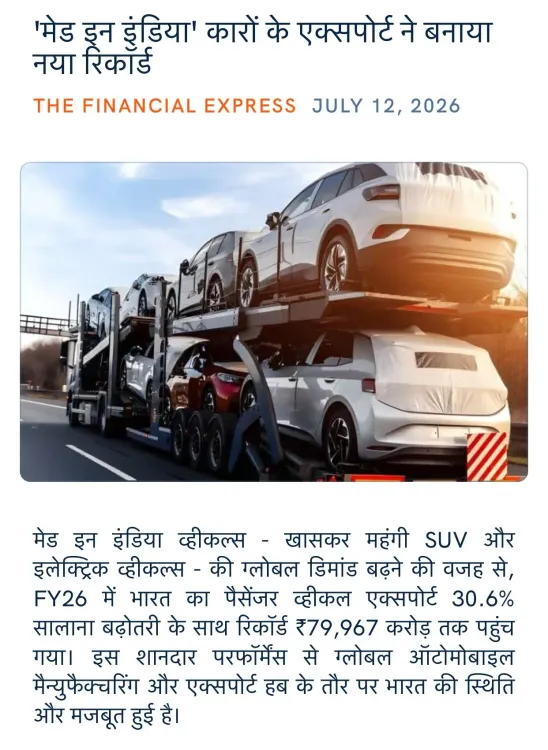
Union Textiles Minister Giriraj Singh on 12 July 2026 amplified a report of a new record in 'Made in India' automobile exports, citing it as evidence of the government's Make in India and Atmanirbhar Bharat manufacturing drive bearing fruit.
Key Takeaways
Union Textiles Minister Giriraj Singh shared the automobile export record report on 12 July 2026 via the NaMo App on X.
The post frames the milestone as a success of the Make in India initiative launched in September 2014 .
The Production Linked Incentive (PLI) scheme for automobiles and auto components , notified in 2021 , has been a key policy driver for export growth.
India exports cars to markets in Africa, Latin America, and Southeast Asia , leveraging cost-competitive manufacturing.
Official export figures are tracked quarterly by the Ministry of Commerce and Industry , whose next release will confirm the record.
Any revision to Auto PLI scheme guidelines will be a key variable for the sector's export trajectory going forward.
Union Textiles Minister Giriraj Singh on Sunday, 12 July 2026, shared a report highlighting a new record in automobile exports from India, amplifying the milestone on X as a vindication of the government's 'Make in India' manufacturing push.
The minister's post, shared via the NaMo App, cited a report headlined 'Made in India' car exports hitting a fresh high — framing the achievement within the broader narrative of domestic manufacturing gains under the Atmanirbhar Bharat framework.
Context
India's automobile sector has steadily expanded its footprint in global vehicle trade over the past decade. The country has emerged as a significant exporter of passenger cars, two-wheelers, and commercial vehicles, with manufacturers leveraging cost-competitive production and improving quality standards to access markets in Africa, Latin America, and Southeast Asia.
A new export record in this segment would mark a continuation of a trend that has seen India's share in global vehicle trade grow year on year, positioning the country as a meaningful alternative to established auto-manufacturing hubs.
Policy Backdrop
The Make in India initiative, launched in September 2014, placed automobiles among its priority sectors, aiming to convert India into a global production and export hub. Complementing it, the Production Linked Incentive (PLI) scheme for automobiles and auto components, notified in 2021, offered financial incentives tied to incremental sales to scale up both output and overseas shipments.
Together, these schemes have provided the fiscal scaffolding for manufacturers to invest in capacity, localise supply chains, and compete on price in export markets. The record export figure, if confirmed by official trade data, would reflect the compounding effect of these policy interventions over several years.
Stakeholders and Impact
The primary beneficiaries of rising automobile exports are domestic auto manufacturers, their component suppliers, and the workers employed across the value chain. Export-linked growth also has downstream effects on ancillary industries — logistics, ports, and raw-material suppliers — making it a broad economic indicator rather than a narrow sectoral one.
For the government, a record export number serves as a data point in the larger argument that industrial policy is delivering measurable results, particularly ahead of periodic reviews of PLI scheme guidelines by the Ministry of Commerce and Industry.
What's Next
Official confirmation of the record will come through the next quarterly export release by the Ministry of Commerce and Industry, which tracks outbound shipments across vehicle categories. Analysts and industry bodies will watch whether the momentum holds through the second half of 2026, especially given global demand uncertainties and evolving trade policies in key destination markets.
Any revision to the Auto PLI scheme guidelines — including eligibility criteria or incentive slabs — could also shape the trajectory of exports in the quarters ahead, making the upcoming policy calendar a key variable for the sector.
Point of View
Where any export high becomes a shared political asset. The real test will be whether official quarterly data corroborates the record and sustains the narrative into the second half of 2026.
NationPress
12 Jul 2026
Frequently Asked Questions
What record did India set in car exports?
According to the report shared by Union Textiles Minister Giriraj Singh on 12 July 2026, India's 'Made in India' automobile exports hit a new all-time high, though official confirmation awaits the next quarterly release by the Ministry of Commerce and Industry.
What is the Make in India initiative?
Make in India is a flagship manufacturing promotion scheme launched in September 2014 to position India as a global production and export hub across sectors, including automobiles, electronics, and textiles.
What is the Auto PLI scheme?
The Production Linked Incentive scheme for automobiles and auto components was notified in 2021, offering financial incentives tied to incremental sales to encourage domestic manufacturers to scale production and boost exports.
Why is Giriraj Singh, a Textiles Minister, posting about car exports?
Senior ministers in the BJP government routinely amplify manufacturing and export milestones across sectors as part of the broader Atmanirbhar Bharat and Make in India communication strategy, regardless of their specific portfolio.
Where does India export cars?
India primarily exports automobiles to markets in Africa, Latin America, and Southeast Asia, leveraging its cost-competitive manufacturing base and improving vehicle quality standards.