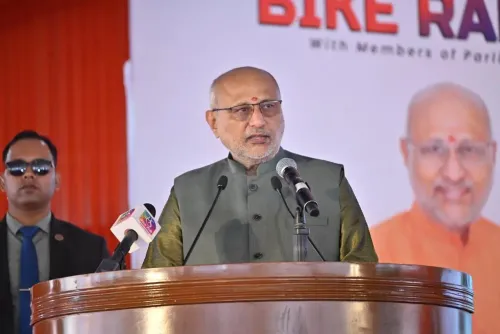
Giriraj Singh greets nation on Vande Mataram anniversary
Synopsis
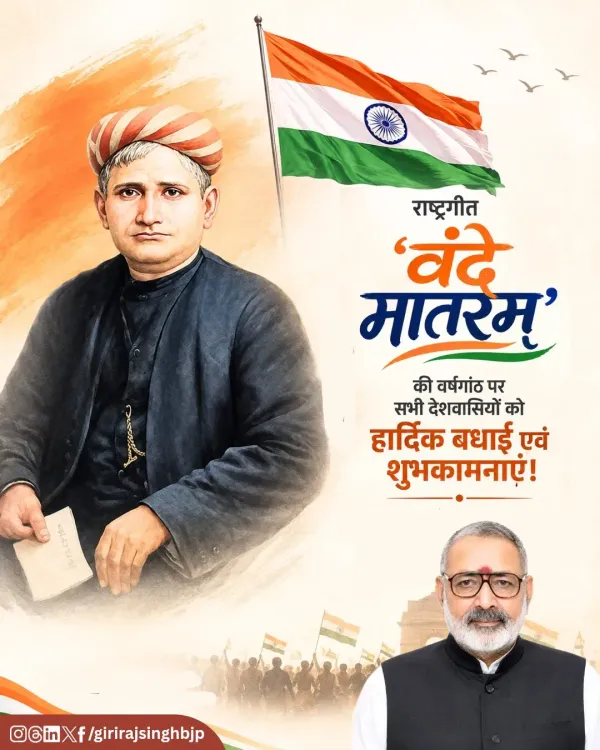
Union Textiles Minister Giriraj Singh marked the anniversary of India's national song Vande Mataram on 7 November 2026, extending greetings to all Indians and calling the 1882 composition a timeless source of patriotic energy.
Key Takeaways
Union Textiles Minister Giriraj Singh posted a greeting on 7 November 2026 marking the anniversary of India's national song Vande Mataram .
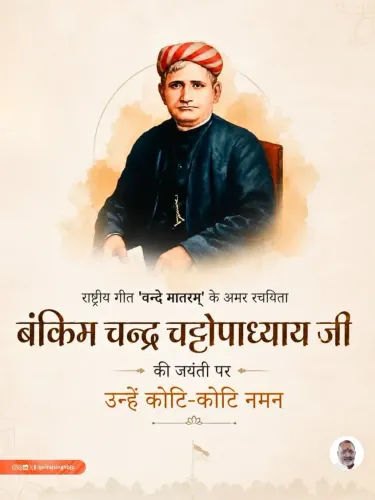
Vande Mataram was composed by Bankim Chandra Chatterjee and first published in 1882 .
The Constituent Assembly granted it official status as the national song in 1950 , distinct from the national anthem Jana Gana Mana .
Singh described the song as filling every Indian's heart with 'boundless energy of patriotism and love for the nation.' The message continues a pattern of senior BJP leaders publicly marking national-symbol anniversaries since 2014 .
A song born in 1882 still moves a billion hearts — and Union Textiles Minister Giriraj Singh marked the anniversary of India's national song Vande Mataram on Saturday, 7 November 2026, with a warm public message extending greetings to every Indian.
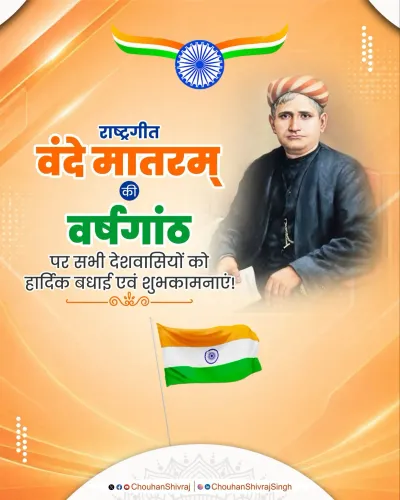
Posting in Hindi, the senior BJP leader and Lok Sabha MP from Begusarai, Bihar, wrote: 'राष्ट्रगीत वंदे मातरम् की वर्षगांठ पर सभी देशवासियों को हार्दिक बधाई एवं शुभकामनाएँ!' — 'Heartfelt congratulations and best wishes to all fellow Indians on the anniversary of the national song Vande Mataram!' He added that this 'energetic song dedicated at the feet of Mother India fills every Indian's heart with boundless energy of patriotism and love for the nation.'
From Bankim Chandra's pen to the Constituent Assembly
Vande Mataram was composed by the towering Bengali litterateur Bankim Chandra Chatterjee and first published in 1882. Its opening verses became a rallying cry during India's independence movement, chanted at marches, in jail cells, and on the streets of a colonised subcontinent.
When India became a republic, the Constituent Assembly in 1950 formally recognised Vande Mataram as the national song, while Jana Gana Mana was designated the national anthem. The distinction matters: both carry official status, but Jana Gana Mana is played at state functions, while Vande Mataram endures as the people's hymn — sung in schools, stadiums, and parliaments alike.
BJP's pattern of amplifying national-symbol moments
Singh's message fits a well-established pattern: since 2014, senior BJP leaders have consistently used anniversaries tied to national symbols to publicly reaffirm themes of cultural nationalism and patriotism. These posts serve both as civic reminders and as deliberate signals about the party's ideological emphasis on India's civilisational heritage.
That a Union Minister — not merely a party spokesperson — leads with this message on a Saturday morning underlines how the government treats such cultural milestones as occasions of genuine public resonance, not mere calendar footnotes.
One hundred and forty-four years after Bankim Chandra first committed those words to paper, Vande Mataram remains perhaps the most emotionally freighted phrase in the Indian political vocabulary — proof that some songs outlast every government that sings them.
Point of View
The BJP signals that national-symbol observances are government priority, not just party ritual. The reference to 'boundless energy' and 'Mother India' also taps into a saffron-inflected vocabulary that has been central to BJP messaging since 2014. Worth watching: whether the winter session of Parliament opens with a formal reference to the song's anniversary, lending it additional institutional weight.
NationPress
7 Nov 2026
Frequently Asked Questions
What is Vande Mataram and why is it significant?
Vande Mataram is India's national song, composed by Bankim Chandra Chatterjee and first published in 1882. It became a powerful rallying anthem during the independence movement and was granted official status by the Constituent Assembly in 1950.
What is the difference between India's national anthem and national song?
Jana Gana Mana is India's national anthem, played at official state functions. Vande Mataram is the national song — both carry constitutional recognition, but they serve different ceremonial roles.
Who composed Vande Mataram?
Vande Mataram was composed by Bengali writer Bankim Chandra Chatterjee and first published in 1882 as part of his novel Anandamath.
What did Giriraj Singh say about Vande Mataram?
Union Textiles Minister Giriraj Singh greeted all Indians on the song's anniversary, calling it an 'energetic song dedicated at the feet of Mother India' that fills every Indian's heart with boundless patriotic energy.
When did the Constituent Assembly adopt Vande Mataram as the national song?
The Constituent Assembly adopted Vande Mataram as India's national song in 1950, the same year the Constitution came into force.