Giriraj Singh greets postal workers on National Postal Employees Day

Synopsis
Union Textiles Minister Giriraj Singh on 1 July 2026 greeted India Post employees on National Postal Employees Day, praising their dedication as the backbone of India's postal network and a lasting force for nation-building.
Key Takeaways
Giriraj Singh , Union Minister of Textiles and Lok Sabha MP from Begusarai , posted greetings to postal workers on National Postal Employees Day, 1 July 2026 .
He described postal employees' dedication and hard work as the 'greatest strength' of India 's postal system.
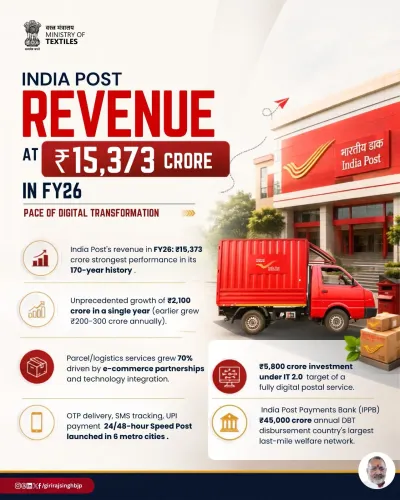
India Post serves as a last-mile delivery channel for welfare payments, Aadhaar seeding, and small savings schemes across urban and rural India.
A postal modernisation drive launched around 2010–12 has been progressively upgrading infrastructure and digital integration within India Post .
The India Post Payments Bank (IPPB) extends doorstep banking to underserved communities, relying heavily on the existing postal workforce.
Union Textiles Minister Giriraj Singh on Wednesday, 1 July 2026, extended greetings to postal workers across the country on the occasion of National Postal Employees Day, honouring their role in connecting every corner of India through messages, empathy, and trust.
Posting in Hindi on X, the minister wrote: 'देश के कोने-कोने तक संदेश, संवेदनाएं और विश्वास पहुंचाने वाले हमारे समर्पित डाक कर्मियों को राष्ट्रीय डाक कर्मचारी दिवस की हार्दिक शुभकामनाएं' — 'Heartfelt greetings to our dedicated postal workers who carry messages, compassion, and trust to every corner of the country on National Postal Employees Day.' He added that the dedication, spirit of service, and tireless hard work of postal employees are the greatest strength of India's postal system, and that their contribution to nation-building will remain an enduring source of inspiration.
Context
National Postal Employees Day is an annual observance that recognises the indispensable role played by the workforce of India Post — the government's postal arm — in maintaining nationwide connectivity and delivering public services. Union ministers and senior political leaders routinely mark such days with public acknowledgments directed at essential service cadres. Giriraj Singh, while holding the Textiles portfolio, echoed a sentiment shared across the political spectrum about the foundational importance of postal infrastructure.
Policy Backdrop
India Post operates one of the largest postal networks in the world, serving urban centres and remote rural households alike. Beyond mail and parcel delivery, it functions as a critical last-mile channel for welfare payment disbursement, Aadhaar seeding, and small savings schemes such as the Post Office Savings Bank and Sukanya Samriddhi Yojana. A modernisation drive initiated around 2010–12 has sought to upgrade infrastructure, integrate digital technology, and improve service quality across post offices nationwide.
Successive governments have leaned on the postal network to advance financial inclusion, particularly in areas where commercial banking penetration remains thin. The India Post Payments Bank (IPPB), launched to extend doorstep banking to underserved communities, further underscored the strategic value placed on the postal workforce as frontline agents of economic outreach.
Stakeholders and Impact
The tribute directly acknowledges the roughly 4 lakh departmental and Gramin Dak Sevak employees who constitute India Post's operational backbone. For rural households — especially those dependent on postal services for pension collection, remittances, and government scheme benefits — the reliability of this workforce has direct welfare implications. Trade unions representing postal employees have long advocated for improved service conditions, regularisation of contractual staff, and parity in pay structures.
Public recognition from senior ministers, while ceremonial in nature, can amplify broader conversations around workforce welfare and the strategic importance of the postal department within the government's digital and financial inclusion agenda.
What's Next
Attention will remain on the pace of the ongoing postal IT modernisation programme and whether the forthcoming Union Budget or a dedicated postal policy update will include new welfare or pension measures for departmental employees. The government's continued push for last-mile digital delivery through India Post means the role of postal workers is likely to grow in policy salience, even as automation reshapes parts of the logistics landscape.
Point of View
But such gestures also serve to keep public-sector cadres — and their unions — politically visible. For Giriraj Singh, aligning with the postal workforce narrative reinforces the BJP's broader outreach to government employees ahead of any electoral cycle. More substantively, the acknowledgment arrives at a moment when India Post is being asked to shoulder an expanding mandate in financial inclusion and welfare delivery, making the morale and conditions of its workforce a genuine policy variable. The real test of ministerial appreciation will come in whether budget allocations and service-condition reforms follow the rhetoric.
NationPress
1 Jul 2026
Frequently Asked Questions
What is National Postal Employees Day in India?
National Postal Employees Day is an annual observance in India that honours the contribution of India Post employees in maintaining postal connectivity, delivering welfare services, and supporting financial inclusion across the country.
Why did Giriraj Singh post about postal workers?
Giriraj Singh , Union Minister of Textiles, posted greetings on 1 July 2026 to mark National Postal Employees Day , acknowledging the dedication of postal workers to nation-building and public service.
What does India Post do beyond delivering mail?
India Post functions as a last-mile channel for welfare payment disbursement, Aadhaar seeding, small savings schemes, and through the India Post Payments Bank , doorstep banking for underserved rural communities.
How many employees does India Post have?
India Post employs roughly 4 lakh departmental and Gramin Dak Sevak workers who form the operational backbone of the country's postal network.
What is the India Post modernisation project?
A modernisation initiative launched around 2010–12 has been upgrading India Post 's infrastructure, integrating digital technology, and improving service quality at post offices across the country to support financial inclusion goals.