Giriraj Singh hails India as world's 2nd-fastest solar market
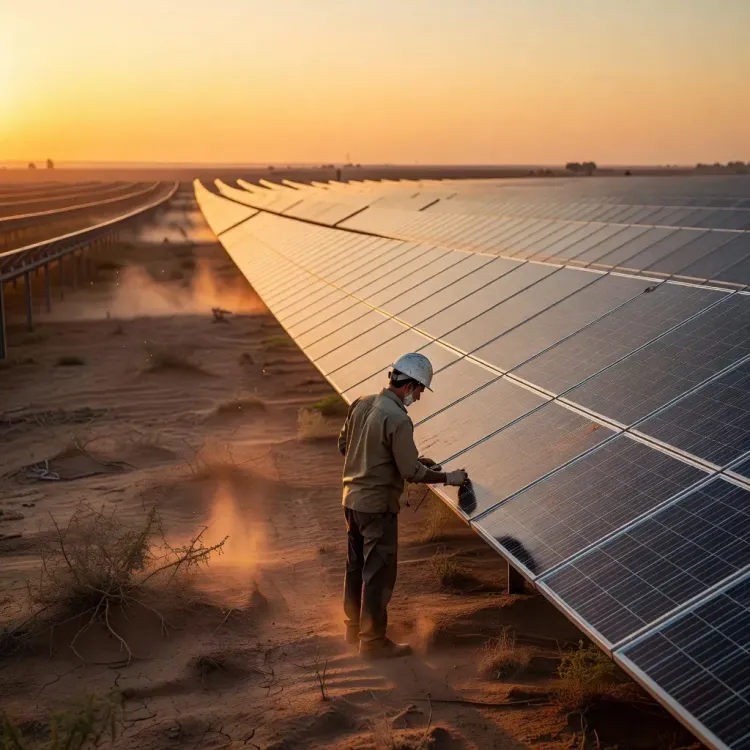
Synopsis
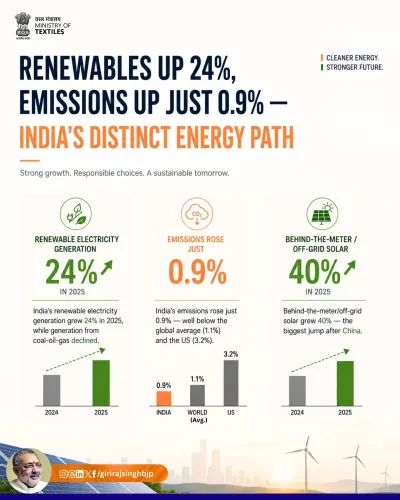
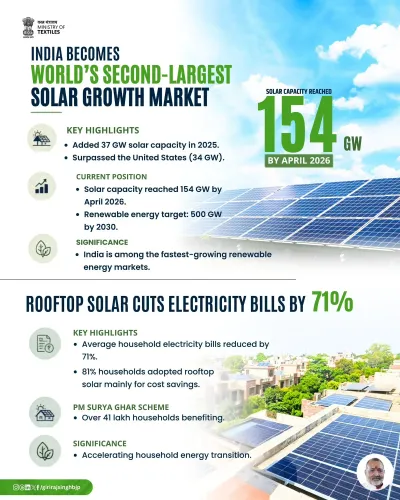
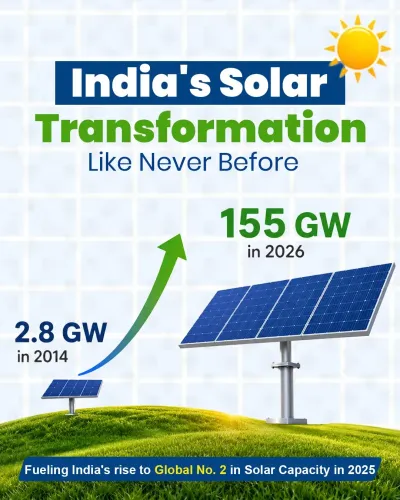
Union Textiles Minister Giriraj Singh highlighted on August 3, 2026 that India has overtaken the United States to become the world's second-fastest growing solar energy market, underscoring India's rapid renewable energy expansion toward its 500 GW non-fossil capacity target by 2030.
Key Takeaways
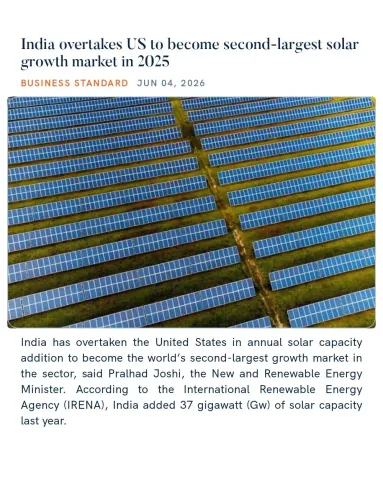
Union Textiles Minister Giriraj Singh shared on August 3, 2026 that India has surpassed the US to become the world's second-fastest growing solar energy market .
India's solar mission began with a 20 GW target by 2022 under the Jawaharlal Nehru National Solar Mission launched in 2010 , later revised to 100 GW .
At COP26 in Glasgow (2021) , India committed to 500 GW of non-fossil fuel capacity by 2030 .
India co-founded the International Solar Alliance with France in 2015 , establishing itself as a leader in global solar diplomacy.
India now ranks among the top three solar markets globally alongside China and the United States in cumulative and incremental capacity additions.
India has overtaken the United States to become the world's second-fastest growing solar energy market — and Union Textiles Minister Giriraj Singh made sure the milestone didn't pass quietly, sharing the news on Monday, August 3, 2026.
The post, shared via the NaMo App, carried a Hindi caption that translates to: 'Leaving America behind, India becomes the second-fastest growing solar energy market.' Terse, declarative, and pointed — it frames the achievement as a competitive leap, not just a domestic milestone.
From 20 GW dreams to a global podium
The arc here is steep and fast. India's solar ambitions began formally with the Jawaharlal Nehru National Solar Mission, launched in 2010 under the National Action Plan on Climate Change, with an initial target of 20 GW by 2022. That ceiling was blown past and revised upward to 100 GW. Then, at COP26 in Glasgow in 2021, India committed to 500 GW of non-fossil fuel capacity by 2030 — a number that reframed India not as a developing-world laggard but as a clean-energy frontrunner. The result is a solar buildout that has consistently ranked India among the top three markets globally, alongside China and the United States, in both cumulative installations and annual additions.The International Solar Alliance and India's diplomatic play
The growth isn't just domestic policy — it's strategic architecture. India co-launched the International Solar Alliance with France in 2015, a multilateral body designed to accelerate solar deployment across member nations through shared policy frameworks and technology cooperation. That move positioned New Delhi as the convening power of global solar diplomacy, well before the capacity numbers backed the ambition. Now the numbers are catching up to the vision. Surpassing the United States in growth rate — even as the US maintains a massive cumulative installed base — signals that India's incremental additions are now outpacing one of the world's most mature solar economies. That is a structural shift, not a statistical blip.What the ranking means for India's 2030 target
Reaching the 500 GW non-fossil target by 2030 demands sustained, accelerating deployment. The Ministry of New and Renewable Energy's quarterly capacity addition reports and updates to the Production Linked Incentive scheme for domestic solar manufacturing will be the real scorecards to watch. If the growth rate holds, India's 2030 pledge moves from aspiration to trajectory. A country that once imported nearly all its solar panels is now racing to manufacture them at scale — and racing past America doing it.Point of View
Particularly the United States. The choice to share a solar milestone by a Textiles Minister signals that the party treats clean-energy achievements as broad political capital, not just sectoral news. The post arrives as India's 2030 renewable targets face mounting scrutiny over grid integration and domestic manufacturing gaps, making the growth-rate ranking a useful, if partial, counter-narrative. It also reinforces India's positioning in global climate diplomacy ahead of the next COP cycle.
NationPress
3 Aug 2026
Frequently Asked Questions
Has India really overtaken the US in solar energy?
According to the report shared by Minister Giriraj Singh on August 3, 2026, India has surpassed the United States to become the world's second-fastest growing solar energy market, though the US retains a larger cumulative installed base.
What is India's solar energy target for 2030?
India committed to achieving 500 GW of non-fossil fuel capacity by 2030 , a pledge made at the COP26 climate summit in Glasgow in 2021 .
What is the Jawaharlal Nehru National Solar Mission?
The Jawaharlal Nehru National Solar Mission was launched in 2010 under India's National Action Plan on Climate Change, initially targeting 20 GW of solar capacity by 2022 , a figure later revised upward to 100 GW .
What is the International Solar Alliance?
The International Solar Alliance (ISA) is a multilateral organisation co-founded by India and France in 2015 to accelerate solar energy deployment among member countries through policy cooperation and technology sharing.
Which country is the fastest growing solar energy market?
Based on the context of the post, China is widely regarded as the world's fastest growing solar market, with India now ranked second, ahead of the United States.