Giriraj Singh Blames Congress for Kashmir Militancy, Hails Article 370 Abrogation

Synopsis
Union Textiles Minister Giriraj Singh has blamed Congress for enabling anti-India forces in Kashmir and praised the BJP government's 2019 abrogation of Article 370, calling it the beginning of a new era of peace and development in the valley.
Key Takeaways
Giriraj Singh posted on X on 25 October 2026 blaming Congress for boosting anti-India forces in Kashmir.
He credited the abrogation of Article 370 on 5 August 2019 with bringing a 'new dawn of development and peace' to Kashmir.
The presidential order in 2019 also triggered the Jammu and Kashmir Reorganisation Act , splitting the state into two union territories.
The BJP has consistently used this narrative since 2019, attributing pre-abrogation militancy to Congress-era governance.
Congress disputes the framing, arguing the abrogation has not resolved the region's core tensions.
Security data, tourism figures, and investment flows in Jammu and Kashmir remain the key benchmarks for evaluating the post-370 transformation.
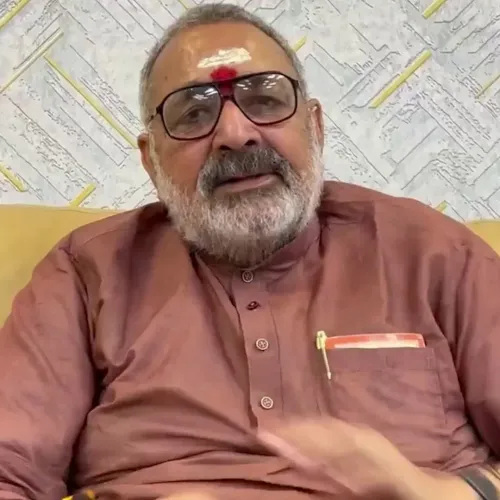
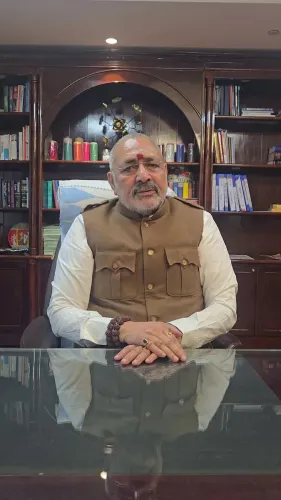
Seven years after Article 370 was struck from the Constitution, the political battle over who shaped Kashmir's turbulent past is as sharp as ever. Union Textiles Minister Giriraj Singh took to X on Sunday, 25 October 2026, squarely blaming the Indian National Congress for what he called the nurturing of anti-India forces in the valley — and crediting the BJP-led government's 2019 abrogation with ushering in a new era of peace and development.
Posting in Hindi, Singh wrote: 'Kaangres ke paapon ka hi parinaam tha ki Kashmir mein Bharat-virodhi taakton ko badhaava mila!' — 'It was the consequence of Congress's sins that anti-India forces were given a boost in Kashmir!' He added that with the scrapping of Article 370, 'a new dawn of development and peace has arrived in Kashmir today.'
What Article 370's Removal Actually Changed
On 5 August 2019, the Narendra Modi government revoked Article 370 through a presidential order, stripping Jammu and Kashmir of its special constitutional status. The Jammu and Kashmir Reorganisation Act followed, bifurcating the former state into two union territories — Jammu and Kashmir and Ladakh. It was the most sweeping constitutional change to the region since its accession to India in 1947.
The BJP has since anchored a consistent narrative around the move: that decades of Congress stewardship enabled separatism and militancy by keeping Kashmir constitutionally ring-fenced from the rest of India. Singh's post is a pointed restatement of that argument — framing the abrogation not merely as a policy choice but as a corrective to historical failures.
The Congress Record in BJP's Frame
The BJP's critique traces back to decisions taken under successive Congress-led governments — from the circumstances of accession and the entrenchment of Article 370 in the 1950s, to later periods when insurgency peaked in the late 1980s and 1990s. Critics of Congress argue those governments failed to integrate Kashmir politically or economically, leaving space for separatist movements to deepen roots.
Congress has consistently disputed this framing, arguing that Article 370 was itself a tool for maintaining peace and that the abrogation has not conclusively resolved the region's underlying tensions. The debate cuts to the heart of competing visions of Indian federalism and security strategy.
The Metrics That Will Settle the Argument
Singh's claim of a 'new dawn' is a political assertion — but it is one that hard data will eventually judge. The key indicators to watch: official figures on security incidents and civilian casualties in the union territory, tourism arrivals and investment flows into Jammu and Kashmir, and the trajectory of its elected assembly, whose restoration was itself a milestone in the post-370 political arc. How those numbers move will determine whether the BJP's narrative of transformation holds up beyond rhetoric.
For now, Giriraj Singh's post is a reminder that Kashmir remains live political terrain — a place where every anniversary, every incident, and every data point feeds an ongoing argument about who built the problem, and who finally fixed it.
Point of View
However, lies not in social-media rhetoric but in verifiable ground-level data on security, governance, and economic activity in Jammu and Kashmir — metrics that the BJP will need to own as fully as it owns the abrogation decision itself.
NationPress
25 Oct 2026
Frequently Asked Questions
What did Giriraj Singh say about Kashmir and Congress?
Singh said it was a consequence of Congress's 'sins' that anti-India forces were given a boost in Kashmir, and that the abrogation of Article 370 has ushered in a new era of development and peace in the valley.
When was Article 370 abrogated and what did it do?
Article 370 was revoked by presidential order on 5 August 2019 . It had granted Jammu and Kashmir special constitutional status; its removal was followed by the Jammu and Kashmir Reorganisation Act, which split the state into two union territories.
What is the BJP's argument against Congress on Kashmir?
The BJP argues that Congress-led governments from the 1950s onward kept Kashmir constitutionally separate from the rest of India, enabling separatist and militant movements to take root rather than integrating the region fully.
Has Article 370's abrogation improved conditions in Kashmir?
The government has pointed to increased tourism and investment as positive indicators, but the full impact remains a subject of political debate. Security incidents, governance quality, and economic data are the key metrics analysts watch to assess real change.
Who is Giriraj Singh?
Giriraj Singh is a senior BJP leader, Union Textiles Minister in the Modi government, and Lok Sabha MP from Begusarai, Bihar .