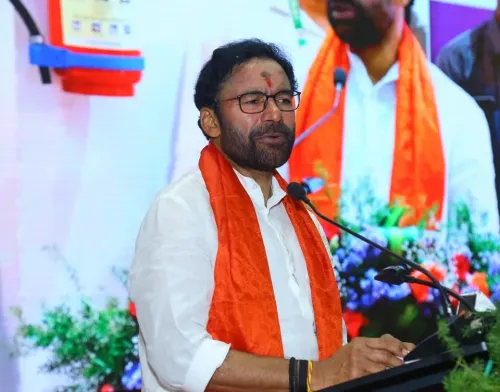
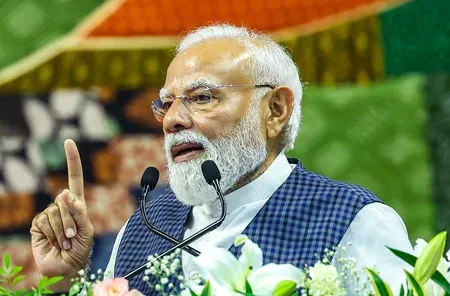
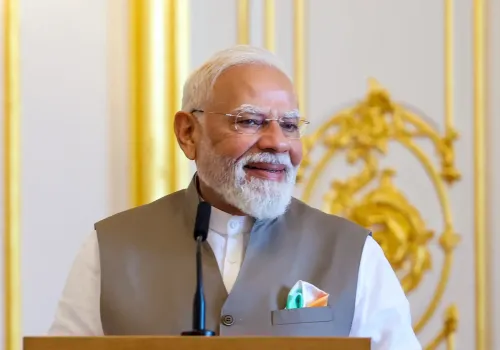
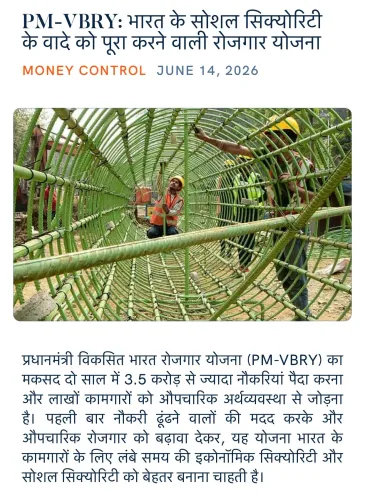
Giriraj Singh: PMVBRY Created 70 Lakh Jobs, 10 Lakh Workers Got Incentives
Synopsis
Union Textiles Minister Giriraj Singh cited PM Modi's claim that PMVBRY has created 70 lakh jobs and given incentives to 10 lakh workers, spotlighting the government's labour-intensive manufacturing push under the Atmanirbhar Bharat framework.
Key Takeaways
Union Textiles Minister Giriraj Singh shared PM Modi's figures on June 20, 2026 via the NaMo App.
The PMVBRY scheme is claimed to have generated 70 lakh jobs across the sector.
10 lakh workers have reportedly received direct incentives under the scheme.
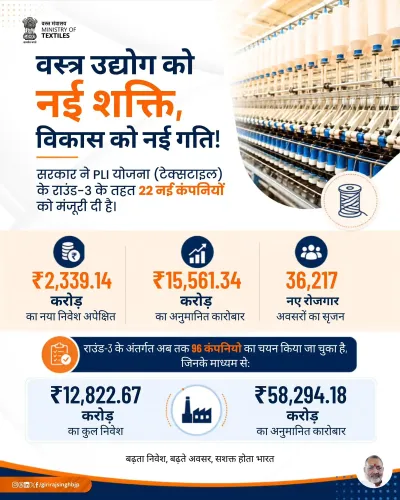
The textile PLI scheme, launched in the 2021 Union Budget , carries an outlay of Rs 10,683 crore and underpins this employment push.
Textile workers and apparel manufacturers are the primary beneficiaries targeted by these overlapping central government programmes.
Detailed, independently verified performance data is expected in the next Economic Survey or parliamentary budget discussions.
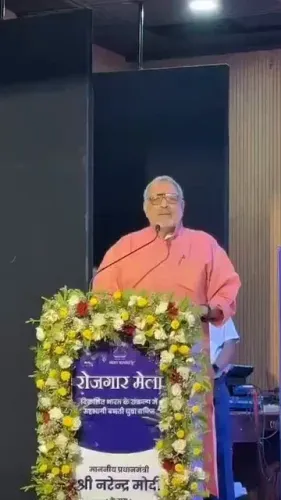
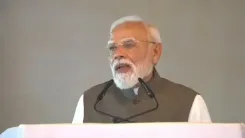
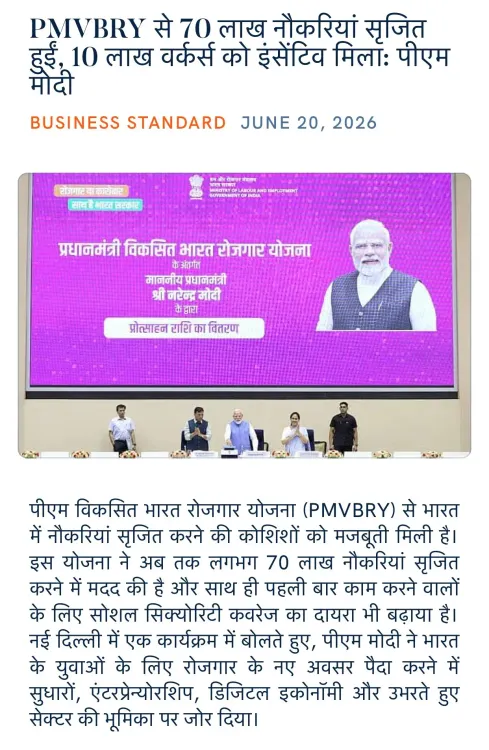
Union Textiles Minister Giriraj Singh on Saturday, June 20, 2026 shared data attributed to Prime Minister Narendra Modi claiming that the PM Vishwakarma Bima Rojgar Yojana (PMVBRY) has generated 70 lakh jobs and provided incentives to 10 lakh workers, underscoring the government's push to scale formal employment in labour-intensive sectors.
Context
Singh shared the figures via the NaMo App, quoting PM Modi's assertion: 'PMVBRY se 70 lakh naukariyan srujit huin, 10 lakh workers ko incentive mila' ('PMVBRY has created 70 lakh jobs, 10 lakh workers received incentives'). The post comes as the central government continues to highlight employment outcomes from flagship manufacturing and worker-welfare schemes ahead of parliamentary discussions on budget allocations.
The figures, as cited by the minister, position PMVBRY as one of the government's most significant job-creation instruments. Singh's amplification of the data through his official social media channels signals the ruling party's intent to keep scheme performance at the centre of its economic narrative.
Policy Backdrop
PMVBRY sits within the broader Atmanirbhar Bharat framework launched in 2020, which channelled incentive-linked programmes into labour-intensive sectors including textiles, apparel, and technical manufacturing. The government has consistently used production and employment benchmarks to measure the success of these interventions.
The textile sector has been a particular focus: the Production Linked Incentive (PLI) scheme for textiles, announced in the 2021 Union Budget with an outlay of Rs 10,683 crore, was designed to promote man-made fibre apparel and technical textiles manufacturing. Schemes such as PMVBRY complement PLI by targeting direct worker welfare and formalisation of employment alongside output-linked incentives for manufacturers.
Successive governments have recognised textiles as a strategic sector given its potential to absorb large numbers of semi-skilled and unskilled workers, particularly in states such as Gujarat, Tamil Nadu, Maharashtra, Uttar Pradesh, and West Bengal.
Stakeholders and Impact
Textile workers and apparel manufacturers are the primary beneficiaries of PMVBRY's twin objectives — job creation and direct incentive disbursement. The claim that 10 lakh workers have already received incentives suggests the scheme has moved beyond the roll-out phase into active disbursal, which would mark a significant operational milestone.
For apparel manufacturers, particularly small and medium enterprises, schemes that incentivise formal hiring reduce the cost of compliance with labour regulations, making formalisation more attractive. A 70 lakh employment figure, if sustained, would represent one of the largest single-scheme job-creation outcomes in the sector in recent years.
Worker groups and industry bodies are likely to scrutinise the quality of jobs created — whether they are full-time, contract, or gig-based — and the adequacy of the incentive amounts disbursed per worker, details that the government has yet to release publicly in granular form.
What's Next
Detailed scheme performance data is expected to surface in the forthcoming Economic Survey or during parliamentary committee deliberations on the Ministry of Textiles budget. Independent verification of the 70 lakh jobs and 10 lakh incentive recipients figures will be critical to assessing the scheme's real-world impact.
With the government keen to demonstrate employment dividends from its manufacturing push, PMVBRY's outcomes could become a key data point in the political debate over job creation ahead of state elections. The Ministry of Textiles under Singh is expected to release a formal performance report, which will be closely watched by industry associations, labour economists, and opposition parties alike.
Point of View
Singh reinforces a top-down communications strategy where scheme milestones are broadcast through ministerial channels to build public confidence in Atmanirbhar Bharat's results. The 70 lakh figure, if verified, would be a landmark for a single textile-sector scheme and could shift the terms of the opposition's critique on jobless growth. However, the absence of granular, audited data leaves the claim vulnerable to scrutiny, and the government's credibility on this front will depend on how quickly the Ministry of Textiles publishes a transparent performance report.
NationPress
21 Jun 2026
Frequently Asked Questions
What is PMVBRY and what does it do?
PMVBRY is a central government scheme aimed at generating employment and providing financial incentives to workers in labour-intensive sectors, particularly textiles. It operates within the Atmanirbhar Bharat framework and targets both job creation and formalisation of the workforce.
How many jobs has PMVBRY created according to PM Modi?
According to figures shared by Union Textiles Minister Giriraj Singh and attributed to PM Modi, PMVBRY has created 70 lakh jobs since its inception.
How many workers received incentives under PMVBRY?
10 lakh workers have received incentives under PMVBRY, as per the data cited by PM Modi and shared by Textiles Minister Giriraj Singh on June 20, 2026.
What is the PLI scheme for textiles and how is it related?
The Production Linked Incentive scheme for textiles was announced in the 2021 Union Budget with an outlay of Rs 10,683 crore . It promotes man-made fibre apparel and technical textiles manufacturing, complementing worker-welfare schemes like PMVBRY under the same Atmanirbhar Bharat umbrella.
Who is Giriraj Singh and why is he sharing these figures?
Giriraj Singh is the Union Minister of Textiles, a senior BJP leader and Lok Sabha MP from Begusarai, Bihar . As the minister responsible for the textile sector, he routinely communicates scheme performance data and government achievements to the public through social media.