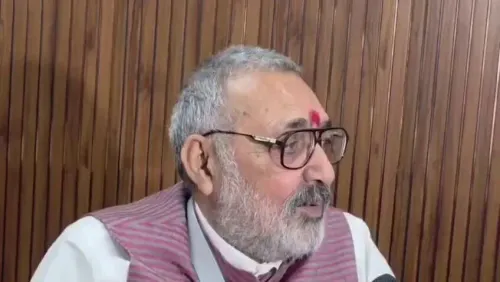
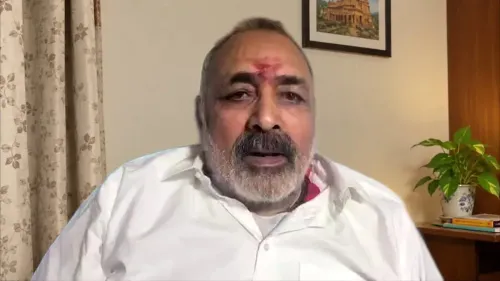
Giriraj Singh fires at Opposition over Modi-era development

Synopsis
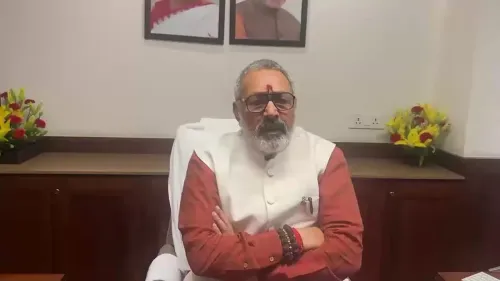
Union Textiles Minister Giriraj Singh used the Hindi idiom 'khisiyani billi khamba noche' on X to argue that Opposition anger over PM Modi's development record reflects frustration, not principle — a move drawn from BJP's long-standing political playbook since 2014.
Key Takeaways
Union Textiles Minister Giriraj Singh posted on X on 5 November 2026 invoking the proverb 'khisiyani billi khamba noche' to dismiss Opposition criticism of PM Modi.
The post frames opposition attacks as a reaction to India's development under PM Narendra Modi , not as substantive critique.
Singh, Lok Sabha MP from Begusarai, Bihar , is a consistently combative BJP voice on social media.
BJP's 'Sabka Saath, Sabka Vikas' framework, promoted since 2014 , underpins the development-as-rebuttal strategy the post deploys.
No specific scheme, statistic, or named opponent is cited — the post operates as broad political signalling to BJP's base.
A Hindi idiom older than democracy itself — 'khisiyani billi khamba noche' (a cornered cat claws at the post) — landed squarely on India's political opposition on Thursday, 5 November 2026, when Union Textiles Minister Giriraj Singh turned to X to frame critics of the Narendra Modi government as frustrated bystanders of the country's growth story.
Singh's post, in Hindi, reads: 'Under the leadership of our respected Prime Minister Shri Narendra Modi Ji, the country's development has rattled the opposition — 'khisiyani billi khamba noche'.' The idiom, deployed as the opening punch, signals that Singh reads Opposition attacks not as legitimate critique but as the thrashing of a party unable to slow a tide it cannot explain.
The idiom and what it signals
Invoking a proverb to dismiss a rival is a staple of Indian political rhetoric — but the choice of this particular phrase carries weight. It reframes every criticism as a symptom of powerlessness, not principle. For BJP's base, the message is clean: the government is delivering, and the other side is simply angry about it. It is a move designed less to debate than to energise.
Singh, the Lok Sabha MP from Begusarai, Bihar, has long been one of the BJP's most combative voices on social media. His posts routinely blend Hindi idiom with pointed political jabs, and this one follows a pattern that has played out repeatedly since 2014 — the ruling party presenting development as an unanswerable rebuttal to any opposition charge.
BJP's 'Sabka Saath, Sabka Vikas' as political armour
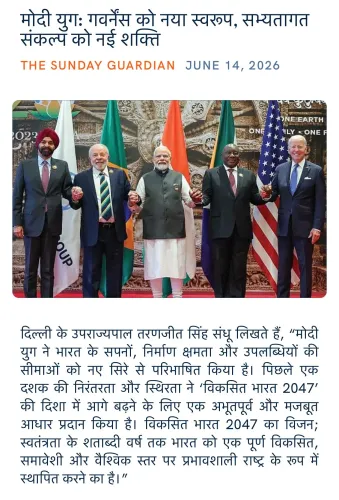
Prime Minister Modi's 'Sabka Saath, Sabka Vikas' — 'Together with all, development for all' — has served as the ideological scaffold of the NDA government since its first term. The slogan has been deployed consistently in Parliament, campaign rallies, and social media to position GDP growth, infrastructure expansion, and welfare reach as evidence that criticism is groundless. Singh's post slots neatly into that architecture.
What makes the moment politically readable: the post carries a video but names no specific scheme, statistic, or opponent. That vagueness is itself a strategy — broad enough to apply to any current opposition salvo, targeted enough to energise BJP supporters who fill in the blanks themselves.
The opposition, for its part, has countered development claims on platforms ranging from Parliament's floor to their own social-media feeds, and that counter-narrative is precisely what posts like Singh's are engineered to pre-empt. As state-level election cycles continue and Parliament sessions sharpen, expect the development-versus-criticism exchange to only grow louder.
Point of View
He sidesteps the burden of proof while keeping the emotional frame firmly in BJP's favour. The move has a twelve-year lineage — since 2014, the party has consistently deployed 'development delivers' as an all-purpose deflection against criticism. With no named opponent or specific trigger, the post functions less as a rebuttal and more as a loyalty signal — a reminder to the base that the government's record is, in the party's telling, beyond credible challenge.
NationPress
5 Nov 2026
Frequently Asked Questions
What does 'khisiyani billi khamba noche' mean in politics?
The Hindi proverb literally means 'a cornered cat claws at the post' and is used in political discourse to suggest that a frustrated or powerless opponent is lashing out without cause. BJP leaders, including Giriraj Singh, have used it to dismiss Opposition criticism as reactive and groundless.
Why did Giriraj Singh post this on 5 November 2026?
Singh posted the idiom to argue that the Opposition's criticism of the Modi government stems from frustration over India's development achievements, not from legitimate policy disagreement. No specific triggering event was named in the post.
Who is Giriraj Singh?
Giriraj Singh is India's Union Minister of Textiles, a senior BJP leader, and the Lok Sabha MP from Begusarai, Bihar. He is known as one of the party's most vocal social-media voices.
What is BJP's 'Sabka Saath, Sabka Vikas' slogan?
'Sabka Saath, Sabka Vikas' — meaning 'Together with all, development for all' — has been the governing philosophy of PM Modi's NDA government since 2014, emphasising inclusive economic growth and welfare delivery as the cornerstone of its mandate.
How does BJP typically respond to Opposition criticism on development?
Since 2014, BJP has consistently framed Opposition criticism of its governance record as politically motivated frustration rather than substantive critique, citing infrastructure expansion, welfare schemes, and GDP growth as evidence. Social-media posts like Singh's reinforce this narrative at scale.