Giriraj Singh: Textile exports cross ₹3.25 lakh crore in 2025-26
Synopsis
Union Textiles Minister Giriraj Singh announced that India's textile and apparel exports crossed ₹3.25 lakh crore in 2025-26, attributing the milestone to PM MITRA, PLI, National Technical Textiles Mission, RoSCTL, RoDTEP, and new free-trade agreements under PM Modi's leadership.
Key Takeaways
India's textile and apparel exports crossed ₹3.25 lakh crore in 2025-26 , as announced by Union Textiles Minister Giriraj Singh .
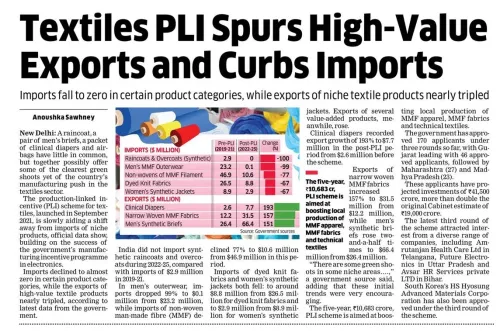
The PLI scheme for textiles , approved in September 2021 with a ₹10,683 crore outlay, is among the key drivers cited.
The National Technical Textiles Mission (launched February 2020 , outlay ₹1,480 crore ) targets high-value technical textile products.
Seven PM MITRA integrated textile parks announced in Union Budget 2021-22 are central to India's hub ambition.
RoDTEP , introduced from January 2021 , refunds embedded taxes on exports, directly improving exporter competitiveness.
New FTAs are part of a strategy to diversify India's export destinations for apparel and technical textiles.
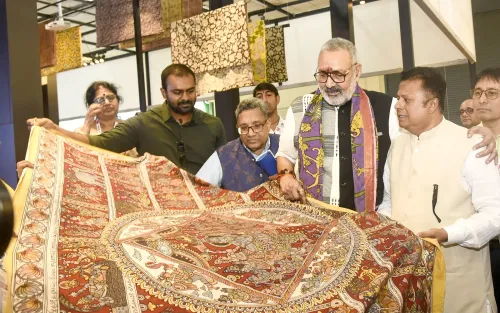
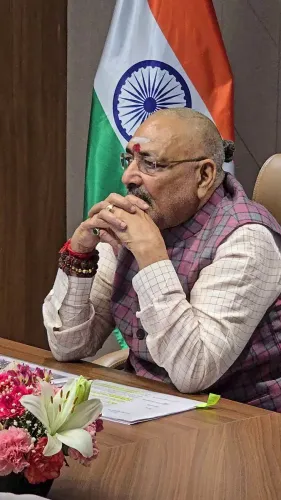
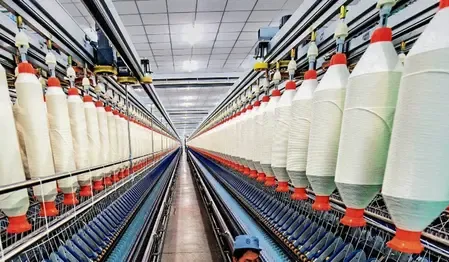
India's textile and apparel exports have crossed ₹3.25 lakh crore in 2025-26 — a milestone that Union Textiles Minister Giriraj Singh says signals the country's rising competitive muscle in global trade. The figure, cited by the Minister on Wednesday, 29 July 2026, marks what he calls a new achievement for an industry that employs millions across looms, factories, and export houses.
What drove the surge: the policy stack behind the number
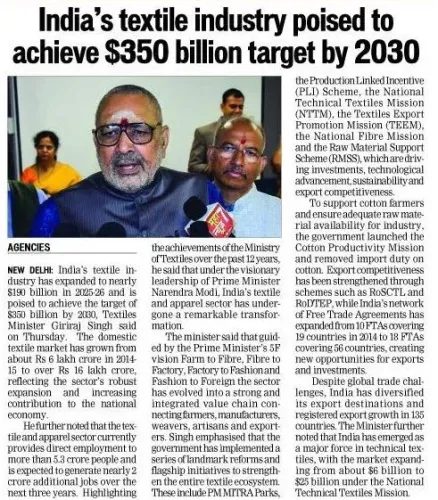
Singh attributed the export leap to a layered set of central government interventions rolled out over the past five years. He named PM MITRA (Prime Minister Mega Integrated Textile Region and Apparel parks), the Production Linked Incentive (PLI) scheme, the National Technical Textiles Mission, duty-remission programmes RoSCTL and RoDTEP, handloom and handicraft promotion, and new free-trade agreements — crediting all of it to the leadership of Prime Minister Narendra Modi.
The policy lineage is concrete. The PLI scheme for textiles was approved by the Cabinet in September 2021 with an outlay of ₹10,683 crore over five years, targeting man-made fibre apparel and technical textiles. The National Technical Textiles Mission was launched in February 2020 with a ₹1,480 crore outlay to push research and adoption of high-value technical textile products. PM MITRA parks — seven of them announced in the Union Budget 2021-22 — aim to create plug-and-play integrated manufacturing clusters that compress the cost and time of scaling up. RoDTEP, introduced from January 2021, replaced the earlier MEIS scheme by automatically refunding embedded central and state taxes on exported goods, directly improving exporter margins.
India's global textile ambition — and what to watch next
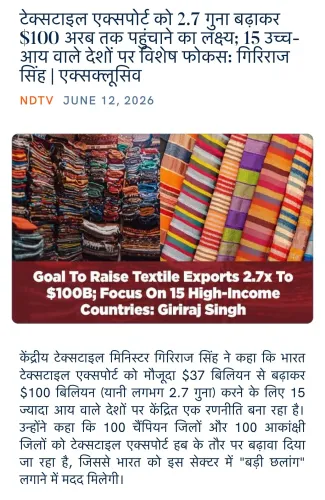
The Minister framed the milestone inside a larger strategic goal: positioning India as a global textile hub under the Atmanirbhar Bharat and Make in India frameworks. The emphasis on new FTAs reflects a push to diversify export destinations beyond traditional markets, giving Indian apparel and technical textiles duty-free or preferential access in more economies.
Two things will determine whether the momentum holds. First, how quickly the seven PM MITRA parks move from approval to operational status — investment inflows and anchor tenant commitments are the real test. Second, whether concluded or ongoing FTAs translate into measurable tariff relief for Indian exporters in key markets. A ₹3.25 lakh crore headline is a strong opening; the sequel is in the execution.
Point of View
If confirmed, would represent a significant step in the Modi government's decade-long effort to revive India's share in global textile trade — a share that had stagnated as competitors like Bangladesh and Vietnam scaled up. Singh's enumeration of six distinct policy instruments in a single post is deliberate: it frames the result as systemic rather than cyclical, insulating the milestone from being read as a commodity price effect. The FTA emphasis is the forward-looking signal — market access, not just production subsidies, is now the government's stated lever. Whether PM MITRA parks deliver on their integrated-cluster promise will be the acid test of whether this export surge is durable or a one-cycle spike.
NationPress
29 Jul 2026
Frequently Asked Questions
What is India's textile export target for 2025-26?
Union Textiles Minister Giriraj Singh stated that India's textile and apparel exports crossed ₹3.25 lakh crore in 2025-26 , describing it as a new achievement for the sector.
What is the PM MITRA scheme for textiles?
PM MITRA (Prime Minister Mega Integrated Textile Region and Apparel parks) is a scheme to develop seven integrated textile parks across India, announced in the Union Budget 2021-22 , aimed at creating end-to-end manufacturing clusters to boost exports.
What is the PLI scheme for textiles and how much is its outlay?
The Production Linked Incentive (PLI) scheme for textiles was approved by the Cabinet in September 2021 with an outlay of ₹10,683 crore over five years, targeting man-made fibre apparel and technical textiles to boost domestic value addition.
What is RoDTEP and how does it help textile exporters?
RoDTEP (Remission of Duties and Taxes on Export Products), introduced from January 2021 , automatically refunds embedded central and state taxes on exported goods, directly improving margins for textile and apparel exporters.
What is India's National Technical Textiles Mission?
The National Technical Textiles Mission was launched in February 2020 with a ₹1,480 crore outlay to promote research, innovation, and adoption of technical textiles — high-value products used in sectors like healthcare, defence, and infrastructure.