Opposition Claims Government is Fast-Tracking Legislation for Political Advantage Ahead of Elections
Synopsis
Tensions escalated in the Rajya Sabha as the government expedited key legislative measures, prompting the Congress party's accusations of prioritizing political gains over proper parliamentary processes ahead of upcoming Assembly elections.
Key Takeaways
The government is pushing through significant legislation amid Assembly elections.
The Andhra Pradesh Bill aims to solidify Amaravati's status as the state capital.
Opposition members express concerns over the rushed legislative process.
The women's reservation law is being amended quickly, raising questions about political motives.
Discussions about the Nari Shakti Vandan Adhiniyam's implementation continue amidst political tensions.
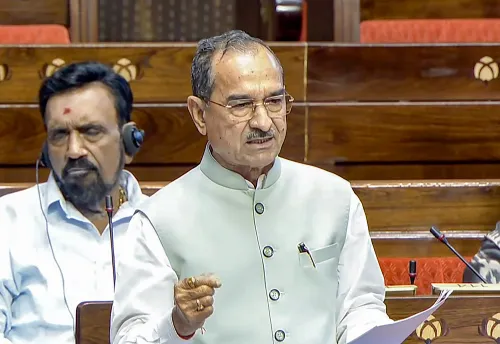
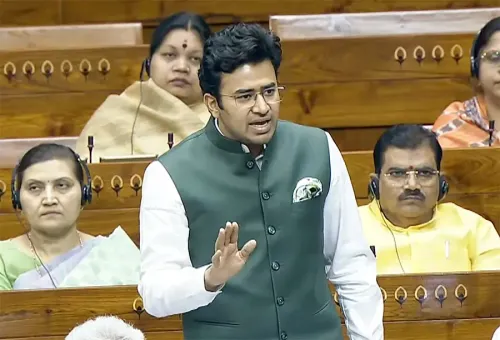
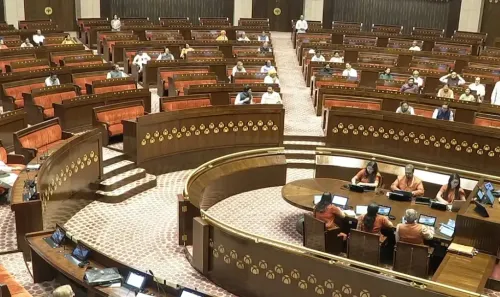
New Delhi, April 2 (NationPress) The Rajya Sabha experienced intense debates on Thursday as the government advanced key legislative measures, prompting fierce criticism from the Congress party. They accused the ruling party of placing political advantage above proper parliamentary procedures in light of the imminent Assembly elections.
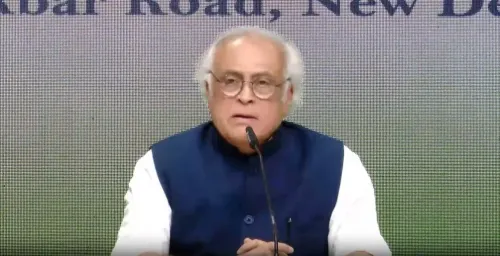
As the Upper House was poised to discuss the Andhra Pradesh Reorganisation (Amendment) Bill, 2026, which aims to officially designate Amaravati as the exclusive and permanent capital of Andhra Pradesh, senior Congress member Jairam Ramesh voiced his dissent.
Speaking to the Chairman, Ramesh noted that his previous inquiry regarding the House's agenda had not been adequately addressed.
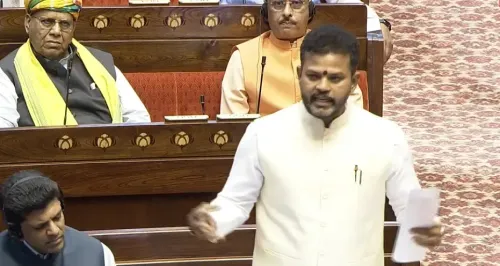
Union Minister of Parliamentary Affairs Kiren Rijiju responded by outlining the agenda. He indicated that the House would first consider the Andhra Pradesh Reorganisation (Amendment) Bill, followed by the pending Jan Vishwas (Amendment of Provisions) Bill, 2026, which had already been approved by the Lok Sabha.
Rijiju added that the government might suggest a brief adjournment before reconvening to tackle additional issues.
Ramesh strongly condemned the government's strategy, stating, “The government has a singular aim of passing these Bills prior to the upcoming Assembly elections,” claiming that this maneuver was designed to achieve political gains by breaching the essence of the Model Code of Conduct (MCC) effective in election-bound states.
The Andhra Bill, which the Lok Sabha passed on April 1 via voice vote, seeks to end the ambiguity surrounding the capital issue that emerged after the 2014 bifurcation by providing legal validation to Amaravati as the state’s sole capital.
The Jan Vishwas Bill intends to decriminalize various minor offenses under central laws to enhance both ease of doing business and quality of life.
Opposition members expressed alarm over the accelerated legislative timeline. Ramesh pointed out that the government seemed intent on rushing significant bills through without sufficient discussion, particularly as several states, including Assam, Kerala, Tamil Nadu, West Bengal, and the Union Territory of Puducherry, are set for Assembly elections in April-May 2026.
Rijiju defended the government's actions, asserting that the Andhra Bill was being addressed as a matter of urgency and that the House operates in accordance with established rules and the prevailing circumstances, rather than political claims.
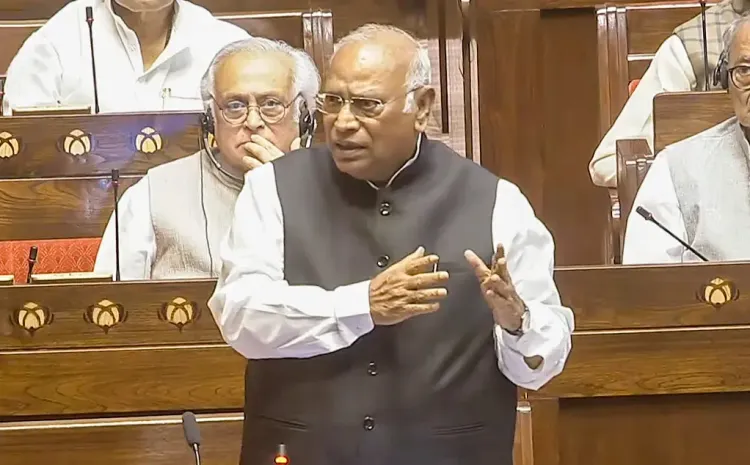
Leader of the Opposition in Rajya Sabha, Mallikarjun Kharge, sharply criticized the Central government for exhibiting undue haste in amending the Women’s Reservation Act (Nari Shakti Vandan Adhiniyam), alleging that it was a calculated move to gain political credit ahead of the ongoing Assembly elections.
While reiterating that the Congress initially introduced the women's reservation bill and continues to support it, Kharge expressed that the current speed to amend the Constitutional Amendment Act—passed 30 months ago—seemed politically driven. “The government has a singular aim of passing these Bills before the upcoming Assembly elections,” he remarked, questioning why there was such a hurry regarding a law whose implementation is set for the 2029 Lok Sabha elections.
Kharge reiterated his demand for an all-party meeting to deliberate on the modalities and implementation framework of the women’s reservation law but insisted it be held only after April 29, 2026, once the election campaigns in the affected states conclude.
“We are all heavily engaged in the election campaign. That is why we suggested that the meeting be scheduled post-campaign,” he stated.
He also recalled that during the debate on the bill in Rajya Sabha on September 21, 2023, he had called for its immediate implementation, yet the government had not acquiesced at that time.
Union Minister Kiren Rijiju responded, indicating that the government had proposed a “very straightforward amendment” and that no one, including Congress members, opposed its substance.
“Why doesn’t Congress step forward to attend or oppose a session? We have already met with 80 percent of political parties; the remaining will be engaged soon. Let’s not delve into politics,” Rijiju remarked.
Kharge retorted, “We will convene after the Assembly elections conclude. Do not seek credit before the elections.”
Leader of Rajya Sabha J.P. Nadda urged viewing the bill's passage from a ‘Viksit Bharat’ perspective rather than a political one. He noted, “PM Modi’s government has passed the bill in two days, which had been stalled for 30 years.”
Nadda highlighted the government's objective of ensuring women constitute 50 percent of the House's capacity.
Kharge countered that the government seemed to have suddenly remembered the bill after three months, asserting that not everything will proceed according to the BJP government's wishes in a democracy. He added that BJP MPs only heed PM Modi, disregarding even the Chairman of the House.
This exchange underscored the escalating conflict between the government and the opposition regarding the timing and process of finalizing the implementation roadmap for the landmark 33 percent women’s reservation in Parliament and State Assemblies.
The Nari Shakti Vandan Adhiniyam, unanimously passed in 2023, remains unnotified due to pending delimitation exercises linked to the upcoming census. The government is reportedly considering constitutional amendments to allow the quota to take effect from the 2029 general elections.
Point of View
The opposition's concerns about the government's legislative agenda reflect a broader tension in Indian politics. The debate not only highlights the urgency felt by the government but also reveals the strategic maneuvering typical in election seasons.
NationPress
3 Oct 2026
Frequently Asked Questions
What is the Andhra Pradesh Reorganisation (Amendment) Bill?
The Andhra Pradesh Reorganisation (Amendment) Bill aims to legally establish Amaravati as the sole and permanent capital of Andhra Pradesh.
What does the Jan Vishwas Bill propose?
The Jan Vishwas Bill intends to decriminalize several minor offenses under central laws to improve the ease of doing business and enhance the quality of life.
Why is the Congress party criticizing the government?
The Congress party accuses the government of prioritizing political gains over parliamentary procedures by hastily pushing through significant legislation before the Assembly elections.
What is the Nari Shakti Vandan Adhiniyam?
The Nari Shakti Vandan Adhiniyam is a law aimed at reserving 33 percent of seats for women in Parliament and State Assemblies.
When is the implementation of the women's reservation law expected?
The implementation of the women's reservation law is scheduled for the 2029 Lok Sabha elections.